
Introduction
Struggling to get cookies that stay crisp, vegetables that roast evenly, or food that doesn’t spill all over your oven often comes down to using the wrong pan in the first place. The confusion between baking tray vs baking sheet is very common, but this small difference can completely change your cooking results.
Many home bakers use these terms interchangeably without realising that one is designed for containment and roasting, while the other is built for airflow and even browning. In this guide, you’ll clearly understand the difference between both, when to use each one, and how choosing the right option can instantly improve your baking results.
Table of Contents
What Is a Baking Tray?
A baking tray is a flat oven pan with raised edges (a rim) designed to hold food, oil, or juices during cooking. It is commonly made from aluminium, stainless steel, or non-stick coated metal and is built to handle higher heat and heavier foods.
The raised sides help prevent spills and retain moisture, making a baking tray ideal for roasting vegetables, baking meats, and sheet pan meals. Compared to flatter pans, it provides more control when cooking foods that release liquid.
What Is a Baking Sheet?
A baking sheet is a flat, rectangular oven pan with very low or no raised edges, designed for even heat distribution and maximum airflow during baking. It is typically made from aluminium or non-stick coated steel, which helps food cook quickly and evenly.
Because of its flat surface, a baking sheet allows hot air to circulate around the food, making it ideal for cookies, biscuits, pastries, and foods that need a crisp texture. Unlike deeper pans, it does not trap moisture, which helps prevent soggy bottoms.
Key Differences between Baking Tray vs Baking Sheet
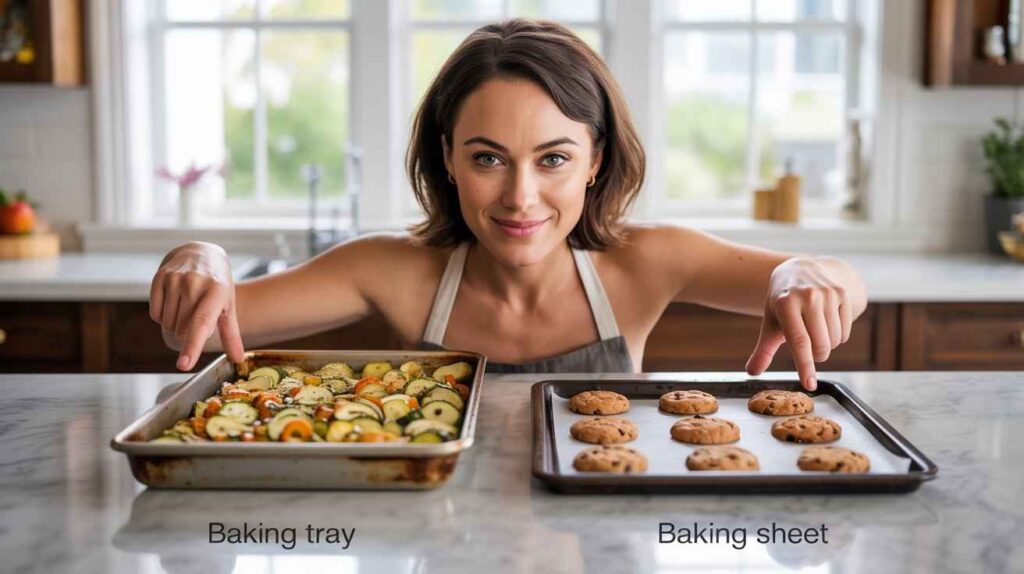
A baking tray (rimmed sheet pan) and a baking sheet (cookie sheet) differ mainly in their edge design and cooking performance. A baking tray has raised sides that help contain liquids, oils, and juices, making it ideal for roasting and messy oven dishes. In contrast, a baking sheet is flat with very low edges, allowing maximum airflow around food for faster, more even browning and crisp textures.
Structural Differences
- Baking Tray → deep or raised rims on all sides.
- Baking Sheet → flat surface with minimal or no edges.
But what matters is not shape—it’s how heat behaves during cooking:
- Trapped edges = more moisture retention.
- Open edges = better airflow and crisp results.
Cooking Performance Differences
A baking tray is best when food releases liquid, such as:
- roasted vegetables.
- chicken or meat.
- baked dishes with oil or marinade.
A baking sheet performs better when dryness and crispness are important:
- cookies.
- biscuits.
- crackers and pastries.
Heat & Texture Impact
The key difference is how they affect moisture and browning:
- Baking Tray → slightly traps steam → softer textures, less crispness.
- Baking Sheet → allows airflow → faster browning, crispier results.
This is why cookies often turn soggy on trays but crisp on sheets.
Which One Should You Use?
- Use a baking tray if you need containment and versatility.
- Use a baking sheet if you need precision baking and crisp results.
Why People Confuse between Baking Trays and Baking Sheets
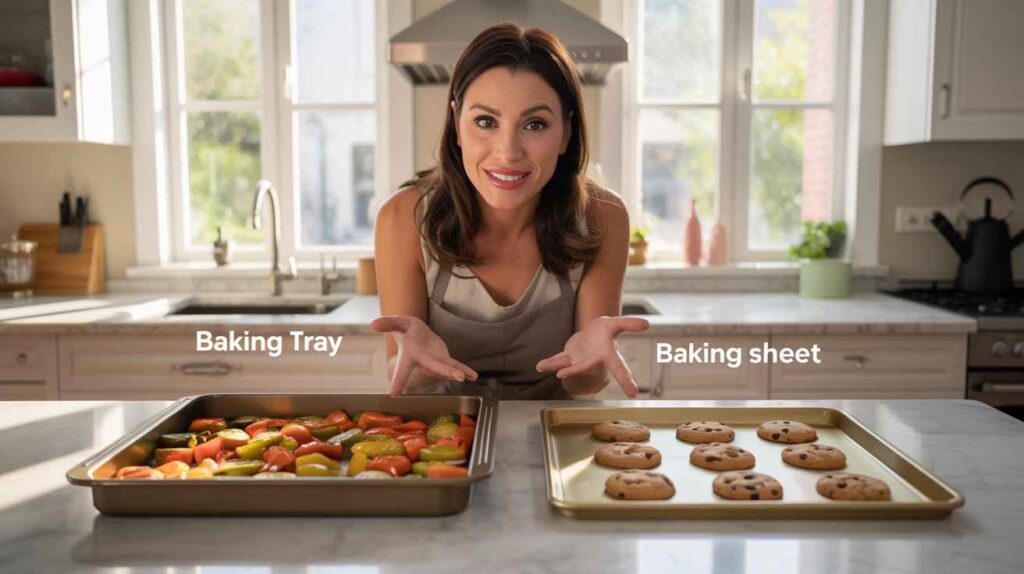
People often confuse baking trays and baking sheets because the terms are widely used interchangeably in cooking stores, recipes, and even by brands. In many countries, both tools are simply called a “baking tray” or “sheet pan,” even though they are not exactly the same in design or performance.
Another major reason for the confusion is their similar appearance. Both are flat metal pans used in the oven, so at a glance they look identical. The difference only becomes clear when you notice the edges—baking trays have raised rims, while baking sheets are mostly flat or have very low sides.
Confusion also happens because recipes don’t always specify the correct tool clearly. A recipe may say “baking tray” while actually expecting the airflow and crisp results of a baking sheet, or vice versa. This leads many home bakers to assume they are fully interchangeable.
Baking Tray vs Baking Sheet — Which One Should You Choose?
If you want versatility and control for roasting or messy oven cooking, choose a baking tray, but if your goal is even baking with crisp, well-browned results like cookies or biscuits, a baking sheet is the better choice. The right option depends on whether you need containment (tray) or maximum airflow for texture (sheet).
A baking tray works best when your food releases liquids or oils—such as roasted vegetables, chicken, or saucy dishes—because its raised edges help prevent spills and retain moisture. A baking sheet, on the other hand, is flat and allows hot air to circulate freely around the food, which improves heat distribution, browning, and crisp texture, especially for baked goods like cookies and pastries.
So the decision is simple: use a baking tray for roasting and liquid-heavy recipes, and use a baking sheet when you want dry, even, and crispy baking results.
Can You Use a Baking Tray Instead of a Baking Sheet?
Yes, you can use a baking tray instead of a baking sheet, but the results will change because a baking tray’s raised edges trap more moisture and reduce airflow, which can make baked foods less crisp compared to a flat baking sheet.
A baking tray works as a substitute when you are roasting vegetables, cooking meats, or baking dishes with oil or juices, since it helps prevent spills and holds liquids safely in the oven. However, for foods that depend on even heat circulation and crisp texture—like cookies, biscuits, or pastries—a baking sheet performs better because its flat surface allows hot air to move freely around the food, improving browning and reducing sogginess.
You can use a baking tray instead of a baking sheet, but choose it only when containment matters more than crisp, evenly baked results.
Best Baking Tray and Sheet Recommendations for Reliable Results
If you want consistent baking results, even browning, and long-lasting performance, the best choice is to use a heavy-gauge aluminum baking tray for roasting and a natural aluminum baking sheet for cookies and dry baking. Aluminum performs best because it delivers fast, even heat distribution without warping, which directly improves texture, browning, and overall baking reliability.
Best Baking Tray (Rimmed Sheet Pan)
Nordic Ware Naturals Aluminum Half Sheet Pan
This is one of the most trusted baking trays used in both home and professional kitchens because it is made from pure heavy-duty aluminium with reinforced rims, which prevents warping at high heat.
Why it performs well:
- Deep rim design safely holds oil, juices, and marinades.
- Excellent for roasting vegetables, chicken, and sheet pan meals.
- Aluminium body ensures fast and even heat distribution.
- Durable enough for high-temperature oven use.
👉 In real cooking results, this tray helps prevent spills and keeps roasted foods moist while still browning properly.
Best Baking Sheet (Flat Cookie Sheet)
Nordic Ware Naturals Baker’s Half Sheet
This is a top-rated baking sheet known for its flat surface and superior heat conduction, making it ideal for crisp and evenly baked results.
Why it performs well:
- Flat design allows maximum airflow around food.
- Perfect for cookies, biscuits, and pastries.
- Heavy-gauge aluminium prevents uneven baking and hot spots.
- Produces golden, crisp bottoms without sogginess.
👉 In real baking performance, it helps cookies spread evenly and brown consistently without trapping steam underneath.
Why These Two Work Best Together
Using both gives you full control in the kitchen:
- Baking tray = control + containment (roasting & messy cooking)
- Baking sheet = airflow + crisp texture (cookies & dry baking)
Together, they cover almost every everyday baking need and eliminate common problems like:
- soggy bottoms.
- uneven browning.
- spilling oils or juices.
- inconsistent baking results.
Conclusion
Choosing between a rimmed sheet pan and a flat cookie sheet ultimately comes down to the results you want in the kitchen. If you need versatility for roasting vegetables, baking meats, or handling recipes with oils and juices, a baking tray is the more practical choice. On the other hand, if your goal is even browning, crisp textures, and perfectly baked cookies or pastries, a baking sheet delivers better performance due to improved airflow.
Understanding these differences helps you avoid common baking problems like soggy bottoms, uneven cooking, or spilling in the oven. When used correctly, both tools complement each other and give you more control over texture, heat distribution, and overall baking quality—helping you achieve more consistent and reliable results every time you cook.
Faqs
Are a baking sheet and a baking tray identical tools?
No, a baking sheet and a baking tray are not exact the same tools.. A baking sheet is usually flat or has very low edges, designed for better airflow and even browning, while a baking tray has raised sides to hold liquids, oils, and food juices during cooking.
Do you need both in your kitchen?
Yes, keeping both in your kitchen is a smart choice if you cook or bake often. A baking tray is great for roasting food and handling dishes with liquids or sauces, while a baking sheet works best for cookies, biscuits, and recipes that need a light, crispy finish. Using both together gives you more versatility and better results across different types of cooking.
What is a baking sheet used for?
A baking sheet is typically used for foods that require steady, even heat and an open surface for proper airflow. It is ideal for baking cookies, toasting nuts, and preparing pastries or other items that need a golden, crisp finish without excess moisture getting trapped underneath.
How frequently should a baking sheet be replaced?
A well-made baking sheet can last for many years when it is cared for properly. However, it should be replaced if it becomes badly warped, has deep surface damage, or no longer heats evenly or releases food properly, as these problems can negatively impact baking performance.

Hi, I’m Muhammad Din. I test and compare kitchen tools in my own kitchen before I ever recommend them — if it’s in a guide on HomePlora, I’ve used it or dug deep enough to know exactly where it holds up and where it doesn’t. My goal is simple: help you find tools that actually earn a spot in your kitchen, without wasting money on ones that don’t.