
Introduction
The first time I tried to sear a chuck roast in a brand-new Dutch oven, I lifted the lid ten minutes in and found gray, boiled-looking meat instead of the dark crust I was expecting — the exact same cast iron that gives a skillet a hard sear was steaming my dinner in a pot that cost three times as much. That’s the moment I actually understood the difference between a Dutch oven and a cast iron pot: it was never really about the metal. It was about the walls.
Most people treats “cast iron” like it’s one product, but a bare cast iron skillet and an enameled cast iron Dutch oven don’t behave the same way over the same burner, even though they’re built from the same material. One is shaped to brown fast. The other is shaped to trap heat and hold it in. Confusing the two doesn’t ruin your cookware — it just means you’re reaching for the wrong tool and blaming the pot when the shape was actually the problem.
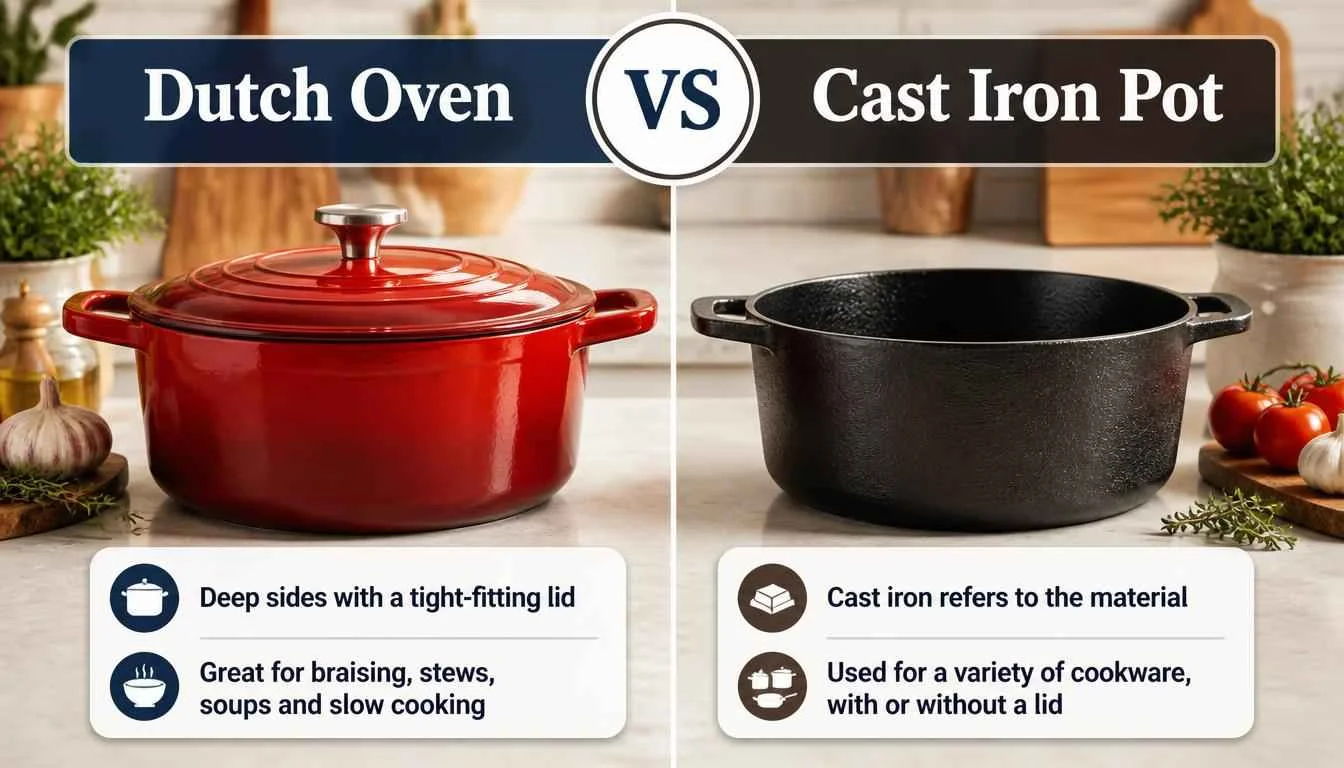
A Dutch oven is a deep pot with a tight-fitting lid — most are cast iron, though stainless and ceramic-coated versions exist now too. “Cast iron pot” just describes the material, which also covers skillets, chicken fryers, and other cookware that has no lid at all. The distinction that actually matters at the stove isn’t the metal — it’s whether the pot has high walls and a sealed lid, because that’s what decides whether it sears well or braises well.
Cast Iron Is a Material. Dutch Oven Is a Shape.
Cast iron tells you what a pot is made of. Dutch oven tells you what shape it’s built in. The two get treated as synonyms because most Dutch ovens have historically been cast iron — but material and shape are two separate questions, and neither one automatically answers the other.
What Actually Makes a Pot a “Dutch Oven”
A pot earns the name “Dutch oven” by meeting three conditions: thick walls that store heat instead of losing it, a tight-fitting lid that seals in steam, and enough depth to go from a stovetop sear to an oven braise in the same vessel. Drop any one of those three and you’ve got a different piece of cookware, even if it’s still made of cast iron.
The thick walls matter because they act as thermal mass — once they’re hot, they keep radiating heat back into the food even after you cut the burner, which is why a Dutch oven can finish a braise on residual heat alone. The lid matters because it keeps moisture from escaping as steam, which is the entire mechanism behind a low-and-slow braise staying moist for hours instead of drying out.
A Cast Iron Pot Isn’t Always a Dutch Oven
A bare cast iron skillet, a cast iron chicken fryer, or an open cast iron stockpot are all technically “cast iron pots,” and none of them are Dutch ovens. Without a lid trapping steam and without the wall height to hold a real braise, they’re built for a different job entirely — direct, fast heat with the food’s surface left open to the air, not sealed in.
That open design is the point, not a shortcoming. Searing depends on the food’s surface staying dry enough for a real crust to form, and a lidless, low-walled pan lets moisture escape instead of collecting back onto the food.
Not Every Dutch Oven Is Cast Iron Anymore
Modern Dutch ovens increasingly skip cast iron altogether. Stainless tri-ply and ceramic-hybrid nonstick versions have shown up specifically to solve cast iron’s weight and chip risk, while keeping the two things that actually define a Dutch oven: the tight lid and the deep walls. I’ve tested five of these side by side — enameled cast iron, stainless tri-ply, and hybrid nonstick versions — and the material changes how much upkeep the pot needs, not whether it still qualifies as a Dutch oven.
Does a Dutch Oven Actually Replace a Cast Iron Skillet?
Not for every job. A Dutch oven can do a lot of what a skillet does, but the same high walls and tight lid that make it excellent for braising work against it when you’re trying to sear, because they trap the exact steam a good sear needs to escape.
Here’s the mechanism: browning depends on the food’s surface getting hot and dry enough for the Maillard reaction to kick in. In an open skillet, moisture releasing from the meat has nowhere to go but up and away. In a Dutch oven, that same moisture hits the high walls, condenses, and settles right back onto the food’s surface — so instead of a crust forming, you get gentle, moist heat. That’s exactly what makes it excellent for a pot roast and exactly why it disappoints for a quick sear.
There’s one clear exception: deep frying. A Dutch oven’s depth becomes an asset there instead of a liability, since it holds more oil at a steadier temperature and contains splatter far better than a shallow skillet can. Flat, high-heat jobs favor the skillet’s low walls and open surface; deep, moisture-retaining jobs favor the Dutch oven’s height and lid — and frying is the one task where depth wins regardless of moisture.
Comparison at a Glance
The fastest way to decide which pot to reach for is matching the cooking method to the shape, not the material, since both tools can technically be cast iron and the shape is what actually predicts the result.
| Task | Better Tool | Why |
|---|---|---|
| Searing a steak or chop | Cast iron skillet | Open, low sides let moisture escape instead of collecting on the food |
| Frying eggs, pancakes, or cornbread | Cast iron skillet | Flat surface makes flipping and sliding food out easy |
| Deep frying | Dutch oven | Depth holds more oil at a steadier temperature and contains splatter |
| Braising a pot roast or short ribs | Dutch oven | Sealed lid traps moisture through hours of slow cooking |
| Baking no-knead bread | Dutch oven | Lid creates a steam chamber that mimics a professional oven |
| A big batch of soup or chili | Dutch oven | Capacity and thick walls hold even heat across a large volume |
Seasoning and Care: Where They Actually Diverge
Owning a well-seasoned cast iron skillet doesn’t prepare you for caring for an enameled Dutch oven — the two follow almost opposite rules, even though they’re often the same metal underneath.
A bare cast iron skillet depends on seasoning: a polymerised oil layer you build up over repeated use and protect by skipping soap-heavy soaks, drying it immediately after washing, and rubbing in a thin coat of oil before it goes back in the cabinet. Skip that upkeep and the surface turns sticky or starts to rust. If you’re building out a set of bare cast iron pieces to maintain this way, a full cookware set is usually a more economical way to start than buying pieces one at a time.
An enameled Dutch oven flips that entirely — there’s no seasoning to maintain, since the fired glass coating is already non-reactive, but that same coating can chip if it takes a hard knock from a metal utensil or a dropped lid, and thermal shock from moving it straight from a hot burner to a cold surface can crack it outright. Treating an enameled pot like a seasoned skillet, or vice versa, is the fastest way to damage either one.
Price and Kitchen Footprint
A bare cast iron skillet is almost always the cheaper entry point into cast iron cooking, often a fraction of what a quality enameled Dutch oven costs, since it’s a single casting with no coating or lid to manufacture. A Dutch oven costs more up front but replaces more pots on its own — one vessel that sears, braises, bakes, and serves at the table.
Storage is the tradeoff that rarely gets mentioned. A skillet stacks flat and slides in with your other pans. A Dutch oven, especially in the 5-to-6-quart range most households actually need, eats a dedicated shelf on its own — worth factoring in before you add a second large pot to a kitchen that’s already tight on space.
So, Do You Need Both?
For most kitchens, yes — but not because more cookware is automatically better. If your cooking is mostly quick, high-heat, solo meals — eggs, a weeknight steak, grilled cheese — a cast iron skillet alone covers nearly everything you’ll make. If you regularly braise, batch-cook, or host, a Dutch oven earns its cabinet space fast, since nothing else in a home kitchen holds moisture and heat the same way over a multi-hour cook.
Where the two genuinely stop being redundant is the overlap zone: a serious home cook ends up reaching for the skillet for anything fast and dry, and the Dutch oven for anything slow and moist, often in the same meal — searing meat in one, then finishing it low and slow in the other. In my own kitchen, both get used most weeks, just never for the same dish. They’re not competing for the same job. They’re splitting one.
Faqs
How does a standard pot differ from a Dutch oven?
A standard pot is usually thinner-walled and built mainly for boiling — pasta water, stock, blanching vegetables — where fast, even heat matters more than heat retention. A Dutch oven has thick walls built to store and radiate heat, plus a heavier, tighter-sealing lid, which is what makes it suited to braising instead of just boiling.
Are Dutch Ovens Always Made of Cast Iron?
No, not anymore. Cast iron, both bare and enameled, is still the most common material, but stainless tri-ply and ceramic-hybrid nonstick Dutch ovens have become widely available too. What makes a pot a Dutch oven is the shape — deep walls and a tight lid — not the specific metal it’s made from.
Can a cast iron skillet go in the oven the same way a Dutch oven does?
Yes, a bare cast iron skillet is fully oven-safe and handles high heat well, often higher than an enameled Dutch oven’s rated ceiling. What it can’t do is seal in moisture the way a lidded Dutch oven can, so it’s better suited to oven-finishing a sear than to a long, covered braise.
Conclusion
That chuck roast eventually turned into a good braise — just not until I moved it, lid off, back into the same cast iron skillet I should have started with. The metal was never the issue. A Dutch oven and a cast iron pot can be made from identical material and still be built for opposite jobs, and once you’re picking cookware by shape instead of by metal, the “which one do I actually need” question mostly answers itself.

Hi, I’m Muhammad Din. I test and compare kitchen tools in my own kitchen before I ever recommend them — if it’s in a guide on HomePlora, I’ve used it or dug deep enough to know exactly where it holds up and where it doesn’t. My goal is simple: help you find tools that actually earn a spot in your kitchen, without wasting money on ones that don’t.