
Introduction
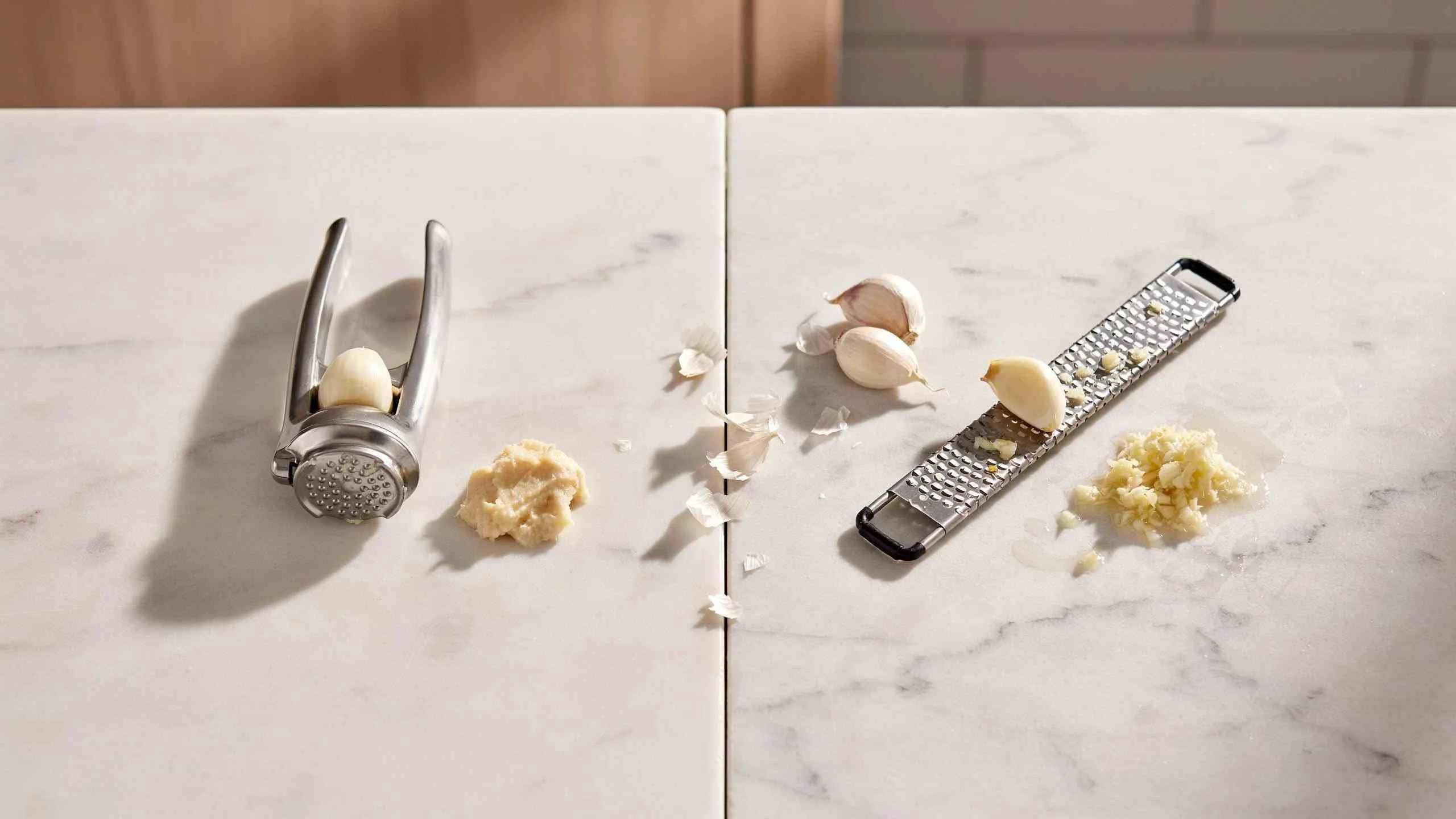
Garlic press vs garlic grater — on paper it looks like a five-second choice between two tools sitting in the same drawer. Use them back-to-back on the same clove, though, and the flavour, the mess, and the time each one takes aren’t close. Most kitchen advice never explains why, because the real answer isn’t about preference — it’s about what physically happens to a clove of garlic under each tool.
This isn’t another roundup telling you which brand to buy. The real comparison should happen before you decide. It comes down to which method delivers a stronger flavour, which one minimises waste, and which tool truly deserves a place in your kitchen based on the meals you prepare—not simply because it’s popular right now.
A garlic grater wastes less of the clove, cleans up faster, and produces a sharper, more pungent flavor than a press — making it the better choice for raw or lightly-cooked dishes. A press wins on pure speed: it works with unpeeled cloves and fits into a hot pan mid-cook, where flavor differences matter less than getting garlic in fast.
The Confusion Nobody Clears Up: What “Garlic Grater” Actually Means
No — a box grater is not the same as a garlic grater, and that mix-up is exactly why so many home cooks try to grate garlic, get a mangled, half-crushed mess, and decide “grating garlic just doesn’t work.” It works fine. You were likely using the incorrect tool.
“Garlic grater” actually gets applied to three different products, and only one of them is built specifically for garlic:
Microplane-style rasp graters — a long, flat blade covered in dozens of tiny, razor-sharp photo-etched teeth. This design didn’t start in the kitchen at all; it was originally a woodworking rasp before a kitchen brand adapted the same etching technique into food graters in the 1990s. Run a clove across it and the fine teeth shred the garlic into an almost wet, paste-like texture, releasing juice as it goes.
Ceramic grater plates — a small, flat or slightly curved ceramic disc covered in raised nubs instead of blades. You rub the clove across it in a circular motion rather than a straight pass. This is the tool most product listings actually mean when they say “garlic grater,” and it produces a similar juicy paste to a microplane, just with a gentler, less bladed action.
Box graters — the standing, four-sided grater in most kitchens, including the ones in our own grater roundup. This one is not built for garlic, and here’s the actual mechanical reason why: box grater holes are sized and spaced for something you can press flat with your whole palm — a block of cheese, a carrot, a potato. A garlic clove is small enough that by the time you’ve got enough of it in contact with the grating surface to do anything, your fingertips are within a few millimeters of the blade. The first time I tried it anyway, I got maybe a third of the clove grated before my fingertips were pressed right up against the coarse holes — I stopped there and finished the rest with a knife rather than push it further. It’s not that a box grater “can’t” grate garlic — it’s that doing so safely means grating almost nothing at a time, which defeats the point.
| Tool | Best for garlic? | Texture produced | Why |
|---|---|---|---|
| Microplane / rasp grater | Yes | Fine, wet, paste-like | Etched micro-blades shred and release juice |
| Ceramic grater plate | Yes | Fine, wet, paste-like | Raised nubs break down the clove with less bite |
| Box grater | No | Uneven, partially crushed | Built for larger, flat-held foods — not small cloves |
What Actually Happens to the Garlic
Grating produces the most pungent, sharpest-tasting garlic of any prep method — more intense than a press, and far more intense than a knife mince — because it ruptures the highest number of the clove’s cells per pass.
Here’s the actual mechanism. A garlic clove stores two things separately inside its cells: a stable, odorless compound called alliin, and an enzyme called alliinase. As long as the cell walls stay intact, the two never touch. The moment you damage the clove — cutting, crushing, or shredding it — those cell walls rupture, alliinase comes into contact with alliin, and the reaction between them produces allicin: the sharp, assertive compound behind garlic’s characteristic bite.
The more cells you rupture, and the more finely you rupture them, the more allicin gets produced. That’s the entire difference between your three options:
- A knife mince cuts through relatively few cell walls per slice, leaving many cells intact inside each small piece. Mildest result.
- A garlic press forces the whole clove through a grid of holes under pressure — real rupture, but concentrated at fewer contact points, since each hole is only pressing against one section of the clove at a time.
- A microplane or ceramic grater drags dozens of fine teeth or nubs across the entire surface of the clove in a single pass, rupturing cells across nearly the whole thing at once rather than through a handful of holes. That’s why it ends up sharper than the press, not milder — it’s simply the most thorough method of the three at breaking cells open.
This is also why grated garlic tastes different in a dish rather than just “stronger” — with more cells opened at once, more juice releases alongside the allicin, which is why grated garlic behaves more like a wet paste that disperses evenly through a dressing or marinade, while pressed garlic sits closer to a coarse, chunkier pulp by comparison.
Where Each One Actually Wins
Once garlic hits hot oil, most of the raw flavor differences between a press and a grater get cooked away — so the real decision for a sautéed dish is about workflow, not flavor, while for a raw dish it’s entirely about flavor, because there’s nothing to homogenize it.
That single distinction is the self-check to run before reaching for either tool:
Is this garlic going into heat, or staying raw?
If it’s going into heat — a stir-fry, a pan sauce, sautéed greens, garlic butter melted into a skillet — reach for the press. Not because it changes the final taste much (cooking mellows both tools’ output to a similar place), but because of pure workflow: you can drop an unpeeled clove straight in and crush it one-handed while you’re already managing a hot pan and everything else happening around it. That convenience is the actual win here, not flavor.
If it’s staying raw or only gently warmed — aioli, Caesar dressing, chimichurri, gremolata, a quick marinade — reach for the grater. This is where its extra pungency stops being a downside and becomes the entire point: a raw application has no heat to mellow anything, so you want the fine, juice-rich paste that disperses evenly through a liquid rather than leaving a chunkier bit that bites unevenly in one spot. The grater also happens to shred the whole clove clean, so you’re not fishing stray bits out of an emulsion afterward.
The exception worth knowing: if you’re prepping ahead rather than cooking immediately, skip both. Pressed or grated garlic sitting in a bowl loses its punch fast once the cells are ruptured — for anything you’re making more than a few minutes before it hits heat or gets eaten raw, a knife mince holds up better over time.
Why Some Cooks Own Both
Yes — and it’s not indecision. If your weekly cooking includes both raw garlic applications and cooked ones, owning a press and a grater is the same logic as owning both a whisk and a spatula: two tools solving two different problems, not one tool that just wasn’t versatile enough.
That’s the piece most people miss by forcing a winner. The press and the grater aren’t actually competing for the same job — one is a workflow shortcut for getting unpeeled garlic into a hot pan fast, the other is a flavour tool for raw applications where a fine, evenly dispersed paste matters. A cook who makes stir-fries on Tuesday and a Caesar dressing on Friday isn’t being indecisive by owning both — they’re using the right tool for two genuinely different tasks, the same way nobody accuses someone of clutter for owning a chef’s knife and a paring knife.
Here’s the honest self-check, since owning both isn’t right for everyone: think through your last two weeks of cooking. If you regularly use garlic in both uncooked or lightly heated recipes—such as salad dressings, marinades, aioli, or fresh salsa—along with everyday cooking like sautéing and stir-frying, having both tools is a practical choice and well worth the investment. If you genuinely can’t remember the last time you made anything raw with garlic in it, you don’t need the grater at all — buying it anyway is exactly the kind of drawer clutter people end up quietly regretting and later donating, the same pattern that shows up with tools like apple corers and avocado slicers bought for a use case that never actually materializes.
The case for owning both is also easier to make here than for most “buy two tools” recommendations: a press and a grater together typically cost less than a single mid-range specialty gadget, and both store flat or hang on a hook — neither is the kind of bulky, single-purpose item that eats real drawer space. That’s a very different math than, say, owning three different melon ballers.
Mistakes People Make Switching Between Them
The two mistakes that actually cause problems aren’t about which tool is “better” — they’re about handling the last bit of a clove safely, and assuming the two tools produce interchangeable results when they don’t.
Grating the clove too close to your fingers. Every grater-related finger injury happens the same way: the clove gets small enough that there’s nothing left to hold onto, and your fingertips end up dragging across the teeth right alongside the last sliver of garlic. The fix is simple and specific — hold the clove by its root end (the tougher, fibrous end where the clove attached to the bulb), since it doesn’t shred as easily and gives you something firm to grip until almost nothing is left. Stop when you’re down to a small nub rather than trying to grate every last fragment — the amount you’d save isn’t worth the risk, and a knife can finish off that last bit safely.
Assuming a recipe’s “1 clove, minced” translates 1:1 if you grate instead. Since grating produces the most pungent result of the three prep methods, substituting it into a recipe written for pressed or knife-minced garlic without adjusting the amount is the single most common way home cooks end up with a dish that tastes overpoweringly garlicky and can’t figure out why they followed the recipe exactly. The fix: when a recipe was clearly written with mincing or pressing in mind and you’re grating instead, start with slightly less than called for and taste before adding more — you can always add, but you can’t take pungency back out.
Forcing a clove into a press it doesn’t fit. Presses are sized for a fairly standard clove range — an unusually large or oddly shaped clove can jam the mechanism or slip out sideways under pressure rather than crushing cleanly. Trimming the uneven ends flat before pressing so the clove sits squarely against the plate solves this in about two seconds and avoids the jam entirely.
Using grated garlic in a dry mix. Grating extracts more juice than pressing or finely chopping, making it an excellent choice for dressings where extra moisture is beneficial. However, that same moisture can cause dry seasoning blends or breading mixtures to become sticky, uneven, and difficult to coat evenly.. For anything dry, press or mince instead; save the grater for anything with liquid already in it.
A Note on Grip Strength
If arthritis or reduced grip strength is a factor in your kitchen, the grater is the easier tool of the two — it only asks for a light, repetitive dragging motion, while a press requires a single sustained squeeze that concentrates real force right through the joints most affected by arthritis. If that’s a regular consideration for you, our guide to arthritis-friendly kitchen tools covers which everyday tools are actually built with this in mind.
Conclusion
None of this comes down to which tool is objectively “better” — it comes down to what’s happening on your cutting board on a given night. A press earns its keep on fast, unpeeled-clove convenience when you’re already juggling a hot pan and don’t want one more step. A grater earns its keep everywhere raw garlic needs to actually shine, and anywhere a wasted third of a clove bothers you enough to care. Most cooks who use garlic often enough to have a real opinion on this end up keeping both — not because they couldn’t decide, but because they stopped expecting one tool to do two different jobs.
If you already know which one your kitchen is missing, the specific picks come next: our tested garlic press roundup covers the models that held up to real use, and our grater roundup covers the ones that stayed sharp instead of dulling within a few months
Faqs
Is a garlic press or grater healthier?
Neither, in any meaningful nutritional sense — same clove, same calories either way. The only real difference is allicin, the compound tied to garlic’s health-associated properties: grating ruptures more cells than pressing, so it yields slightly more of it. Too small a difference to choose a tool over.
Does a garlic press waste more garlic than a grater?
Yes. A press often leaves part of the clove un-crushed inside the chamber, especially with larger or irregular cloves, so you end up re-mincing the leftover by hand. A grater shreds the clove’s full length in one pass and typically leaves almost nothing behind.
Can I use a cheese grater instead of a garlic grater?
Not safely on a whole clove. A standard box grater’s holes are sized for something pressed flat with your palm, so by the time enough of a small clove touches the surface, your fingertips are right against the blades. Use a microplane or ceramic grater plate instead.
Do professional chefs use a garlic press?
Many do, especially in high-volume kitchens where speed and consistency matter more than the subtle flavor edge a knife mince gives. Culinary training still centers on knife skills, but a press isn’t an amateur shortcut — it’s a faster tool for a faster pace.
What’s the fastest way to mince garlic without either tool?
Smash the clove with the flat of a chef’s knife to crack it open, then mince while adding a pinch of coarse salt partway through. The salt grinds against the garlic as you chop, breaking it into a near-paste in seconds with nothing but the knife.

Hi, I’m Muhammad Din. I test and compare kitchen tools in my own kitchen before I ever recommend them — if it’s in a guide on HomePlora, I’ve used it or dug deep enough to know exactly where it holds up and where it doesn’t. My goal is simple: help you find tools that actually earn a spot in your kitchen, without wasting money on ones that don’t.