
Introduction
I’ve had a pot boil over more times than I want to admit, and it’s never the polite kind of overflow. It’s the stock I forgot on the back burner while I was unloading the dishwasher, and by the time I turn around there’s a foamy tide crawling down the side of a hot burner, hissing, filling the kitchen with the smell of starch and scorched metal. If you’ve read my stockpot buying guide, you already know how that story ends for me — a smoke detector going off twenty minutes before guests arrived.
For years, the only advice I found for this was to prop a wooden spoon across the pot and walk away. Sometimes it worked. Sometimes I came back to a bigger mess than if I’d done nothing at all. It took actually digging into what’s physically happening inside that pot before stopping it stopped being a coin flip — and once I understood the mechanism, most of the “hacks” floating around either made a lot more sense or fell apart completely.
This guide covers what’s really going on when a pot boils over, which fixes are backed by that mechanism and which are folk wisdom, and why a stockpot doing its actual job — an all-day stock, a big-batch soup — needs a different approach than a ten-minute pot of pasta water.
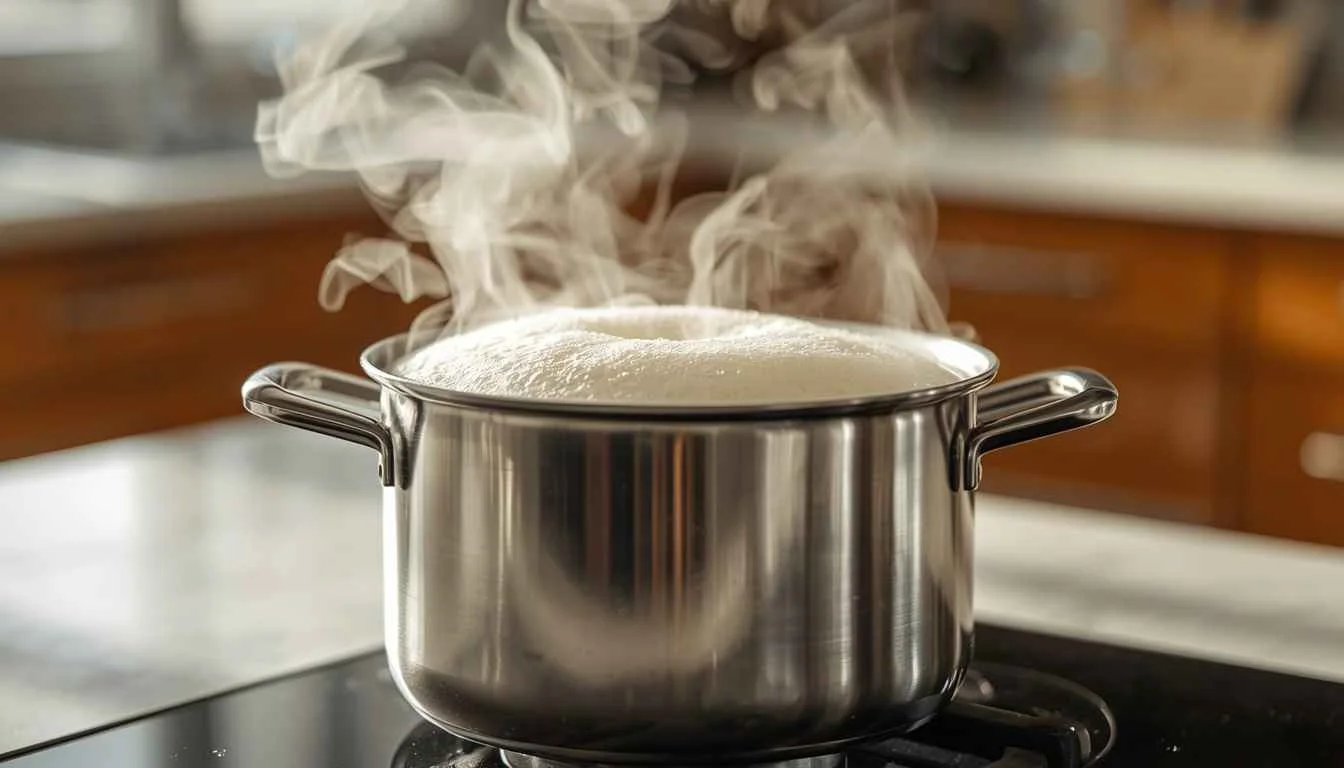
A pot boils over because starch and protein trap rising steam under a layer of foam — plain water at a rolling boil doesn’t climb the sides on its own. The most reliable fix is dropping the heat to a bare simmer the instant it nears a boil, cracking the lid instead of sealing it, and leaving at least two to three inches of headspace above the liquid. The wooden spoon trick can buy a minute or two on thin liquids like pasta water or stock, but it isn’t a real fix by itself.
Why Pots Actually Boil Over
Here’s the detail that surprised me most once I looked into this: a pot of plain water at a full rolling boil does not climb over the rim on its own. You can boil water all day in an uncovered pot and it will bubble energetically without ever threatening to spill. Boiling over is caused by what you add to the water, not the boiling itself.
Two things change the moment you drop in pasta, rice, beans, or a bone-in chicken carcass for stock. First, every one of those ingredients adds physical surface area, and bubbles need a surface to form on — what food scientists call a nucleation site. A smooth pot of plain water has relatively few of these sites, so bubbles form at a steady, manageable rate. Add a few hundred grains of rice or a tangle of pasta, and you’ve multiplied the number of nucleation sites almost instantly, which triggers a sudden surge in how fast bubbles form.
Second, and more important, starch dissolving off that pasta, rice, or bone begins to gelatinize in the hot water — the starch granules swell, burst, and release long molecule chains that tangle together into a loose, stretchy film at the surface. That film is the actual problem. Instead of letting steam bubbles rise, burst cleanly, and release their vapor the way plain water does, the film traps them underneath it. Trapped steam keeps expanding, the foam layer keeps growing to accommodate it, and within seconds that whole foamy mass has nowhere left to go but up and over the rim.
This is also why a stock or bone broth boils over more readily than you’d expect from something that looks like plain water — collagen and proteins released from bones behave the same way starch does, thickening the surface into a foam-trapping layer well before the pot ever reaches what looks like a hard boil.
Does the Wooden Spoon Trick Actually Work?
This is where most advice online contradicts itself, and I think the contradiction is exactly why the trick has such a mixed reputation. Some sources swear by it. Others say it does nothing. Both are right, depending on what’s in the pot.
The mechanism is real. A dry wooden spoon laid across the rim gives rising bubbles a cooler, porous surface to hit instead of piling unbroken into that foam layer. Wood pulls a small amount of heat out of the bubbles right at the point of contact and gives trapped steam somewhere to escape rather than building pressure underneath the film. For the first minute or two, that’s a genuine physical effect, not a myth.
The problem is what happens next. As the spoon sits in that hot, humid environment, it heats through and picks up moisture and sticky starch on its underside. Once that happens, it stops being a cool, porous surface — it’s now roughly the same temperature as the boiling liquid and coated in the same starch film it was supposed to interrupt. At that point it does essentially nothing, which is exactly why so many people report it “just stopped working” a couple of minutes after they walked away.
There’s a second limit that matters even more for anything you’re actually cooking rather than just boiling water: liquid thickness. On a thin, starchy liquid like pasta water, fresh stock, or beans that haven’t broken down yet, the spoon has a real shot at interrupting the foam because the film is still relatively delicate. On something already thick and gel-like — a reducing sauce, a dense bean stew, oatmeal — the starch mesh is already structurally strong enough that a spoon across the top barely registers. I’ve tested this side by side in my own kitchen more than once: the same trick that buys real time on a pot of pasta water does almost nothing once a liquid has thickened past a certain point.
The honest verdict: the wooden spoon trick is a legitimate short-term stopgap on thin, starchy liquids — the exact category most stockpot cooking falls into — but it’s not a walk-away solution, and it’s not something to rely on for anything already thick.
The Methods That Actually Prevent It, Ranked
These are ordered by how much they actually address the mechanism above, not by how popular they are online.
Cut the heat right as it reaches a boil, not after. The moment the surface breaks into a rolling boil, drop the burner to medium-low immediately, rather than waiting to see if it settles on its own. Bubble formation and foam buildup scale sharply with temperature just above the boiling point — dropping the heat even slightly cuts foam production far more than it seems like it should. The result is a pot that holds a steady, quiet simmer instead of climbing toward the rim.
Crack the lid instead of sealing it. Rest the lid tilted open by half an inch rather than centered and closed. A fully sealed lid traps rising steam with nowhere to go except pushing the foam layer up and out past the rim. A cracked lid gives that steam a controlled escape route, so it vents steadily instead of building pressure underneath the foam.
Leave real headspace. Fill the pot to no more than two-thirds of its total capacity, and size up if you’re regularly cooking closer to the rim than that. This is the same sizing logic I cover in the buying guide’s sizing framework — foam needs somewhere to expand into before it reaches the top. A pot filled to the brim gives even a modest surge nowhere to go but over the side.
Oil the rim, not the whole pot. Wipe a thin film of neutral oil or butter around just the inside rim, about an inch below the top edge, before you start cooking. This is a different technique than mixing fat through the whole liquid, and it works through a different mechanism — a ring of fat right at the rim breaks surface tension exactly where foam would otherwise climb over, so bubbles collapse at that line instead of continuing past it. Coating the whole pot’s worth of liquid has much less effect; the placement is what does the work, not the volume of oil.
Stir at the critical moment. Give the pot a real stir right as it approaches a boil, not continuously throughout cooking. Stirring physically breaks up the starch mesh before it knits into a continuous foam layer capable of trapping steam. It’s a genuine reset, but only if you’re actually standing there to do it.
Use the wooden spoon honestly. Treat it as a short-term stopgap on thin liquids while you handle the real fix — heat, lid position, headspace — not as something you prop up and walk away from for good.
Why This Matters More for a Big Pot Than a Small One
Every method above assumes you can react quickly, and that assumption falls apart for what a stockpot is actually used for. A ten-minute pot of pasta water is something you stand over. An eight-hour bone broth or a big-batch holiday stock is not — walking away for long stretches is the entire point of using a large pot in the first place.
That changes which fixes actually matter. Active tricks — stirring, repositioning a spoon — require supervision you won’t have for most of a long simmer. What protects an unattended pot is the passive stuff: the right heat level set from the start, a lid left cracked rather than sealed, and real headspace so a surge has somewhere to go even if nobody’s watching. If you’re only going to get one of these right before you walk away, make it headspace and starting heat — those are the two that keep working with nobody in the room.
Pot shape plays into this too. The tall, narrow profile I recommend in the buying guide for long simmers — the same shape that slows evaporation over an eight-hour stock — also means more vertical headspace sits above the liquid line relative to the surface area generating foam, compared to a wider, shallower pot holding the same volume. It’s not a boilover-proofing feature on its own, but it works in your favour rather than against it.
And an undersized pot crowded to the rim for a big batch rarely announces itself in the first five minutes. It shows up two or three hours into an unattended simmer, which is exactly the moment you’re least prepared to catch it.
Gas vs Electric vs Induction — Does Your Stovetop Change the Fix?
It does, and this is the part most advice skips entirely.
Gas responds to a dial adjustment almost instantly, but flame height can be a misleading visual cue — a pot can be seconds from surging before the flame itself looks dramatic. Time your reaction to what’s happening at the surface of the liquid, not to how the flame looks.
Electric coil elements stay physically hot for a while after you turn the dial down, since the coil itself has to cool rather than switching off instantly. That means a boilover can still happen several seconds after you’ve already lowered the heat. Treat turning the dial down as step one, not the whole fix, and be ready to slide the pot half off the burner as a backup if it’s already climbing.
Induction is the most responsive of the three for exactly this situation. Because an induction cooktop generates heat directly inside the pot’s base through a magnetic field rather than heating a separate element first, dropping the power level changes the actual cooking heat almost immediately — the same near-instant response I describe in the buying guide’s induction section for bringing a pot up to heat works identically in reverse for cooling one down fast enough to catch a near-boilover in time.
What to Do the Moment It’s Already Boiling Over
Prevention fails sometimes. When it does:
Cut the heat first, before you reach for anything else. Everything else is secondary to stopping more heat from going into the pot.
Don’t reach across an open gas flame to grab a lid or move the pot — turn the burner off before your hand goes anywhere near rim height.
If you need to move a full stockpot off the heat entirely, slide it rather than lifting it. A stock-scale pot full of liquid is heavy and awkward to lift quickly, and boilover residue on the burner or grates makes footing and grip unpredictable in exactly the moment you need them to be reliable.
Let residue on a glass-top burner cool before you scrub it. Aggressive scrubbing on a still-hot glass surface risks scratching it; a few minutes’ wait and a damp cloth handle most starchy spills without a fight.
Faqs
Does salt stop a pot from boiling over?
Not meaningfully. Salt raises water’s boiling point by only a fraction of a degree — far too little to prevent overflow. What actually helps is dropping the heat once it reaches a boil and leaving enough headspace; salt is a seasoning decision, not a boilover fix.
Why does adding pasta or rice make water suddenly boil over?
Pasta and rice add surface area, which multiplies the sites where bubbles form, and release starch that thickens the surface into a foam-trapping film. That combination turns a calm boil into a sudden surge within seconds of adding them.
Can oil actually prevent a pot from boiling over?
A thin ring of oil right at the inside rim can, because it breaks surface tension exactly where foam would spill over. Mixing oil through the whole pot has much less effect — the fix is in the placement, not the amount.
Does pot size affect boiling over?
Yes. A pot filled close to the rim leaves foam nowhere to expand before it spills. Keeping liquid to roughly two-thirds capacity, or sizing up for big batches, gives a foam surge room to rise and settle back down instead of climbing over.
Conclusion
The pot that set off my smoke detector wasn’t undone by a bad wooden spoon or bad luck — it was undersized, filled too close to the rim, and left sealed and unattended at too high a heat for something meant to run all day. Once I understood that boiling over is a starch-and-steam problem rather than a mystery, fixing it stopped being about finding the right hack and started being about getting three basics right before I walked away: the right heat, a cracked lid, and enough room in the pot for foam to rise without going anywhere.
That last one matters most if you’re still cooking in a pot that’s too small for what you actually make — my stockpot buying guide breaks down sizing by exactly this kind of task, so you’re not relying on a spoon trick to make up for a pot that was never going to hold the batch in the first place.

Hi, I’m Muhammad Din. I test and compare kitchen tools in my own kitchen before I ever recommend them — if it’s in a guide on HomePlora, I’ve used it or dug deep enough to know exactly where it holds up and where it doesn’t. My goal is simple: help you find tools that actually earn a spot in your kitchen, without wasting money on ones that don’t.