
Introduction
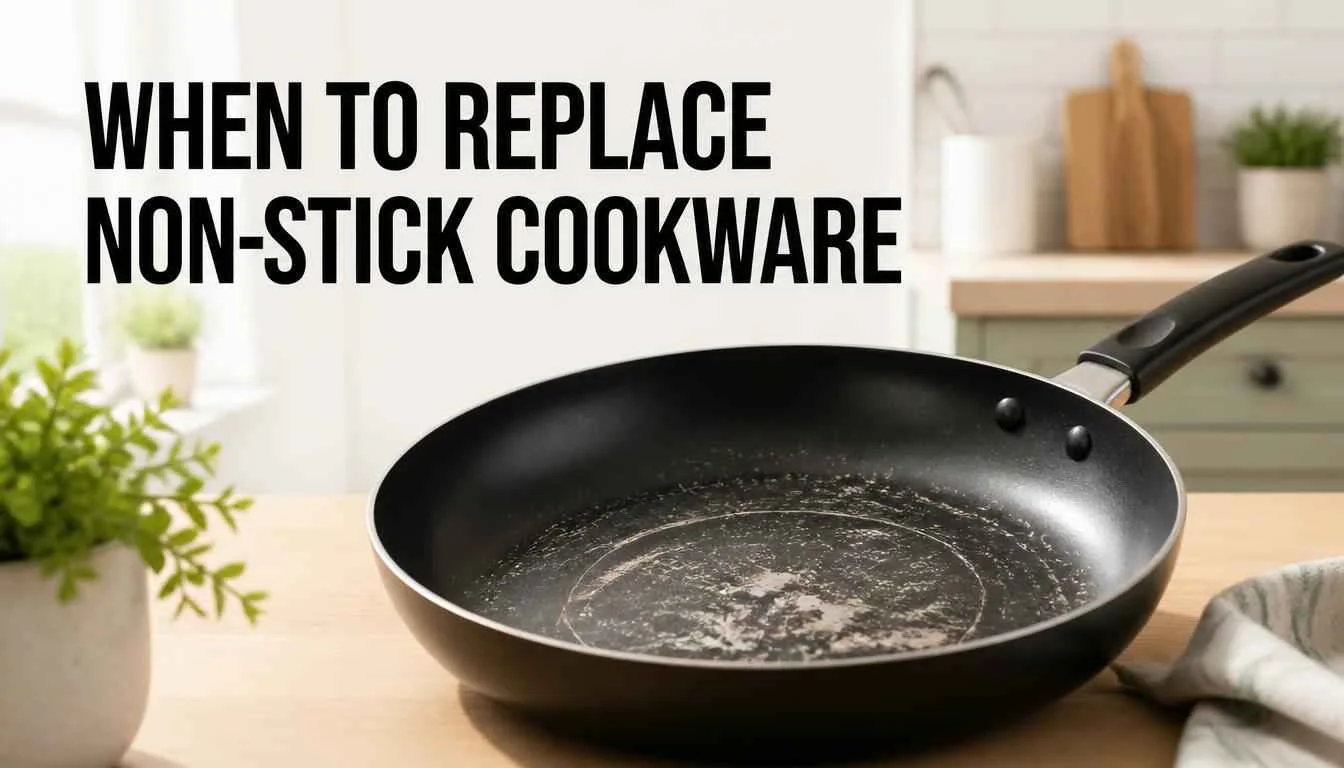
Non-stick cookware covers more than the skillet sitting on your stovetop right now — every saucepan, wok, and griddle with a coated surface falls under the same question, and none of them come stamped with an expiration date. The real answer isn’t a number of years or a count of meals cooked: replacement is a condition you can check for directly, not a date you circle on a calendar. A pan that’s five years old and still passes that check has more life left in it than one that’s five months old and doesn’t. The fastest way to know which one you’re holding takes about sixty seconds, and a kitchen skillet is the easiest way to picture it — though everything below applies the same way to whatever else in your cookware sits on the coated side of your cabinet.
| Verdict | What you felt |
|---|---|
| Replace now | Coating that’s actually lifted — a catch on the glide, a raised edge at the rim, a soft spot on the base |
| Keep cooking | Surface changes that stay flat under your finger — dulled shine, staining, fine scratches with no ridge |
| It’s not the pan | Sticking that moves to a different spot each time — usually skipped preheating, the wrong oil, or heat pushed too high |
Table of Contents
The check you can run in the next 60 seconds
Forget cooking a test egg. The fastest way to know whether a piece of non-stick cookware still has life left in it is a 60-second hands-on check: run a fingertip across the cooking surface for texture changes, press along the rim where the floor meets the side wall, and press firmly on the base to feel for any give. No stove, no oil, no waiting to see how something cooks — just your hand and a decent light source at the sink.
Start with the glide. Rest your fingertip flat against the center of the cooking surface — the spot that sits directly over the burner and takes the most direct heat every time you use it — and slide it slowly out toward the edge, in three or four directions, the way you’d trace spokes on a wheel. Tilt the pan slightly under the light while you do it. A coating that’s still doing its job feels completely uniform the whole way out, and catches the light the same way everywhere — no dull patches, no drag, no spot where your finger hesitates for a fraction of a second. That hesitation, or a faint dullness that doesn’t match the rest of the surface, is what you’re logging here. Not fixing yet. Just noting it.
Next, the rim — the curve where the flat cooking floor rises into the side wall. It’s the single most overworked spot on any piece of non-stick cookware, because it’s where every spatula scrape, every flip, and every push of food up and out actually happens. Press the pad of your finger along that entire curve and feel for whether it stays flush or whether you catch the edge of a lip — a place where the coating feels lifted off the metal underneath it, even by a hair. On a skillet or griddle that curve is usually shallow; on a saucepan or a wok it runs deeper and closer to vertical. The angle changes, but the check doesn’t — you’re feeling for a seam, not judging the shape of the pan.
Last, the base — and this is the one almost nobody actually does, because it’s invisible until it’s too late to catch early. Instead of gliding, press down firmly with one fingertip at two or three spots on the main cooking floor, holding for a second each time. Sound coating feels evenly rigid no matter where you press. What you’re checking for is a spot that gives slightly — a soft, faintly spongy feel that doesn’t match the firmness around it. That small give is a blister forming between the coating and the metal underneath it, and it shows up under a fingertip well before it ever shows up as a visible bubble or crack. It’s the same reason I press every pan this way before deciding it’s earned another season in my kitchen — by the time you can see a blister, you’ve usually been cooking on top of it for weeks.
Run all three checks the same way on anything — a saucepan, a wok, a griddle, not just a frying pan. The surface changes shape from one to the next, but what you’re feeling for doesn’t: even smoothness on the glide, a flush seam at the rim, consistent firmness on the base. Whatever you find in those 60 seconds, hold onto it — that’s exactly what the next two sections are for.
What the check means when it says “replace now”
Of the three checks, only one thing actually means replace this piece of non-stick cookware today: coating you can feel has come loose from the metal underneath it. Discoloration doesn’t qualify. Dullness under the light doesn’t qualify. What qualifies is something raised, caught, or soft under your fingertip — because that’s not the coating aging, that’s the coating already separated and waiting for the next scrape to finish the job.
The glide told you two different things depending on what actually stopped your fingertip. If it was a shift in texture and nothing more, hold that thought — the next section is where that belongs. But if what stopped you was an actual edge, a spot where your fingertip catches on something raised instead of sliding across something duller, that’s not wear reading as texture. That’s a flake already starting, and the surface has begun lifting off the metal in that exact spot.
The rim is the one I’d never talk myself out of. If you caught your fingertip — or worse, a fingernail — on a genuine lip, where the coating sits even slightly proud of the metal instead of running flush into it, that edge only gets bigger from here. Every spatula push against that spot works it looser, the same way a sticker peeling back at one corner comes away faster the second time than the first.
The base is the least ambiguous of the three. A soft spot under a firm press — a faint spring or give the rest of the surface doesn’t have — is a blister that’s already detached from the metal, even though it hasn’t cracked open yet. Coating doesn’t reattach itself once it’s separated. That spot is heading toward flaking; the only question is how many more bakes or sautés it takes to get there.
None of this means the piece is dangerous to look at sitting in your cupboard — it means it’s already costing you something every time you cook in it, whether you’ve noticed the pattern or not. A lifted spot needs more oil than it used to, because the coating’s actual job — letting food release with almost nothing between it and the surface — has stopped working right there, so you compensate without registering why. Heat stops behaving evenly the moment coating separates from metal, too: that pocket of air between them insulates the spot instead of conducting heat the way solid contact does, which is why food browns everywhere except that one stubborn patch no matter how you adjust the burner. And more than either of those, it’s the meal you lose outright — the egg that tears at the exact spot your hand already flagged, the fish skin that stays behind instead of releasing, the pancake that’s perfect everywhere but one scorched, stuck corner. That’s not a coating problem by then. That’s dinner, gone, over something your fingertip told you about a week earlier.
What the check means when it’s just cosmetic
Not everything your fingertip and the sink light turn up is a problem. Most of what makes older non-stick cookware look worn — a shine gone flat, a ring of staining near the handle, a faint rainbow tint across the base — has nothing to do with whether the coating is still doing its job. The signal that actually matters is the one from the last section: something raised, caught, or soft. Everything below is texture and color changing evenly, with nothing lifted and nothing giving way underneath your finger.
The glide’s harmless version is a surface that’s gone from glossy to matte but still slides the same the whole way across — no hesitation anywhere, no spot where your fingertip catches before it should. That flattened shine is just the coating’s top layer losing its factory polish from years of dish soap, scrubbing pads, and the low-grade abrasion of ordinary cooking — cosmetic erosion of the finish, not a breach down to the metal. A faint gold, blue, or brownish tint spreading evenly across the center — usually from a pan left empty on a hot burner a beat too long — reads the same way: color has changed, texture hasn’t. If your finger travels smoothly from center to edge without a single catch, the coating underneath that dulled color is still intact and still doing its one job.
The rim’s harmless version is staining, not a seam. A dark ring where oil tends to pool and recook against the curve, or a faint brownish edge a scrub pad won’t fully lift, is baked-on residue sitting on top of the coating — not the coating separating from the metal beneath it. The test that tells them apart is the same press you already ran: if your fingertip travels the entire curve flush, without ever catching an edge or feeling a lip stand proud of the surface, that stain is cosmetic. It’ll outlast the pan.
The base’s harmless wear shows up as fine scratch marks — the ghost outline of a metal spatula’s edge, or a faint circular pattern from years of stirring — that stay completely flat under a fingertip. Scratches you can see but can’t feel a ridge in are surface-deep, sitting in the coating’s top layer without reaching whatever’s underneath it. What separates this from the blister described earlier is firmness: press down on a scratched-but-sound base and it holds the same rigid resistance everywhere, with no soft give hiding under the mark.
Most people skip, because “your pan is fine” doesn’t sell a replacement. But non-stick cookware that’s lost its shine, picked up a stain, or collected a few years of faint scratch marks — while still gliding smooth, sitting flush at the rim, and holding firm under pressure everywhere you press — is cookware doing exactly what it’s supposed to do. Looking seasoned and performing worn are two different things, and only one of them is a reason to buy anything.
When it’s not the cookware — it’s what you’re doing to it
Most “my non-stick pan is done” moments aren’t a coating problem at all — they’re a technique problem wearing a coating problem’s clothes. Skipped preheating, the wrong oil, and heat pushed too high all produce the exact same symptom as a failing coating — food that won’t let go — on cookware that’s completely fine. If the piece just passed every point of the 60-second check, this is the section to read before you buy anything.
Skipped preheating is the most common misdiagnosis, and it’s almost always invisible to the person doing it, because it feels like saving time rather than causing a problem. Oil dropped into a pan that’s still cold doesn’t spread — it sits in a puddle at the center while the rest of the surface stays bare, and food that goes in during that window sticks exactly where the oil didn’t reach. The tell is in the pattern: a coating problem sticks in the same fixed spot every single time you cook, because that’s where the damage physically is. A preheating problem sticks in a different spot depending on where you happened to set the food down that day, because the surface itself never changed — only the moment you used it did.
Wrong oil, or the wrong amount of it, causes the same confusion in the opposite direction. Cooking dry because “non-stick shouldn’t need oil” strips away the thin working layer the surface actually relies on to let food glide — a good coating reduces how much fat you need, it doesn’t eliminate the need for any. On the other end, a heavy, uneven pour just puddles in the low point of the pan instead of coating the surface evenly, so food set down anywhere else still sticks. Either way, the giveaway is that the same pan releases perfectly the very next time you use a thin, even coating of oil in a fully heated pan — which a genuinely failing coating won’t do no matter how carefully you oil it.
Heat pushed too high is the one people get backwards most often, because the instinct when something sticks is to crank the burner higher, assuming more heat means more release. It’s the opposite. Non-stick surfaces have a working range, and past it, food seizes onto the surface the instant it hits — a fried egg that was gliding fine an hour ago will grab and tear at the same spot the moment the burner runs hotter than the dish needs. This shows up differently depending on what you’re cooking in: a skillet run too hot scorches and sticks right where the food first makes contact, while a saucepan run too hot tends to scorch along the base during a simmer, which gets misread as the coating breaking down rather than the heat being wrong for the pace of the cook.
The pattern that ties all three together: technique problems move around depending on what you cooked and how, while coating problems sit in the exact same physical spot the check already flagged. If sticking shows up in a new place every time, on cookware that passed the fingertip test clean, the fix is a lower flame, a fuller preheat, or a proper film of oil — not a trip back to the store.
Why the same test reads differently, piece to piece
The 60-second check works the same way on every piece of non-stick cookware, but where it turns up trouble first — and how obvious that trouble looks when it does — depends on two things that have nothing to do with age or how many times you’ve used it: what the coating is actually made of, and what shape the piece is.
The coating decides how it fails. A standard non-stick coating tends to fail as a single, localized lift — one distinct spot where the coating has separated from the metal underneath before anywhere else has, which is exactly the sharp catch the rim and base checks are built to find. Ceramic coatings fail differently. Instead of one clean lift point, they tend to develop as a fine network of hairline lines spreading slowly across a wider area — closer to old glaze crazing than a single flake — so the check often finds a faint, broad roughness across a whole zone rather than one sharp edge to catch a finger on. Titanium-reinforced coatings generally hold their slickness longer at the surface before anything registers under a fingertip at all, but once they do start going, the pattern tends to read closer to ceramic’s broad wear than PTFE’s single sharp point.
The shape decides where it shows up first. A skillet’s earliest wear concentrates at the center, directly over the burner, for reasons already covered. A saucepan wears differently — liquid sits and reduces at the base through a long simmer, so heat exposure concentrates at the base center rather than the walls, and that’s where scorching or dulling shows up first, not around the sides. A wok wears along the curve instead: the constant motion of tossing and stirring drags food up and along that sloped surface far more than it ever touches the flat bottom, so the curve tells you the truth before the base does. A griddle has no single hot spot to watch at all — it’s one continuous flat surface, so wear doesn’t concentrate anywhere in particular. It shows up as one section releasing food cleanly while another section, sometimes just inches away, quietly doesn’t.
That’s why the same check can hand back two completely different verdicts on two pieces that are the same age and have seen roughly the same amount of cooking. A ceramic saucepan and a standard non-stick skillet don’t age in the same pattern, and knowing which pattern to expect is what tells you where to actually press first — instead of patting down the whole piece blind and hoping you land on the right spot.
If you’re trying to place what’s already in your cabinet, or you’d rather switch coating families entirely instead of replacing like-for-like, our ceramic cookware set breakdown, our titanium cookware and our granite stone cookware guide go deeper on how each of these coating families actually performs over time — since those are sets built around a whole kitchen’s worth of pots and pans, not one skillet sold on its own.
What actually shortens cookware’s life in your kitchen
None of this is about a single bad move ruining a pan in one use — it’s about a handful of everyday habits that quietly set the pace for how fast a coating separates from the metal underneath it, long before any of the signs in the earlier sections show up. Four matter more than the rest, and none of them are specific to a skillet: how you bring the piece up to heat, how you move food around in it, how it sits when it’s not on the stove, and whether it goes through the dishwasher.
Heat cycling does more damage than any single high-heat cook ever will. Metal expands and contracts faster than the coating bonded to its surface, and every time that happens abruptly — an empty pan left over a hot burner before anything goes in, or a hot pan rinsed under cold water the second you’re done — the bond between the two materials gets stressed a little more than gradual, even heating ever would. That stress doesn’t show up as a visible mark the first time, or the tenth. It shows up later as exactly the lifted edge the rim check is built to catch, arriving sooner than it would have if the piece had simply been allowed to heat up with something already in it and cool down on its own.
How you move food, not just what with, is where most advice stops short. Swapping a metal spatula for a silicone one solves half the problem — but a silicone or wooden edge dragged hard at a steep angle to scrape a stuck piece of food free wears a groove into a coating almost as effectively as metal does, just more slowly. The habit that actually protects a coating is angle and motion: a flatter tool moved under food to lift it, rather than any utensil dragged across the surface to scrape it. That’s true whether you’re flipping in a skillet, stirring a saucepan, or tossing along a wok’s curve — the tool matters less than whether it’s lifting or scraping.
How it sits when it’s not in use causes damage nobody’s watching happen. Nesting one piece directly inside another concentrates real weight onto small points of contact — usually the rim and the center of the base, the same two spots the 60-second check already flags as the most failure-prone areas on the whole piece. Every time a stacked set gets pulled apart and pushed back together, those same points grind against each other again, which adds up to real wear over the course of a few years even though no single instance of it ever looked like damage in the moment.
The dishwasher cycle wears a coating down in a way hand washing doesn’t, and it’s rarely the heat or the water that’s the real cause — it’s the detergent. Dishwasher formulas are built to cut through baked-on residue on glass and ceramic dishware, which makes them more aggressive than a coated surface actually needs, cycle after cycle. That’s compounded by the tumbling — coated pieces sitting against other cookware, utensils, or racks through an entire wash and dry cycle, picking up small contact abrasion the whole time. Neither one leaves a mark you’d notice after a single run. Over a couple of years of regular dishwasher use, the surface just quietly loses the shine the earlier section described as a good sign — arriving faster than it would have with a hand wash and a soft cloth.
Buying secondhand, thrifted, or inherited non-stick cookware
A secondhand piece needs the same 60-second check as anything already in your kitchen — plus a few extra checks that only matter when you have zero idea how it was treated before it reached you. With your own cookware, “this used to glide better than it does now” is part of the read. With a box lot from an estate sale, a thrift store shelf, or a pan your mother handed you on her way out of her old kitchen, that comparison point doesn’t exist. You only get this one moment to judge it, which means the same check needs one rule change before you run it.
Treat borderline as a no, not a maybe. On your own cookware, a faint catch during the glide check might earn a “keep an eye on it.” On a piece with no history, that same faint catch gets read as already failing, because you have no way to know if today is week one of that flaw or year three of it. You’re not being overly cautious — you’re just missing the one piece of information that makes a borderline result safe to sit with.
Check the handle before you check the surface at all. A wobble at the rivets, a loosely fitted grip, or hardware that’s visibly been tightened and re-tightened over the years tells you more about how hard a piece was used than a quick look at the cooking surface ever will. A pan can look untouched on top and still have handle hardware that’s worked loose from a decade of being lifted, flipped, and set down hard — and a loose handle over a hot burner is its own hazard, coating condition aside. If it moves at all under a firm grip, that’s a repair to make or a reason to pass, before the surface even enters the conversation.
Smell it before you decide anything else. This is the one check that doesn’t apply to your own cookware, because you already know how it’s been stored. A secondhand piece might have sat in a garage, a damp basement, or a cupboard with old cooking oil never fully wiped from the surface — and a wash doesn’t always clear that first. A faint rancid or musty smell that lingers after washing and drying means the piece absorbed something over however many years you didn’t witness, and it’s worth a second wash and an honest sniff before it goes anywhere near food.
Read the age off the object itself, since nobody’s going to tell you. Riveted handles generally mean an older, heavier-built piece; molded or welded handles usually mean something newer. A manufacturer’s stamp worn soft and shallow, rather than crisp, has been through enough dishwasher cycles or scrubbing to round off its own edges — a genuine clue to real-world age that has nothing to do with how the coating looks today. None of this tells you exactly how old the piece is, but it tells you whether you’re likely looking at something built to last decades or something built to last a few years, which changes how much weight to put on a clean-looking surface.
Watch for a recoat sold as original. Flea markets and online resale listings occasionally include pans that have been sprayed with a consumer non-stick coating and passed off as good-as-new. The tell is usually texture, not color — a factory coating is uniformly smooth edge to edge, while a home recoat often shows faint overspray dusting the exterior walls, the rim, or the underside of the handle, places a factory application would never reach. If you spot that dusting anywhere the cooking surface isn’t, assume the piece has already had one full life you weren’t there for.
If it passes the check clean, the handle’s solid, it smells like nothing at all, and there’s no overspray anywhere it shouldn’t be, it’s reasonable to put it into rotation — just watch it more closely for the first several uses than you would a piece you bought new, since “clean today” still isn’t the same as “known good.” If it’s borderline on any single one of these, the safer call is to let it go. You’re not just missing a data point on a secondhand pan — you’re missing the only kind of data point that makes a borderline read something other than a guess.
What to actually do with the old one
Here’s the part most people find out the hard way: your curbside bin won’t take it. Not because it isn’t metal — it is — but because the coating that made it nonstick in the first place is exactly what makes it too much trouble for most recycling facilities to process. Toss it in with your cans and bottles, and it usually just gets pulled out and landfilled anyway, recycling symbol stamped on the bottom or not.
Two things actually work.
Scrap metal, not curbside. Most scrap yards will take a dead pan, sorted by metal type rather than mixed in with your steel cans. Quick way to check which pile it belongs in before you go: run a magnet over the bottom. Sticks — it’s steel. Doesn’t stick — it’s aluminum. Either way, most yards take both.
A mail-back program, if there’s no yard nearby. A few brands have run take-back recycling in the past — worth checking a brand’s current site before assuming a free mail-in option still exists, since these programs change
One distinction worth keeping straight: if the pan’s only cosmetically worn — nothing flaking, nothing lifted — that’s not a disposal problem, that’s a donation. Someone else may be able to use it for several more years. Save the scrap run for the ones that actually earned it.
Choosing what replaces it — matched to how you cook, not one “best” pick
Here’s a fact almost nobody uses when they’re shopping for a replacement: the way your old pan died is the best information you have about what to prioritize this time. A pan that warped tells you something completely different than a pan that lost its release gradually over three years of careful use. Most people ignore that and just go searching for “the best nonstick pan,” which is a question with no real answer — because “best” depends entirely on what you’re about to put it through.
So instead of one pick, here’s how to match the replacement to the job.
If you’re in the pan every single day — eggs, searing, the works. Your old pan probably didn’t fail from age. It failed from volume. That means the coating spent more hours over real heat and picked up more contact with utensils, spatula edges, and stacking than a pan used twice a week ever would. For this kind of daily abuse, you want something built to take contact, not just release well on day one — a hybrid stainless-nonstick construction or a reinforced, heavier-gauge set holds up to that pace in a way a standard coating won’t.
If it’s mostly a saucepan, and mostly occasional. You don’t need to buy for abuse you’re not putting it through. Reinforced, heavy-duty coatings are solving a problem you don’t have, and you’ll pay for durability you’ll never test. What actually matters here is consistent release on delicate stuff — sauces, eggs, reheated leftovers — from a set sized for how little you actually use it.
If what pulled you into this article was the PFAS question, not the pan’s condition. You’re not shopping on a performance ceiling — you’re shopping on material, and that’s a legitimate reason to replace a perfectly functional pan. Just go in with eyes open about the tradeoff you already know from earlier: ceramic coatings tend to have an honest lifespan, even with careful use, that runs shorter than a hybrid or reinforced set. That’s not a flaw to avoid — it’s the deal you’re making on purpose.
None of these is the “winner.” The winner is whichever one matches the failure that just put you here.
Faqs
Is it safe to use non-stick cookware with light scratches?
Yes — as long as those scratches feel completely flat under a fingertip, with no raised edge and no catch anywhere along them. A scratch you can see but can’t feel a ridge in is sitting in the coating’s surface layer, not through it, which means there’s nothing loose to shed into food. The distinction that actually matters isn’t visible versus invisible, it’s flat versus lifted — the same rim and base checks covered earlier in this guide tell you which one you’re looking at in about ten seconds.
Does the dishwasher shorten non-stick cookware’s lifespan?
Yes, and it’s usually the detergent doing the damage, not the heat — dishwasher formulas are built for cutting through baked-on residue on glass and ceramic, which is more aggressive than a coated surface needs run after run. If a piece has to go in occasionally, loading it on the top rack and away from anything it can knock against cuts down on the tumbling contact that adds to the wear, even though the detergent exposure stays the same either way.
Can a worn coating be repaired instead of replacing the pan?
Not once it’s already lifted or blistered — coating that’s separated from the metal underneath it can’t be rebonded at home, only covered over. Spray-on “non-stick repair” products exist, but they sit as a thin layer on top of the damage rather than reattaching anything, which means they wear through again fast, often within a few uses. If a piece landed in the “replace now” verdict from earlier in this guide, a repair spray delays the decision — it doesn’t change it.
Does a non-stick saucepan or wok wear out the same way a frying pan does?
The check is identical, but where it finds trouble first isn’t. A frying pan wears earliest at the center, directly over the burner; a saucepan tends to wear at the base center instead, from liquid reducing there through long simmers; a wok wears along the curve first, from the constant motion of tossing food up and along that sloped surface rather than across a flat bottom. Same test, different first place to press.
Is there a non-stick pan that never needs replacing?
Not a coated one — every coating wears eventually, which is the whole premise of this guide. What comes closest is cookware with no coating to begin with: bare stainless steel or cast iron has nothing to lift, chip, or blister, because the release surface and the metal are the same material. The tradeoff is real, though — you’re trading a coating’s convenience for proper preheating and fat every time, not getting something for nothing. Our Cookware for Healthy Cooking goes deeper on that tradeoff if it’s one you’re weighing.
Conclusion
Non-stick cookware doesn’t fail on a schedule — it fails at a spot, and now you know exactly where to press to find it. Run the sixty-second check before you decide anything, let what you actually feel tell you which verdict applies, and let the rest of this guide sort the real damage from the cosmetic wear and the technique problems that only look like it.

Hi, I’m Muhammad Din. I test and compare kitchen tools in my own kitchen before I ever recommend them — if it’s in a guide on HomePlora, I’ve used it or dug deep enough to know exactly where it holds up and where it doesn’t. My goal is simple: help you find tools that actually earn a spot in your kitchen, without wasting money on ones that don’t.