

Introduction
A good cake turntable can completely change the way you decorate. Instead of leaning across the counter, chasing the cake with your spatula, or struggling to keep a scraper at the same angle, you can keep your decorating tool steady and let the cake rotate underneath it. In this best cake turntable for decorating guide, I focus on the details that actually matter in a working kitchen: rotation smoothness, stability under pressure, platform size, grip, and how comfortably each stand handles real frosting and cake-decorating tasks. The goal is simple—to help you find a turntable that makes smoother buttercream and cleaner finishes easier to achieve.
The best overall is Ateco 12-Inch Cast-Iron Cake Decorating Turntable. Its heavy cast-iron base, 12-inch aluminium rotating surface, and included non-slip pad provide the stability and workspace most home bakers need for smoothing buttercream and decorating cakes. It is best for home bakers and regular cake decorators who prioritise a planted, sturdy stand over lightweight portability.
Comparison
| Image | Product | Details | Price |
|---|---|---|---|
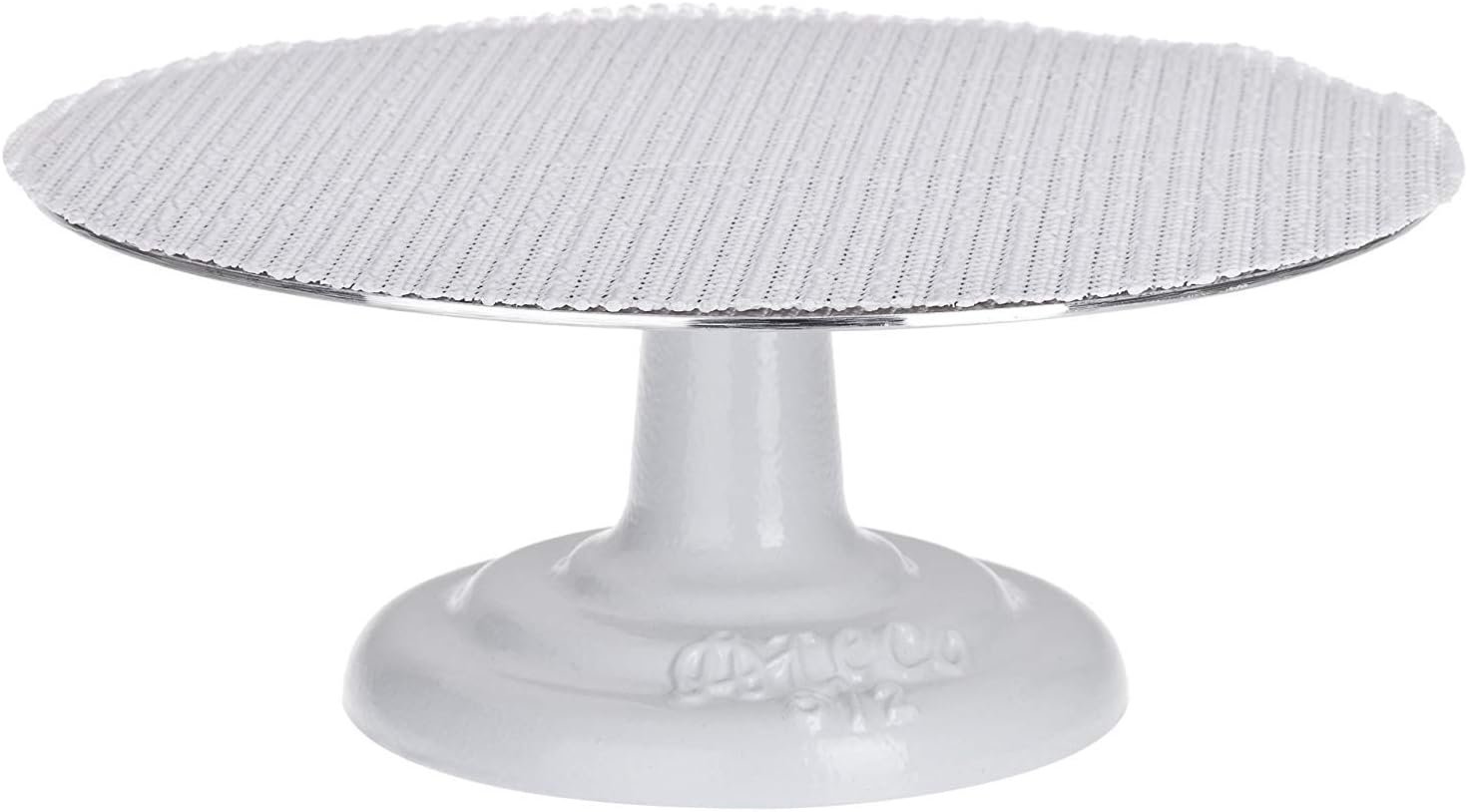 |
Ateco 12-Inch Cake Turntable | A 12-inch aluminium rotating platform with a sturdy cast-iron base and non-slip pad for a more stable cake decorating setup. | Check on Amazon |
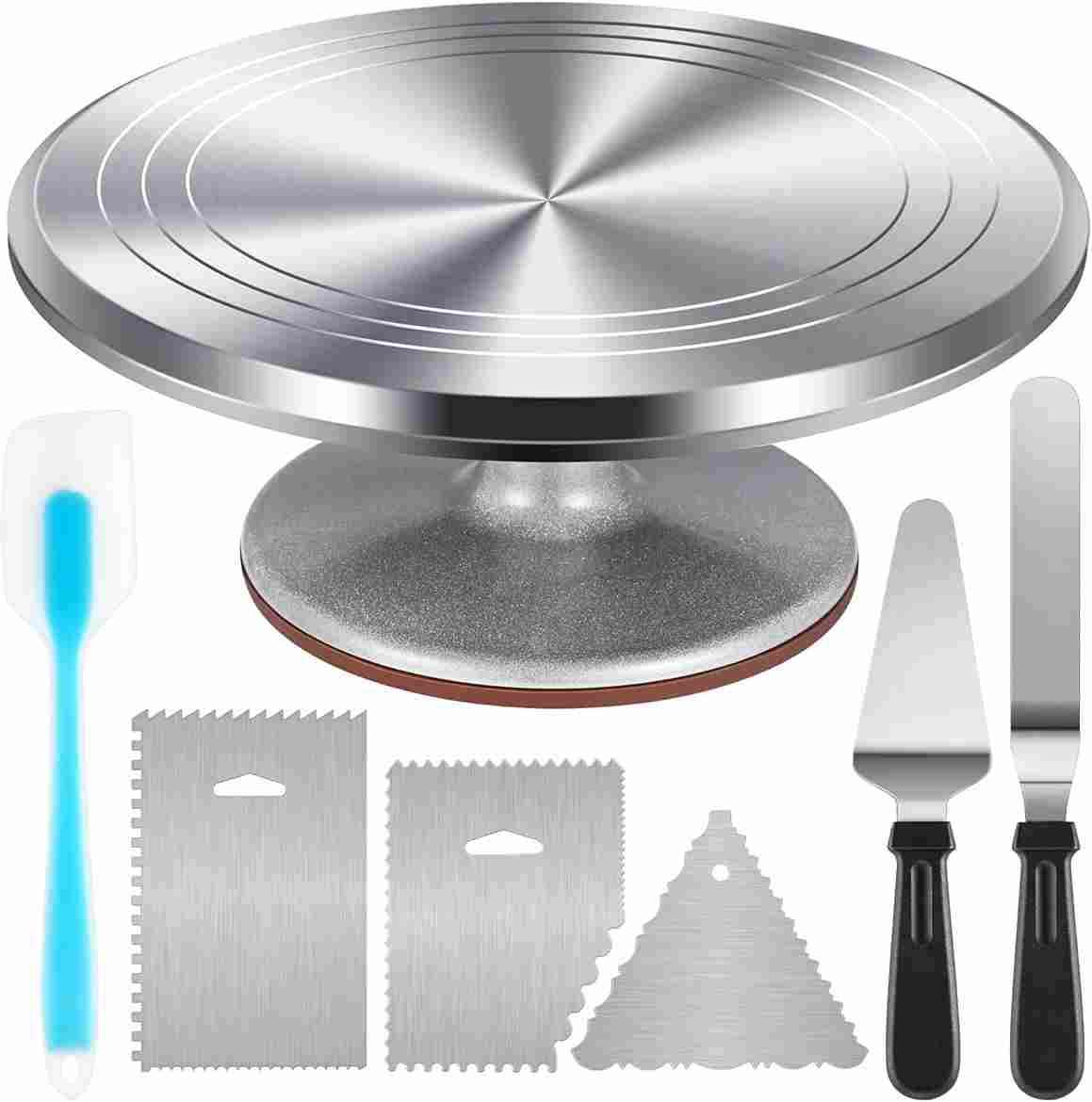 |
Kootek 12-Inch Cake Decorating Set | A sturdy 12-inch aluminium alloy rotating stand bundled with an offset spatula, silicone spatula, stainless steel decorating combs, and cake server for an all-in-one cake decorating setup. | Check on Amazon |
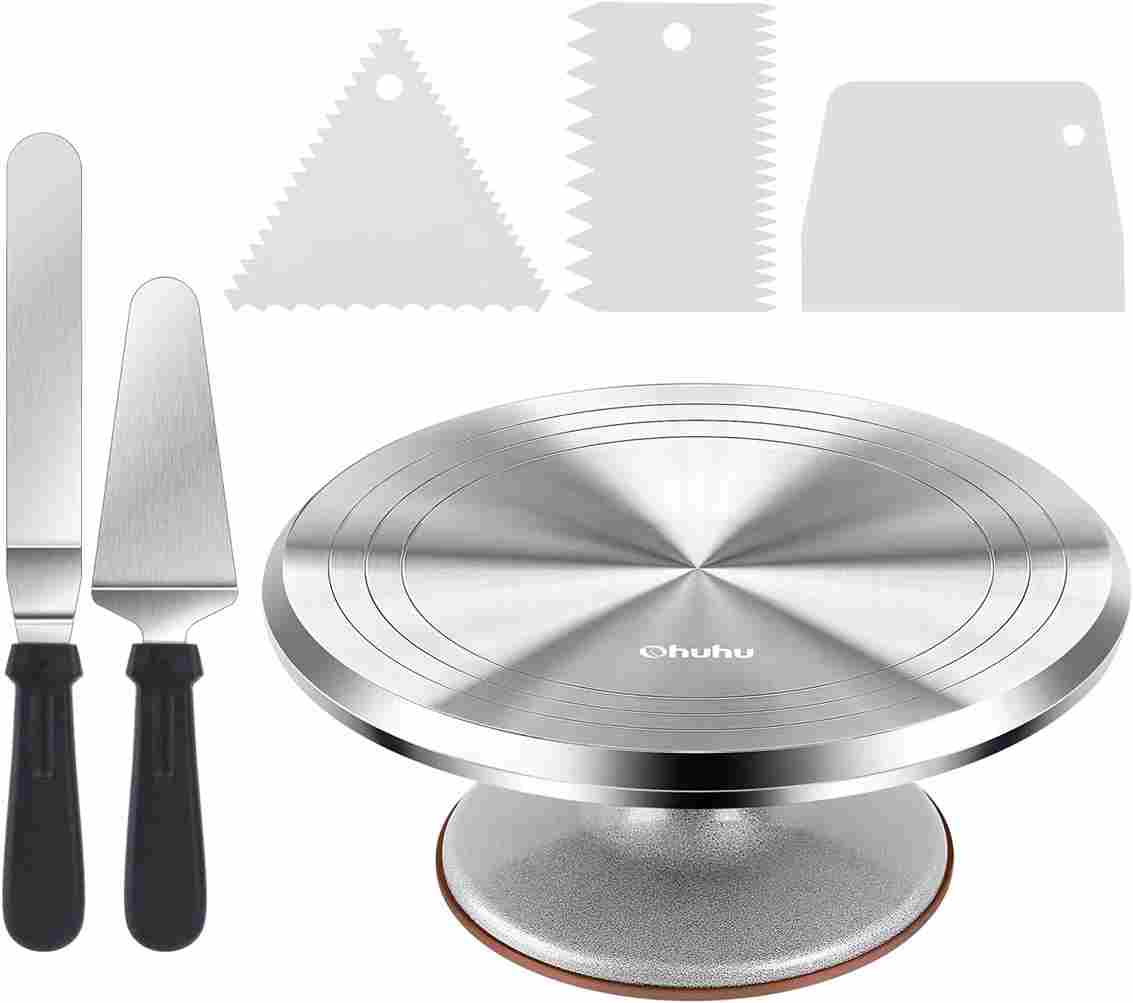 |
Ohuhu 12-Inch Aluminum Cake Turntable | A heavy-duty aluminum rotating stand with two-way bearing rotation, anti-slip support, and essential tools for smoothing and decorating cakes. | Check on Amazon |
Buying Guide — What Actually Matters
A cake turntable’s quality comes down to six things: how it spins, how well it grips your counter, whether the surface fits your cake size, how comfortable the height feels, how much load it can safely support and the material used to build it. Get any one of these wrong and you’ll feel it the first time you’re mid-frosting on a heavy cake.
Rotation Mechanism: Ball Bearing vs. Bushing
The spinning mechanism is the single biggest factor in how a turntable feels to use. A ball bearing cake turntable rides on small steel balls that distribute weight evenly, so the spin stays smooth even when you’re leaning on it with a bench scraper. A bushing or friction-based turntable relies on two flat surfaces rubbing against each other — fine for a light sponge cake, but under a heavier tiered cake, that friction builds up, and the spin starts to catch or grind. Buy for the cakes you’ll actually make: if tiered or fondant cakes are in your future, bearings are worth paying for.
Base Grip: Rubber Ring, Suction Feet, or Weighted Base
A turntable can spin perfectly and still be frustrating if the whole thing slides while you work. Three grip styles handle this differently: a rubber ring grips best on smooth surfaces like laminate or quartz, suction-cup feet work well on flat, non-textured counters but lose their hold on rougher stone, and a weighted metal base (like cast iron) solves the problem by being too heavy to move in the first place. Match the grip style to your actual countertop, not just the spec sheet — a suction base that works beautifully on granite can slide right off a textured tile counter.
Surface Diameter: Matching Your Cake Size
An undersized turntable creates a real, common problem: your cake board overhangs the edge, and every push of the spatula tips it slightly off-balance. As a working rule, an 8″–10″ cake pan needs a 10″–12″ turntable — the extra few inches around the edge give your cake board full support and leave room for your hand and scraper to move without hitting the rim.
Height and Piping Angle
Turntable height changes your wrist angle, not just your view of the cake. A shorter stand (around 3″–4″) forces your wrist to bend downward for side-icing, which tires your hand faster over a long decorating session. A taller stand (5″ or more) brings the cake closer to eye level and keeps your wrist straighter, which matters most when you’re piping fine detail work for more than a few minutes at a time.
Weight Capacity
Weight capacity only becomes a real concern once you’re stacking tiers. A single 8″ layer cake rarely stresses any turntable. A three-tier fondant cake is a different story — it can easily weigh 15–20 lbs, and a turntable rated for less will develop wobble under that load, right when you need the most stability for smoothing the sides.
Material: Plastic vs. Aluminum vs. Melamine
Plastic is light and affordable but flexes slightly under heavier cakes and shows wear faster. Aluminum stays sturdy under heavier loads, is less likely to dent, and works well for bakers who decorate cakes frequently. Melamine sits in between — a smooth, hard surface that resists staining, though some reviewers report it’s more prone to cracking under a hard drop than aluminum; this seems to vary by product, so it’s worth checking individual reviews rather than treating it as a fixed rule. Follow the manufacturer’s cleaning instructions too, since dishwasher-safety varies even among melamine models.
For most home bakers, prioritize smooth rotation, a base that won’t slide, and a platform that comfortably supports your cake board. If you regularly decorate tall or multi-tier cakes, move weight capacity and grip stability to the top of your list. The best turntable is the one that lets your hands stay steady and your cake move smoothly — without you fighting the equipment to get there.
Our Top Picks
1. Ateco 12-Inch Cast-Iron Cake Decorating Turntable
A turntable that shifts while you’re smoothing buttercream can quickly turn a clean finish into a frustrating mess. This Ateco cake decorating stand tackles that problem with a sturdy cast-iron base, a 12-inch aluminum rotating surface, and an included non-slip pad to help keep the setup steady while you work. The larger platform gives you useful room for decorating with an icing spatula or scraper, although the hand-wash-only design means cleanup takes a little more effort.
| Spec | Detail |
|---|---|
| Material | Cast iron base, aluminum top |
| Finish | Powder-coated |
| Diameter | 12 inches |
| Height | 5 inches |
| Weight capacity | Up to 200 lbs |
| Base grip | Non-slip pad included |
| Cleaning | Hand wash only |
| Color | White |
Key Features
- Sturdy cast-iron base: Provides a solid foundation for everyday cake decorating and helps reduce unwanted movement while you work.
- 12-inch aluminium rotating surface: Gives you a generous platform for working on cakes while rotating them as you frost, smooth, or decorate.
- Non-slip pad included: Adds extra grip between the stand and countertop to help keep the decorating setup in place.
- 5-inch overall height: Raises the cake off the counter, giving you a more comfortable working position when icing the sides.
- Revolving design: Lets you rotate the cake while keeping your icing spatula or scraper in position, making it easier to work around the cake evenly.
- Traditional, durable construction: The cast-iron base makes this a more substantial option than lightweight plastic cake turntables, though it also means the stand is less convenient to move and store.
Pros
- Sturdy cast-iron base provides a stable decorating platform
- 12-inch surface gives you useful working space around the cake
- Rotating design helps when smoothing buttercream and applying icing
- Includes a non-slip pad for additional countertop grip
- 5-inch height can make side decorating more comfortable
Cons
- Doesn’t lock in place, so it keeps spinning if you bump it mid-detail-work
- The included non-slip pad is thin, closer to basic shelf liner than a grippy mat
- Heavier to move around than plastic turntables — not ideal if counter space or storage is tight
Best For
Best for home bakers and regular cake decorators who want a substantial, full-size rotating stand for frosting, smoothing buttercream, and finishing cakes with an icing spatula or scraper. Its sturdy cast-iron base makes it particularly appealing if you prefer a more planted decorating setup over a lightweight, easy-to-move turntable.
2. Kootek Aluminum Cake Decorating Kit with Turntable
Starting cake decorating from scratch usually means buying a turntable, spatula, and scraper separately — and guessing which ones actually work well together. This kit solves that by bundling an aluminum revolving cake stand with an offset spatula, three icing smoothers, and a cake server in one box. In real kitchen testing, the turntable held steady while frosting a two-layer cake, and the icing combs laid down clean texture patterns without needing any extra tools.
| Spec | Detail |
|---|---|
| Material | Aluminum alloy turntable, stainless steel accessories |
| Diameter | 12 inches |
| Total kit weight | 5.1 lbs |
| Included tools | 12.7″ offset spatula, 3 icing smoother combs, cake server |
| Base | Non-slip rubber feet |
| Color | Silver |
| Cleaning | Hand wash only, dry before storing |
Key Features
- Aluminum turntable with a non-slip base — steady enough to work as a real cake turntable for icing full layer cakes, not just light display use
- 12.7-inch offset spatula for spreading icing evenly across sides and tops
- Three stainless steel combs giving up to 12 different texture patterns
- Stainless steel cake server included, so serving is covered too
- One purchase handles turntable, spreading, texturing, and cutting — useful if you own nothing yet
Pros
- Real value for beginners — no separate shopping trip for tools
- Aluminum build feels sturdier than all-plastic starter kits
- Icing combs give genuine pattern variety without buying extras
Cons
- The spatula and combs are starter-grade — a serious hobbyist will likely upgrade them before the turntable itself wears out
- Not dishwasher safe; everything needs hand washing and full drying to keep the steel pieces from rusting
- If you already own spatulas or scrapers, you’re paying for tools you don’t need
Best for
First-time cake decorators who want a complete turntable for cake decorating without buying pieces separately — if you already have your own spatulas and scrapers, the standalone Kootek turntable is the smarter buy.
3. Ohuhu Aluminum Cake Turntable Kit
Cheap plastic turntables tend to squeak and drag halfway through frosting a cake, right when you need the smoothest control. This aluminum stand fixes that with a sealed steel bearing that spins both directions without noise or friction. In real kitchen testing, it held steady while piping borders on a two-layer cake, and the anti-slip base kept it from creeping across the counter — a solid pick among cake decorating turntables for anyone tired of a stand that fights back.
| Spec | Detail |
|---|---|
| Material | Aluminum, polished finish |
| Diameter | 12 inches (13.31″ with base) |
| Height | 4.8 inches |
| Weight | 5.5 lbs |
| Rotation | Two-way, stainless steel bearing |
| Base | 7.3″ anti-slip rubber pad |
| Included tools | 2 icing spatulas, 3 decorating combs, 1 cake server |
| Cleaning | Hand wash, dish soap and warm water |
Key Features
- Stainless steel bearing gives a smooth, silent spin in both directions
- 7.3-inch rubber base keeps the whole stand from sliding mid-decoration
- Comes with 2 spatulas, 3 texture combs, and a cake server — everything needed to start decorating
- Polished aluminum surface wipes clean in seconds, no scrubbing required
- Round, one-piece design that’s simple to store between uses
Pros
- Genuinely quiet, smooth rotation — no grinding or sticking under normal use
- Rubber base holds firm on standard kitchen counters
- Good accessory bundle for someone building a decorating kit from nothing
Cons
- One-piece build means the whole stand has to be washed as a unit, not disassembled for deeper cleaning
- At 5.5 lbs it’s heavier to store than plastic turntables, though lighter than cast iron options
- The bundled combs and spatulas are functional starter tools, not something a serious decorator will keep long-term
Best for
Home bakers who want a quiet, steady turntable plus basic decorating tools in one purchase — those who already own spatulas and combs may prefer a standalone turntable instead.
What is the purpose of a cake turntable?
A cake turntable’s purpose is to rotate the cake while your hands and tools stay still, so you can apply icing and decorations evenly all the way around without repositioning yourself or the cake. Instead of walking around the table or twisting your wrist to reach each side, you spin the platform and keep your spatula, scraper, or piping bag steady in one spot.
Keeps Your Tool Steady While You Frost
Frosting a stationary cake means your pressure and angle shift slightly every time you move to a new side — and that inconsistency is exactly what causes visible seams, uneven layers, or a lopsided crumb coat. A turntable removes that variable. Your scraper holds one consistent angle and pressure the whole way around, and the cake does the moving instead. The same principle applies to smoothing buttercream: a steady scraper against a rotating cake produces a flatter, cleaner side than a moving scraper against a fixed one ever will.
Creates Even, Consistent Decorations
Piping a clean border, adding rosettes, or running a comb pattern around the cake all depend on steady, continuous motion. Trying to do that by walking around a fixed cake makes it nearly impossible to keep the line unbroken or the spacing even — your hand has to stop and restart every time you shift position. A turntable lets you complete the motion in one smooth pass, which is why patterns come out more consistent from one section to the next.
Reduces Unnecessary Handling
Every time you pick up or reposition a freshly frosted cake, you risk disturbing the icing — a fingerprint here, a small dent there. A rotating platform removes that need entirely. This matters most with soft, freshly applied frosting or multi-layer cakes, where even light handling can leave a mark that’s difficult to smooth back out.
Makes Long Decorating Sessions More Comfortable
Raising the cake to a comfortable working height reduces the back and wrist strain that comes from bending over a cake sitting flat on the counter — a difference you notice most during longer decorating sessions, not a quick five-minute frosting job. Bringing each section of the cake toward you by rotating it, instead of leaning across the counter to reach the far side, keeps your posture and wrist angle consistent throughout.
Is a Cake Turntable Necessary?
No — you can decorate a simple, single-layer cake without one. But once you’re regularly smoothing buttercream, piping borders, or working on tiered cakes, a dedicated turntable stops being a convenience and starts being the tool that determines how clean your finish actually looks. A lazy susan can fill in for occasional basic decorating, but it isn’t built with the same height, stability, or rotation control a dedicated cake turntable offers.
A cake turntable is a control tool, not a display stand. It turns “carefully working around a cake” into “the cake works for you” — and the more often you decorate, the more that difference shows up in the finish.
Common Mistakes & Troubleshooting
Most cake turntable problems come down to stability, friction, or the wrong type of rotating mechanism. Before replacing your stand, check whether the wobble is coming from the base, the rotation system, or the way the cake is positioned. A few simple adjustments can often make decorating smoother and more controlled.
Why Does a Cake Turntable Wobble on a Flat Counter?
If your countertop is level but the turntable still rocks or wobbles, the issue may be wear or looseness in the rotating mechanism rather than an uneven counter. On some lower-cost designs, the bushing or friction surfaces can wear over time, allowing the platform to move slightly from side to side.
Remove the cake, then slowly spin the empty turntable. If you can feel sideways movement or the platform visibly shifts, inspect the rotating mechanism and check for dried frosting or debris. Also make sure the non-slip pad or rubber feet are sitting evenly.
A useful test is to place a cake board on the empty turntable and gently press around its edges. If the platform tilts or rocks without a cake on it, the stand itself is likely the issue. If the turntable is stable when empty but wobbles only after adding the cake, check that the cake board is centred and sitting flat.
Quick fix: Clean the rotating area, reposition the non-slip pad, and make sure the cake board is centred. If the mechanism itself has developed noticeable side-to-side play, replacing the turntable is usually more practical than trying to compensate for it while decorating.
Why Does Buttercream Catch or Stop Mid-Spin?
When buttercream seems to “catch” as you rotate the cake, the problem isn’t always the turntable. It can also be caused by too much pressure from the scraper, an uneven cake surface, or a mismatch between the frosting and the decorating tool.
If the scraper is pressed too firmly against a thick layer of buttercream, it can create enough resistance to interrupt a smooth rotation. Try reducing the pressure and letting the scraper remove only a thin layer at a time. You can also check whether the cake board is rubbing against the turntable’s edge.
The turntable itself can also contribute. A rough or inconsistent bearing may become more noticeable when a heavy cake is placed on it, while a lightweight stand may struggle to maintain smooth movement under pressure.
Quick fix: Centre the cake, reduce scraper pressure, and rotate at a slow, steady pace. If the movement remains jerky with an empty platform, the rotation mechanism may be the real problem.
Bearing vs. Bushing: What’s the Difference?
The main difference is how the rotating parts move against each other.
| Feature | Ball Bearing | Bushing / Friction |
|---|---|---|
| Rotation feel | Typically smoother and more consistent | Often simpler and may feel more resistant |
| Under heavier loads | Usually better suited to controlled rotation | Performance varies by design |
| Maintenance | Usually enclosed and low-maintenance | Can be more sensitive to wear or debris |
| Best suited for | Frequent decorating and heavier cakes | Occasional home decorating |
| Main advantage | Smooth, controlled movement | Simple construction and often lower cost |
A ball-bearing turntable is generally the better choice if you regularly decorate heavier cakes or need precise, consistent rotation while smoothing buttercream. A bushing or friction-based design can still be perfectly adequate for occasional decorating, especially with lighter cakes.
The important point is not to assume that the mechanism alone determines quality. The quality of the construction, load, alignment, and overall stability also affect how a turntable performs.
Can a Lazy Susan Replace a Cake Turntable?
Sometimes, but not always. A lazy Susan can work as a temporary substitute for simple cake decorating, particularly if you already have one in your kitchen. Its rotating platform can help you turn the cake while keeping your decorating tool relatively steady.
The problem is that many lazy Susans are designed for organising food, spices, or serving dishes rather than supporting a cake while you apply pressure with a scraper. They may have a smaller platform, less secure grip, or rotation that isn’t smooth enough for detailed frosting work.
For example, if you’re simply spreading icing on a small cake, a stable lazy Susan may do the job. But when you’re trying to create straight, smooth buttercream sides, working on a tall cake, or applying firm pressure with a scraper, a dedicated cake turntable is usually the better tool.
A lazy Susan is a reasonable occasional workaround, but a dedicated cake turntable is worth having if you decorate cakes regularly. Its design is specifically intended to give you the combination of stable support, usable surface area, and controlled rotation that cake decorating requires.
How to Use a Cake Turntable for Smoother Frosting
Getting a smooth, professional-looking finish comes down to keeping your scraper steady while the turntable does the moving — not the other way around. Follow these steps in order, and most of the sliding, smearing, or uneven-side problems people blame on their frosting actually disappear.
1. Secure the Cake Board
Place a small dab of frosting or a non-slip mat under your cake board before setting it on the turntable, then press down to seat it firmly. A board that shifts even slightly while you’re applying pressure with a scraper will throw off your whole finish — securing it first means every later step happens on a fixed, stable surface instead of one you’re fighting.
2. Center the Cake
Line the cake up with the turntable’s center, not just the middle of the platform by eye. An off-center cake spins with a slight wobble at the edges, which makes your scraper hit at a different depth on each pass — that’s what creates thin spots and gouges on one side of an otherwise even coat. Worth knowing: a turntable smooths frosting, but it can’t fix a crooked cake underneath it — make sure your layers are stacked evenly before you start.
3. Apply a Crumb Coat
Spread a thin layer of frosting over the whole cake, just enough to lock in loose crumbs, and rotate the turntable slowly as you go rather than moving your spatula around a fixed cake. This thin first layer acts as a seal, so your final coat glides on clean instead of dragging crumbs through the frosting.
4. Chill the Cake
Refrigerate the crumb-coated cake for 15–20 minutes until the surface firms up to the touch. A soft crumb coat will grab and tear under your final layer no matter how careful you are with the scraper — chilling it first gives you a firm base that the next layer can actually smooth against.
5. Add the Final Frosting Layer
Turn the cake slowly with one hand while applying frosting with an offset spatula in the other, working in sections rather than trying to cover the whole cake in one continuous motion. Keeping the turntable moving at a steady, slow pace lets you build an even layer without leaving ridges where you started and stopped.
6. Smooth the Sides
Hold your bench scraper at a slight angle — close to vertical, tilted just a few degrees — and keep it still while spinning the turntable at a slow, steady speed. Speed matters here: too fast, and the scraper skips and leaves streaks; too slow, and it drags and pulls the frosting. A slow, even rotation with light, consistent pressure is what produces a flat, seamless side.
7. Finish the Top Edge
With the scraper still held level, pull any excess frosting from the edge inward toward the center of the cake as you make one final slow rotation. Pulling inward rather than pushing outward keeps the top edge sharp and prevents the buildup of a ragged lip around the rim — the small detail that separates a clean edge from a messy one.
8. Fix Small Imperfections
Stop the turntable and check the cake from a few different angles rather than eye-balling it from one spot. If you spot a thin patch or a shallow groove, add a small amount of fresh frosting to just that area and smooth it with one slow rotation — that’s a more reliable fix than re-scraping the whole cake again, which tends to remove more frosting than it adds.
Common Mistakes to Avoid
- Spinning too fast — makes the scraper skip and streak instead of gliding
- Pressing too hard — pulls frosting away instead of smoothing it, and can drag the turntable off pace
- Skipping the center check — an off-center cake wobbles at the edges no matter how careful your scraper technique is
- Using a slippery, unsecured board — undoes a steady scraper angle the moment it shifts
- Trying to perfect it in one pass — several light passes beat one aggressive scrape every time
Quick recap: center the cake, chill between coats, keep your tool still and let the turntable move, and match your rotation speed to how firm the frosting is. Get those right, and smooth sides stop being a matter of luck.
Cake Turntable Size Guide
Your turntable should be at least 2–4 inches wider than your cake board, not just your cake pan — that extra margin is what gives your hands and scraper room to work without catching the rim. Get the size wrong in either direction and you’ll either fight a cramped platform or wrestle an oversized one that’s awkward to store.
| Cake Size (Pan Diameter) | Recommended Turntable Size |
|---|---|
| 4″–6″ (mini cakes, cupcakes) | 10″–11″ (compact) |
| 6″–8″ | 10″–12″ |
| 8″–10″ | 12″–14″ |
| 10″+ or multi-tier | 14″+, heavy-duty base |
Platform Diameter Isn’t the Same as Usable Space
This is the part most sizing charts skip: a turntable’s listed diameter includes the space your cake board takes up, not just the room left over for your hands and tools. A 12″ turntable holding a 10″ cake board only leaves about an inch of clearance on each side — workable, but tight for a bench scraper angled against the edge. If you regularly pipe borders or use wider decorating tools, sizing up a couple of inches beyond the minimum gives you room to actually move, not just room for the cake to sit.
Match the Board, Not Just the Cake
Don’t size your turntable off the cake pan alone — size it off the cake board, since that’s what actually sits on the platform. Most cake boards run 2″–4″ larger than the cake itself, so an 8″ cake usually sits on a 10″–12″ board. Skip that step and you can end up with a turntable that looks correctly sized on paper but leaves the board hanging over the edge in practice — which is exactly what causes tipping and uneven pressure while you decorate.
Size up from your cake board, not your cake pan, and leave a couple of extra inches for your hands and tools rather than cutting it close. When in doubt between two sizes, the larger turntable is almost always the safer, more comfortable choice — a platform with room to spare costs you nothing, while one that’s too small costs you control every time you decorate.
Faqs
Are cake turntables worth it?
Yes, especially if you decorate cakes regularly. A cake turntable makes it easier to smooth buttercream, pipe borders, and create even finishes because you can rotate the cake while keeping your decorating tool steady. For occasional simple cakes, you can decorate without one, but a turntable can still make the process quicker and more comfortable.
What is a cake turntable used for?
A cake turntable used to rotate the cake smoothly while you decorate it. It helps with frosting the sides, smoothing buttercream, applying icing with a spatula or scraper, and piping consistent borders and patterns. The main advantage is that you move the cake instead of constantly moving yourself around it.
Do you really need a cake turntable to decorate a cake?
No, you can decorate a cake without one. However, a turntable is particularly helpful for achieving smooth sides and even decorations. If you regularly make layer cakes or detailed designs, it can give you better control and reduce the need to reposition the cake by hand.
What’s the difference between a ball bearing and a bushing turntable?
A ball-bearing turntable uses bearings to support the rotating platform and generally provides smoother, more consistent movement, particularly under heavier loads. A bushing-style turntable uses a simpler rotating support system and may be suitable for occasional decorating. The quality of the overall construction matters too, so the mechanism alone doesn’t determine how well a turntable performs.
Is a heavier or lighter turntable better for beginners?
For most beginners, a moderately heavy and stable turntable is the better choice. A lightweight model is easier to move and store but may slide when you apply pressure with a scraper. A heavier base tends to stay in place more securely, although it can be less convenient to carry. Look for a balance between stability and portability rather than simply choosing the heaviest model.
Can you use a cake turntable on a textured or uneven countertop?
You can, but it may not provide enough stability. Rubber feet or a non-slip base can help on mildly textured surfaces, while suction-style grips usually work best on smooth, non-porous counters. On a significantly uneven surface, the turntable may wobble regardless of its grip. In that case, place it on a stable, level surface before decorating.
Conclusion
Choose the Ateco 12-inch turntable if you want maximum stability for serious cake decorating and prefer a heavy-duty stand with a cast-iron base that stays firmly planted while smoothing buttercream.
Choose the Kootek 12-inch cake decorating kit if you need an all-in-one option with the essential decorating tools included, making it a practical choice for beginners who want to start decorating without buying each tool separately.
Choose the Ohuhu 12-inch turntable if you’re looking for a smooth, two-way rotating stand with a durable aluminium build and useful decorating accessories, especially if easy rotation and flexibility matter to you.
Affiliate disclosure
Some of the products featured here may lead to a small commission for HomePlora if you decide to buy through our links. This comes at no additional cost to you and helps support the work we put into researching and reviewing kitchen tools.

Hi, I’m Muhammad Din. I test and compare kitchen tools in my own kitchen before I ever recommend them — if it’s in a guide on HomePlora, I’ve used it or dug deep enough to know exactly where it holds up and where it doesn’t. My goal is simple: help you find tools that actually earn a spot in your kitchen, without wasting money on ones that don’t.