

Introduction
Half the steamer baskets sitting unused in kitchen drawers aren’t broken — they just never fit the pot they were bought for. A basket that’s too small wobbles and tips when it’s loaded, one that’s too shallow lets food sit half in the water instead of above it, and a mismatched fit is the single biggest reason steamed vegetables turn out soggy instead of crisp. After testing several options across different pots in my own kitchen, the best steamer basket for kitchen use almost always comes down to fit and foot height before it comes down to material — get those two right, and everything else is a smaller trade-off. Below are the picks that actually solved that problem, tested feature by feature.
Best Steamer Baskets at a Glance
Your pick depends mainly on what you’re cooking and what pot you already own — here’s the fast breakdown:
| Category | Pick | Why It Wins |
|---|---|---|
| Best Overall | OXO Elevated-Foot Steamer Basket | 1¾” feet plus a locking handle that clears the lid — fits pots 8″ and up, including pressure cookers |
| Best Silicone | OXO Flex-Wall Silicone Steamer | Pleated walls flex to fit 7″+ pots, with a flat base built for fish and other bulky cuts |
| Best Bamboo | Bamboo Dumpling Steamer | 3.5″ tiers plus a steel ring adapter fit 8–12″ pots and woks without flattening bao buns |
| Best for Instant Pot | KitchenAid Universal Steamer Basket | Soft-touch feet and a retractable handle work across pots, pressure cookers, and multicookers without scratching the finish |
Note: the KitchenAid is a fixed 10″ size with no expandable range — measure your specific Instant Pot’s inner-pot diameter before buying, since it won’t flex down the way the OXO picks do.
What Is a Steamer Basket and do you need it?
A steamer basket is a perforated basket or insert that sits above boiling water inside a pot, letting rising steam do the cooking instead of the water itself. You need one if you regularly cook vegetables, seafood, or dumplings and want them to keep their color, bite, and nutrients rather than turning soft and washed-out the way boiling can leave them.
How It Actually Works
The basket’s holes let steam pass through and surround the food from every side, while its raised base — feet, a center post, or folded petals — keeps the food itself out of the water. That’s the real difference from boiling: the food cooks in vapor, not liquid, so flavor and nutrients stay in the food instead of leaching out into the water.
Steamer Basket vs. Colander
The two look similar, and that trips a lot of people up. A colander drains liquid off food after it’s already cooked. A steamer basket does the opposite job — it holds food above liquid so steam can cook it in the first place. One works after cooking; the other works during it.
Do You Need One?
- Yes, if: you boil vegetables often and notice they turn mushy or lose color, you cook dumplings or dim sum at home, or you steam fish and don’t want it falling apart in a wire rack.
- Maybe not, if: you rarely cook vegetables from raw, or your microwave already handles the steaming you need.
- Worth knowing: even multicookers with a built-in steam setting often steam better with a proper basket inside, since it keeps food from sitting flat against the metal insert.
If you’ve decided one earns a spot in your kitchen, here’s what actually separates a good steamer basket from one that ends up in the back of a drawer.
Comparison
| Image | Product | Details | Price |
|---|---|---|---|
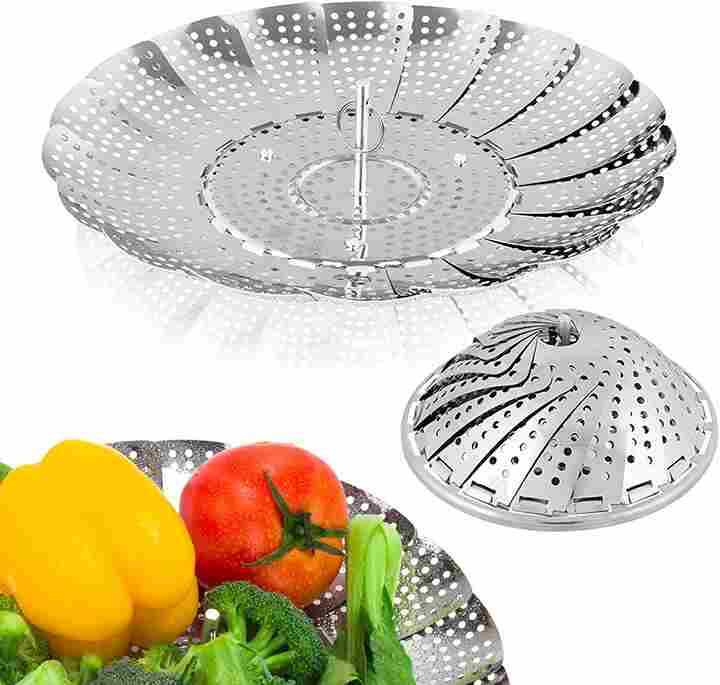 |
SAYFINE Petal Steamer Basket | Folds flat, expands to fit almost any pot, and doubles as a rinse basket for produce. | Check on Amazon |
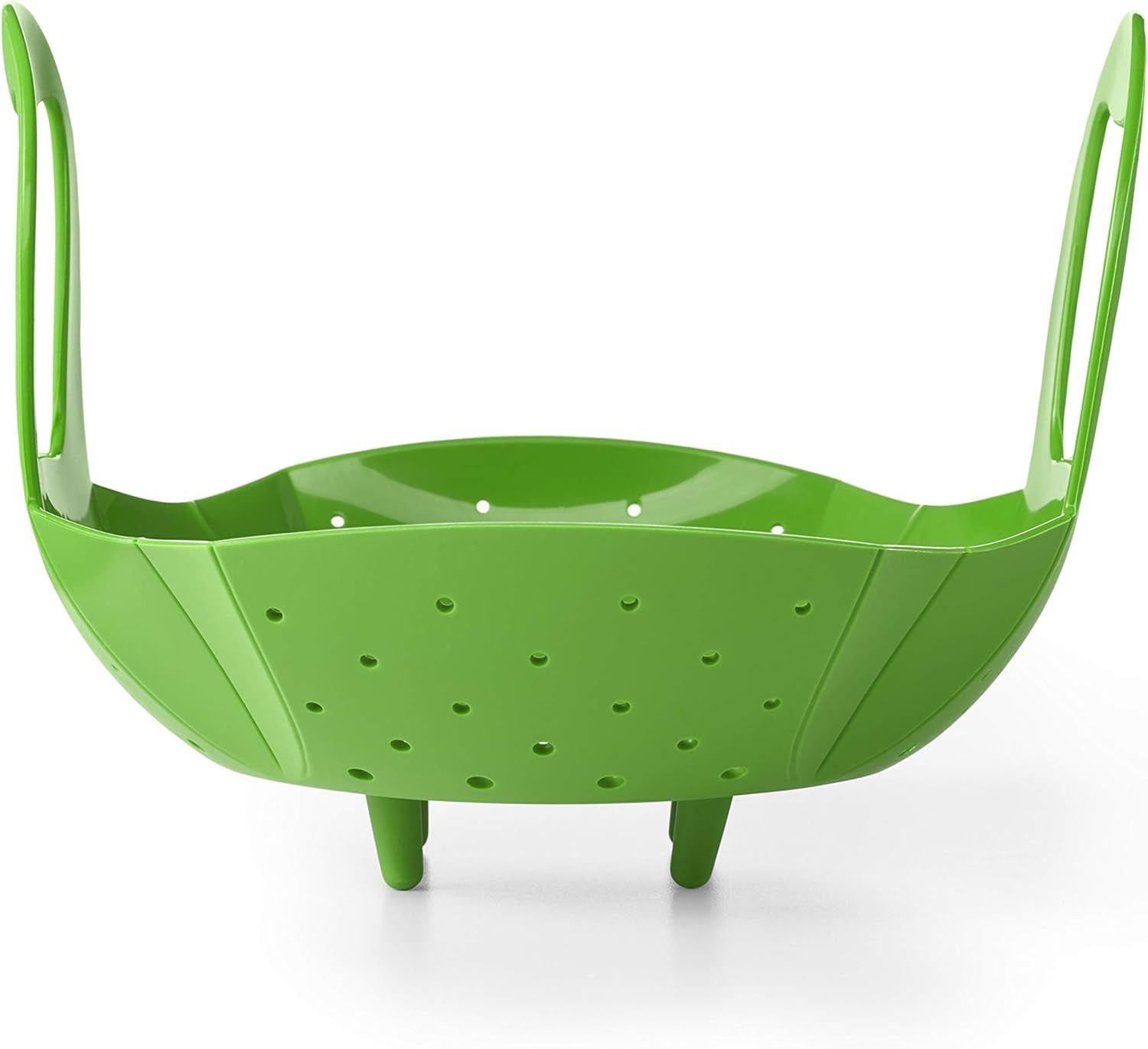 |
OXO Flex-Wall Silicone Steamer | Flexible sides fit larger pots, keep food elevated above the water, and fold down neatly for compact storage. | Check on Amazon |
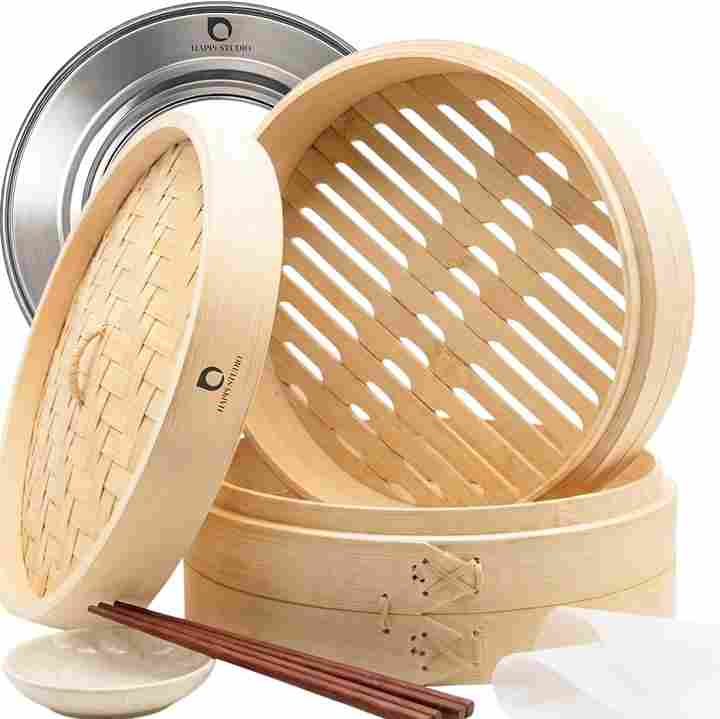 |
Bamboo Dumpling Steamer | Deep stacking tiers, an 8–12 inch pot and wok adapter, and classic bamboo construction for better-steamed dim sum. | Check on Amazon |
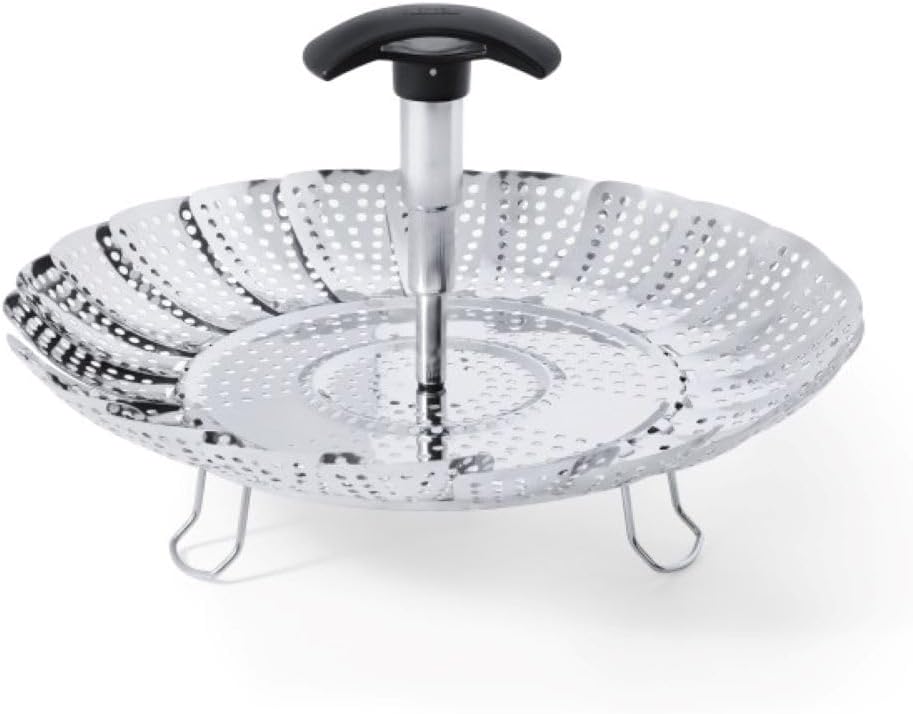 |
OXO Elevated-Foot Steamer Basket | Raised feet keep food off the water, and a locking handle makes it easy to lift straight out. | Check on Amazon |
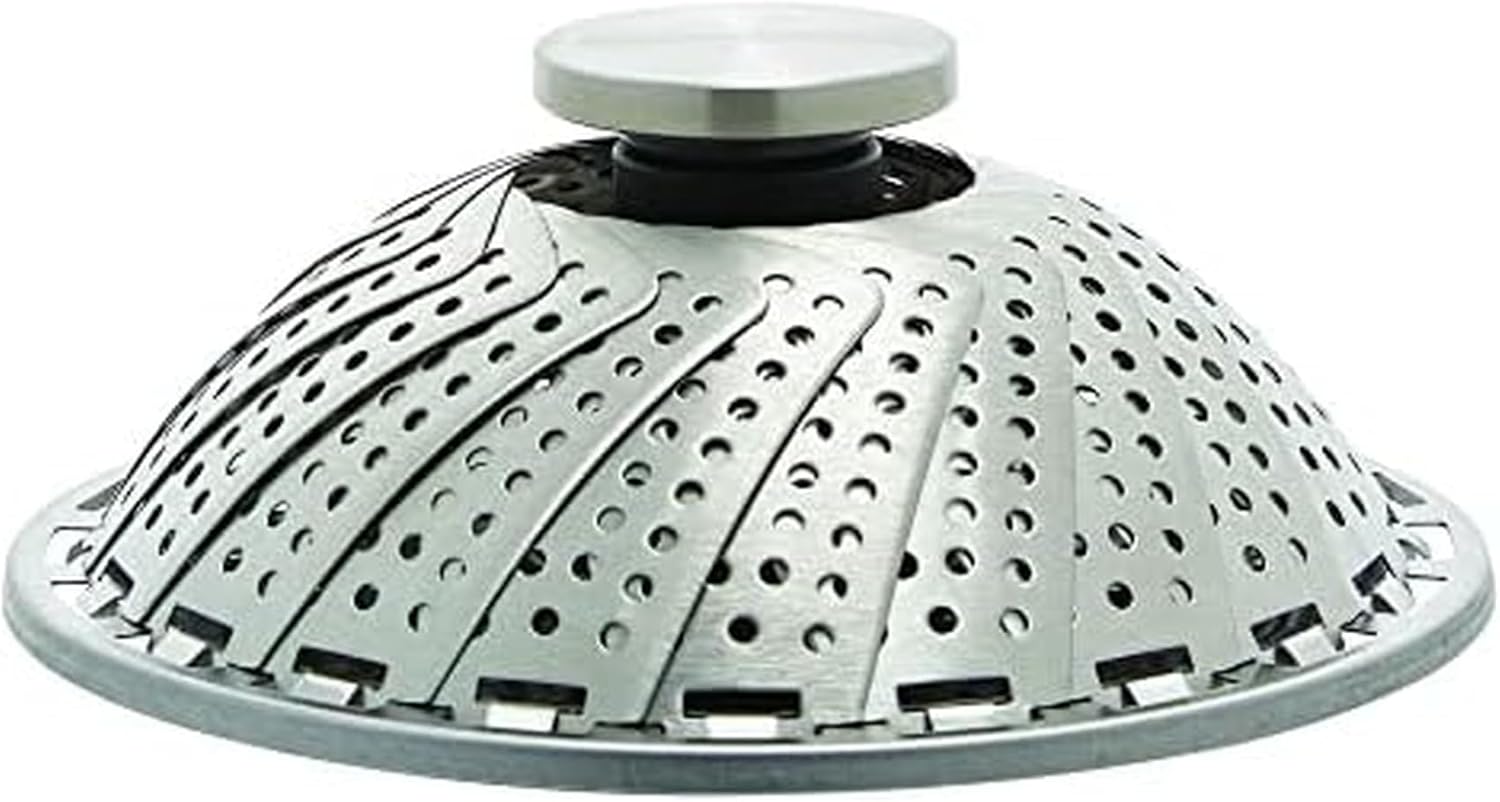 |
KitchenAid Universal Steamer Basket | Soft-touch feet protect your cookware while lifting food above the water, with a handle that adjusts for lifting or steaming under a lid. | Check on Amazon |
How to Choose the Right Steamer Basket for Your Pot
The right steamer basket is simply the one that actually matches your pot — not the one with the most features listed on the box. Measure your pot’s inside diameter first, then match that against the basket’s size (or its expanded size, if it folds), since a basket even slightly too big won’t sit flat, and one too small will tip sideways into the water.
Measure the Pot Before the Basket
Most pots narrow slightly as they curve down toward the base, so measure the inside mouth at its narrowest point, not the outer rim. That’s the number that actually matters — a basket rated “8 inches and up” needs your pot’s inside width to clear that mark, not just the outside.
Check How Much the Feet (or Post) Actually Lift It
A basket only steams properly if its base sits above the waterline, not in it. Feet under about an inch can let the water level creep up and touch the food, or force you to top up water mid-steam as it evaporates. Taller feet, or a raised petal design, buy you more room before that becomes an issue.
Decide How You’ll Actually Lift It Out
- Center post: compact and simple, but usually bare metal — plan on a fork or tongs, not your fingers.
- Extending side handle: easiest for one-handed lifting, though it needs clearance at the pot’s rim to swing out.
- Folding stay-cool handles: comfortable to grab directly, and they usually lock flat so a lid still closes over the basket while it steams.
Match the Material to How You Actually Clean Up
Stainless steel holds its shape and handles the dishwasher well. Silicone flexes into odd-shaped pots and won’t scratch nonstick cookware, but softens faster under repeated high heat. Bamboo needs hand washing and full drying every time, but nothing beats it for keeping dumplings from turning soggy.
Tested picks
1. SAYFINE Petal-Fold Steamer Basket
Boiled vegetables often turn mushy and lose their color before they reach the table. A vegetable steamer basket fixes that by holding food above the water instead of in it, keeping texture and nutrients intact. The SAYFINE version also solves the usual “will it fit my pot” problem, with petals that expand from 5.5″ to 9.2″. I’ve used it in my own kitchen, and it sits steady in the pot once opened, without wobbling.
| Spec | Detail |
|---|---|
| Material | Stainless steel, polished finish |
| Shape | Round, folding petal design |
| Expanded size | 9.2″ diameter |
| Folded size | 5.55 x 5.71 x 2.83 in |
| Weight | 181 g |
| Center handle | 2.4″ removable post |
| Color | Silver |
Key Features
- Petals fold flat for storage and open into a full steaming surface with no extra parts to lose
- Expands from 5.5″ to 9.2″, so one basket fits most saucepans, stockpots, and pressure cookers instead of buying a size-matched insert
- As a stainless steel steamer basket, it holds its shape through regular stovetop use rather than warping like thinner metal versions
- Short center post lifts the whole basket out in one motion, so you’re not reaching into hot water with your fingers
- Doubles as a rinse basket for draining washed vegetables and fruit before they go in the pot
Pros
- Adjusts to fit whatever pot is already on the stove
- Folds down small enough to store flat in a drawer
- One-handed removal using the center post and a fork
- Doubles as a produce colander, not just a steamer
Cons
- The center post is bare metal and does get hot, so you’ll want a fork or tongs rather than grabbing it directly
- No raised feet of its own — the base sits directly on the pot bottom, so it works best with a shallow water level rather than a deep boil
- At the smallest fold, the steaming surface is limited, better suited to side portions than a full family-size batch
Best for
cooks who want one steamer basket that adjusts to whatever pot is already on the stove, rather than a fixed-size insert that only fits one pan.
2. OXO Flex-Wall Silicone Steamer
The SAYFINE petal basket we covered earlier works well for everyday vegetables, but its slotted, petal-shaped surface and lack of raised feet make it a poor match for something like a whole fish fillet — a delicate cut would sag through the folds or need a shallower water level than a bulkier piece really wants. The OXO silicone steamer takes a different approach: its pleated walls flex to fit pots 7 inches wide or larger, and a flat, solid base gives larger cuts full support instead of resting them across petals or a wire frame. I’ve used it for fish and dumplings in my own kitchen — the high sides keep food elevated above the boiling water without depending on the precise foot height a shorter basket needs to get right.
| Spec | Detail |
|---|---|
| Material | Silicone, non-stick finish |
| Shape | Round, flat bottom |
| Base diameter | 7 in (flexes wider via pleats) |
| Dimensions | 7.25 x 3.75 x 10.5 in |
| Weight | 8.32 oz |
| Lid | Stainless steel |
| Color | Green |
| Care | Dishwasher safe |
Key Features
- Pleated silicone walls flex outward to fit pots 7 inches across or wider, so it isn’t locked to one pot size
- High sides keep food contained away from the boiling water instead of sitting right at the waterline
- The stay-cool handles fold inward and lock securely, allowing the pot lid to close neatly over the basket
- Flat bottom gives fish fillets and other larger cuts a full surface to rest on
- Folds down neatly for storage, with the handles securing onto the feet to keep it compact
- Works in a pressure cooker as well as a regular pot
Pros
- Won’t scratch nonstick cookware the way a metal basket can
- Flexes to fit a range of pot sizes instead of one fixed diameter
- Flat, wide base suits fish and other pieces that don’t hold together well in a narrow basket
- Rolls up small for storage
Cons
- Silicone doesn’t hold its shape as firmly as a stainless basket, so a very full load can sag toward the center
- Being silicone, it conducts heat more slowly than metal, so steaming can take slightly longer at the same water level
- Needs a pot at least 7 inches wide — smaller saucepans won’t accommodate it
Best for
cooks steaming delicate items like fish or dumplings who want a steamer that won’t scratch nonstick pots.
3. HAPPI STUDIO Deep-Tier Bamboo Dumpling Steamer
Standard steamer baskets are often too shallow, so bao buns flatten before they finish cooking. This bamboo steamer basket fixes that with significantly deeper tiers than the usual bamboo design, so dumplings stay tall instead of squashed. A steel ring adapter locks it onto pots and woks from 8 to 12 inches, so wobbling isn’t an issue. I’ve used it in my own kitchen for dim sum nights, and the bamboo keeps everything tender rather than damp.
| Spec | Detail |
|---|---|
| Material | Bamboo (Moso), hand-woven |
| Shape | Round, stackable tiers |
| Diameter | 10 in (fits 8–12 in pots/woks via ring adapter) |
| Tier depth | 3.5 in per tier |
| Dimensions | 10 x 10 x 7.4 in |
| Weight | 1.42 kg |
| Includes | 2 tiers, lid, steel ring, 2 silicone liners, drip saucer, chopsticks |
| Care | Hand wash only |
Key Features
- Steel ring adapter locks the basket onto pots and woks from 8 to 12 inches, so it isn’t tied to one exact wok size
- Extra-deep 3.5-inch tiers give dumplings and bao buns room to rise instead of flattening against the lid
- Two stackable tiers let you steam vegetables and dumplings at the same time instead of running separate batches
- Silicone liners included, so food lifts off cleanly without sticking to the bamboo
- Works as an all-purpose food steamer basket for fish and sticky rice, not just dim sum
- Woven bamboo body lets steam vent naturally instead of trapping condensation the way a sealed lid does
Pros
- Ring adapter means one basket fits several pot and wok sizes
- Deep tiers stop bao buns and dumplings from flattening
- Two tiers cook more food in a single pass
- Bamboo pulls in excess moisture so food stays tender, not soggy
Cons
- Hand wash only — bamboo can warp or split if it goes through a dishwasher
- Needs to dry fully between uses, or it’s prone to mold like most bamboo cookware
- At 1.42 kg when fully assembled, it needs more storage room than a folding metal or silicone steamer basket
Best for
cooks making dumplings, bao buns, or dim sum at home who want a pot steamer basket that also adapts to whatever wok they already own.
4. OXO Elevated-Foot Steamer Basket with Locking Handle
Reaching into a boiling pot to grab a steamer basket is how burns happen. OXO built this steamer basket for pot use with a handle that extends for lifting, then locks back flat so a lid still fits on top while food steams. Its 1¾-inch feet also keep food properly elevated above the water instead of sitting in it. I’ve used it in my own kitchen, and the fork hole on the handle keeps hands well clear of the steam.
| Spec | Detail |
|---|---|
| Material | Stainless steel |
| Shape | Round, folding |
| Diameter | 8 in (fits pots 8″ and up) |
| Foot height | 1¾ in |
| Dimensions | 7 x 3 x 7 in |
| Weight | 14.4 oz |
| Care | Dishwasher safe (top rack recommended — handle is plastic) |
Key Features
- Handle extends to lift the basket out, then locks back flat so a pot lid still closes on top while steaming
- 1¾-inch feet raise the basket above the waterline, so food steams instead of half-boiling
- A fork hole built into the handle keeps hands away from rising steam when lifting it out
- Fits pots 8 inches in diameter and up, including multicookers and pressure cookers
- As a steamer basket with handle, it lifts out in one motion instead of tipping food to one side
- Folds flat once the handle and sides collapse, so it stores in a drawer instead of a cabinet
- Dishwasher safe for easy cleanup — top rack keeps the plastic handle from taking the brunt of the heat over time
Pros
- Tall feet keep food properly above the water rather than half-submerged
- Handle locks in two positions, useful for both lifting and steaming under a lid
- Fork hole means no bare-handed reaching into steam
- Fits a wide range of pot and multicooker sizes
- Dishwasher safe, so cleanup doesn’t require hand washing
Cons
- The handle has some built-in play when retracted — that’s intentional, for lid clearance, but it can feel less solid than a fixed handle at first
- The handle is plastic, so while the basket itself is dishwasher safe, top-rack placement helps it hold up better than repeated runs through the bottom rack’s higher heat
- At 8 inches across, it won’t drop into smaller saucepans under that size
Best for
Cooks who want a steamer basket for pot or pressure cooker use with a locking handle for easy one-handed lifting, rather than fishing it out with tongs.
5. KitchenAid Universal Steamer Basket
A steamer basket that scratches your good pots or slides around while cooking is more hassle than it’s worth. KitchenAid solves that with soft-touch feet that lift it off the pot bottom while protecting the finish underneath. It works across regular pots, pressure cookers, and multicookers, making it a solid pick if you’re after the best steamer basket for vegetables that won’t mark your cookware. I’ve used it in my own kitchen, and the feet keep it planted instead of sliding.
| Spec | Detail |
|---|---|
| Material | Stainless steel, polished finish |
| Shape | Round |
| Size | 10-inch |
| Folded dimensions | 6.4 x 6.4 x 2.8 in |
| Feet | Soft-touch, elevated |
| Handle | Adjustable, retractable |
| Care | Dishwasher safe; hand wash recommended |
Key Features
- Soft-touch feet raise the basket above the waterline while cushioning contact with the pot’s surface
- Handle extends for filling and carrying, then retracts so a lid still closes while steaming
- Works over boiling water in regular pots, pressure cookers, and multicookers
- Stainless steel body holds up to daily use without warping
- Dishwasher safe for quick cleanup, though hand washing keeps the polish looking newer for longer
Pros
- Soft-touch feet double as cookware protection, not just elevation
- Handle adjusts for both lifting and steaming under a lid
- Works across several types of pots and cookers
- Stainless build holds up well over time
Cons
- No stated expandable range, so it’s sized around 10-inch pots rather than flexing down to smaller ones
- Handle retracts with a bit of play, like most locking designs, so it won’t feel perfectly rigid
- Hand washing is recommended over the dishwasher to keep the polish looking new, which is an extra step
Best for
Cooks after the best steamer basket for vegetables that also protects the finish on good cookware, rather than a bare metal basket that can scratch it.
Types of Steamer Baskets
There are three main types of steamer baskets — stainless steel, silicone, and bamboo — and the real difference isn’t how well they steam, since all three work on the same basic principle. It’s how they fit your pot, hold up to repeated heat, and store away when you’re done. Picking the right type comes down to matching it to what you actually cook, not which one looks sturdiest on a shelf.
Stainless Steel (Expandable Petal Design)
This is the type most kitchens default to, and for good reason: petals fold outward to cover a range of pot sizes instead of locking you into one fixed diameter, and the metal holds its shape through years of stovetop use without warping. It’s also the easiest to keep spotless in a dishwasher. The trade-off is that bare metal conducts heat straight through, so the basket itself — and any exposed center post — gets genuinely hot. A fork or tongs, not fingers, is how you lift it out.
Silicone (Flexible Pleated Design)
Silicone steamers flex rather than fold, with pleated walls that stretch to fit pots the metal designs can’t, and high solid sides that keep food contained instead of poking through slots. Because it won’t scratch a nonstick pan, it’s the safer pick if your cookware has a coated finish. What it gives up is heat efficiency — silicone transfers heat more slowly than metal, so steaming runs a touch longer, and pushed to sustained high heat it can soften or pick up a faint odor over time.
Bamboo (Traditional Tiered Design)
Bamboo is less a modern kitchen gadget and more the original steamer, still favored in dim sum kitchens for one specific reason: the woven material breathes, letting excess steam escape instead of condensing back onto the food. That’s what keeps dumplings and bao buns tender instead of damp. The catch is upkeep — it’s hand wash only, needs to dry completely between uses to avoid mold, and takes up more drawer space than something that folds flat.
If you’re only buying one: stainless steel is the most forgiving all-around choice. Silicone and bamboo earn their place once you know exactly what you’re steaming most.
How to Use a Steamer Basket
To use a steamer basket perfectly, boil your water first, then load food into the basket in a single layer, lower it into the pot with the water sitting below the base, cover tightly, and drop the heat to a simmer once steam appears. That order — water boiling before the basket goes in, not after — is the one detail most people get backwards, and it’s the real reason some steamed vegetables come out perfectly crisp while others turn soft and waterlogged using the exact same basket.
Why the Order Matters More Than You’d Think
Start the basket in cold water that’s still heating up, and your food sits through a slow, gradual ramp instead of hitting steam right away. During that ramp, the pieces closest to the pot warm up faster than the ones above them, so by the time real steam finally builds, part of your batch is already overcooked and part is still raw. Boil the water first, and every piece hits full steam at the same moment — which is the entire reason restaurant kitchens never start a steamer cold.
The Right Way, Step by Step
1. Boil the water before the basket goes anywhere near the pot
Bring plain water to a full boil on its own first. Only once it’s actively boiling should the basket enter the picture — this is the step people skip, and it’s the one that matters most.
2. Keep the water level below the basket’s base
Once it’s boiling, check that the water line sits clearly under where the basket will rest. Water touching the basket floor turns steaming into part-boiling, which is exactly what a steamer basket exists to prevent.
3. Load your food in a single, evenly spaced layer
Piling food two or three deep blocks steam from reaching the pieces in the middle, so they finish later than the ones on top or around the edges. Give every piece its own space to let steam wrap around it from all sides.
4. Lower the basket in and cover with a tight-fitting lid
A loose or slightly-off lid lets steam escape as fast as it builds, which quietly stretches your cooking time without you noticing. If your lid has a small gap, that gap is where your “10-minute broccoli” turns into 15.
5. Drop to a simmer and start your timer once you see steam
A hard rolling boil can splash water up through the holes onto your food — a gentle simmer produces plenty of steam without that risk. Start counting your cook time from the moment steam is visibly escaping the lid, not from when you turned the burner on.
6. Keep the lid closed while the food is steaming
Every peek releases built-up steam and drops the pot’s internal temperature, which can add a minute or two back onto your total time — the same reason opening an oven door mid-bake sets you back. Trust your timer instead.
7. Refill with hot water, never cold, if you’re steaming for a long stretch
For anything that steams 30+ minutes — tamales, whole artichokes, a big batch of dumplings — check the water level partway through. Topping up with cold water stalls the simmer and pauses your steam, so keep a kettle of hot water nearby instead.
8. Test doneness at the right spot
Vegetables should give slightly to a fork without falling apart; fish should turn opaque and flake easily; dumplings are done when the wrapper turns translucent. Check the thickest piece rather than the thinnest, as it will usually take the longest to cook.
9. Lift the basket out carefully, and angle it away from your face
Steam carries far more stored heat than the boiling water underneath it, which is why a steam burn is often worse than a splash of hot water at the same temperature. Use the basket’s handle, a fork through the handle hole, or tongs — and tilt the lid and basket away from you as you lift, so the steam escapes away from you rather than hitting your hands or face.
10. Let food rest a few seconds before serving
Residual heat keeps cooking food for a short moment even after it’s off the steam — fish and eggs especially. Pulling things a touch before they look fully done, then letting them rest, often lands you closer to perfect than steaming until it looks finished.
Care & Maintenance
How you clean a steamer basket depends almost entirely on what it’s made of — stainless steel, silicone, and bamboo each fail in a different way if you treat them the same, and knowing which failure to avoid is what actually keeps a basket lasting for years instead of months. The short version: dry steel immediately, keep silicone away from repeated high heat when you can, and never let bamboo sit wet.
| Material | Wash Method | Key Rule | What Happens If You Ignore It |
|---|---|---|---|
| Stainless Steel | Dishwasher or hand wash | Dry immediately | Cloudy mineral spots from hard water |
| Silicone | Dishwasher safe | Avoid prolonged high heat | Trapped odors from strong foods |
| Bamboo | Hand wash only | Air-dry fully before storing | Mold in the woven strips |
Stainless Steel
Stainless steel is the lowest-maintenance material here, but it’s not maintenance-free. Those cloudy white spots you sometimes see aren’t rust — they’re mineral deposits from hard water that get left behind when water evaporates on the surface instead of being wiped off. Towel-drying a basket right after washing, rather than letting it air-dry in the rack, is the entire fix.
The other spot worth checking is the hinges. Expandable or petal-style baskets fold at several joints, and food residue collects in those tight folds far more than it does on the flat surfaces — a soft brush or an old toothbrush run through the hinges gets out what a quick rinse leaves behind.
One exception worth flagging: if your basket has a plastic handle — common on baskets with an extendable or locking grip — the body is dishwasher safe, but the handle holds up better on the top rack, away from the heating element at the bottom of the machine.
Silicone
Silicone is dishwasher safe and won’t rust, chip, or corrode, but it has one real weak point: it’s slightly porous at a microscopic level, which means it can absorb oils and odors from whatever you cook in it — fish, garlic, and curry are the most common culprits. Repeated exposure to high heat speeds this up, since heat opens the material up and lets odors work their way in deeper.
If a basket starts holding onto smell even after washing, a soak in warm water with a spoonful of baking soda for an hour usually pulls it back out — regular dish soap alone doesn’t fully release what’s trapped in the material.
Bamboo
Bamboo is the one material where cleaning method matters more than cleaning frequency. It should never go in a dishwasher — the sustained heat and water pressure cause the woven strips to warp or split over time — and it shouldn’t soak in water either, since bamboo absorbs moisture readily and can start to swell or loosen at the joints.
The real risk with bamboo isn’t dirt, it’s mold. The tightly woven construction that makes bamboo steamers work so well also makes them slow to dry, and any moisture left trapped inside those layers after washing is exactly what mold needs to take hold. A quick rinse under hot water, a light scrub if needed, and then full air-drying in an open, ventilated spot — not stacked while still damp, and not sealed in a cabinet — is what actually prevents it. Skip the soap where you can; bamboo is porous enough to hold onto its residue and pass a soapy taste into the next thing you steam.
What You Can Steam
A steamer basket handles far more than vegetables — it’s the right tool for seafood, dumplings and dim sum, eggs, most grains, and a handful of dense vegetables like artichokes that don’t do well any other way. The one common thread: anything that benefits from gentle, even heat without direct water contact is a good candidate, and a few foods actually need a small adjustment to steam properly at all.
Seafood and Fish
Steaming is one of the gentlest ways to cook fish and shellfish, since there’s no direct flame and no submersion to dry it out or overcook the edges before the center’s done. Fish is ready once it turns opaque and flakes easily with a fork — the USDA’s safe internal temperature benchmark is 145°F, which lines up almost exactly with the point where it flakes. Shrimp gives you a visual cue that’s hard to miss once you know it: it curls into a loose “C” shape when perfectly cooked, and tightens into a full “O” if it’s gone too long — a genuinely useful doneness test that doesn’t need a thermometer.
Dumplings, Bao, and Dim Sum
This is where liners earn their keep. Dough sticks to bare bamboo or metal fast, so a parchment round, cabbage leaf, or silicone liner under each piece is the difference between food lifting off cleanly and half of it staying behind in the basket. Doneness here isn’t about time so much as appearance — the wrapper turns from opaque to slightly translucent once it’s cooked through, which is a more reliable signal than a fixed timer, since fresh and frozen dumplings cook at noticeably different speeds.
Rice and Grains
Here’s the detail most steamer-basket guides skip entirely: you can’t just pour loose rice into a standard perforated basket — it’ll fall straight through the holes. Rice needs a heatproof bowl, a layer of cheesecloth, or a fine-mesh liner set inside the basket so the steam can still reach it without the grains dropping into the water below. Sticky or glutinous rice varieties actually steam better than they boil, since the gentler heat keeps the grains from turning gummy the way a hard boil can.
Eggs
Hard-cooked eggs are one of the more underrated uses for a steamer basket, and not just for the cooking — many cooks find steamed eggs peel noticeably more easily than boiled ones, since the shell membrane tends to separate more cleanly from the white. Timing is more forgiving than boiling too, since there’s no risk of a rolling boil cracking the shells against each other or the sides of the pot.
Dense Vegetables and Other Foods
Artichokes are the outlier in the vegetable world — where most vegetables steam in minutes, a whole artichoke needs 30 to 45 minutes depending on size, and it’s done when a knife slides easily into the base or an outer petal pulls away with light resistance. Corn on the cob benefits from a rotation halfway through, since the side facing the rising steam cooks slightly faster than the side turned away from it. Tamales need to stand upright rather than lie flat, and they’re ready when the husk peels back cleanly instead of sticking to the masa.
Faqs
What is the best material for a steamer basket?
Stainless steel is the best all-around material for most kitchens — it holds its shape for years, handles the dishwasher without complaint, and works with almost any cooking style. That said, “best” really depends on what you cook: silicone suits nonstick cookware and oddly shaped pots, while bamboo earns its keep specifically for dumplings and dim sum, where it actually improves texture rather than just holding food.
Are silicone steamer baskets safe?
Yes — food-grade silicone steamer baskets are safe for regular cooking use. They’re built to handle steaming temperatures without leaching chemicals, and unlike metal, they won’t scratch nonstick cookware. The real downside is performance, not safety: silicone can pick up strong odors from foods like fish or garlic over time, and repeated exposure to very high heat gradually makes it a bit stiffer.
Is a bamboo steamer worth it?
It’s worth it specifically if you regularly steam dumplings, bao buns, or dim sum — bamboo’s woven texture absorbs excess moisture so food stays tender instead of turning damp, something a sealed metal or silicone basket can’t replicate. It’s less worth it if you mainly steam everyday vegetables, since bamboo needs hand washing and full drying every time to avoid mold, which is more upkeep than most steaming actually requires.
Is a bamboo steamer good for vegetables?
Yes, bamboo steams vegetables perfectly well, but it isn’t the strongest reason to choose it. Bamboo’s real advantage — pulling excess moisture out of the cooking environment — matters most for dumplings and other dough-based foods, since those are the ones prone to turning soggy. Vegetables don’t carry that same risk, so a stainless steel or silicone basket steams them just as effectively, usually with less cleanup.
What size steamer basket do you need?
Measure your pot’s inside diameter at its narrowest point, not the outer rim, since that’s the number that actually determines whether a basket fits. Most kitchens are well served by a basket sized for 8 to 10-inch pots, or an expandable design that adjusts across a range — roughly 5 to 9 inches — so one basket works across more than one pot instead of being locked to a single size.
Conclusion
Every basket in this guide passes the same two tests: it actually fits the pot you’re likely to use, and it holds food far enough above the water to steam instead of half-boil. That’s the real dividing line between a basket that lasts years and one that ends up back in the drawer after a couple of uses — material is a distant third consideration.
From there, the choice comes down to what you actually cook most. Someone steaming vegetables a few nights a week wants flexibility above everything else — a basket that adapts to whatever pot’s already on the stove. Someone steaming fish regularly needs a flat, solid surface more than expandability. Dumplings and bao need real vertical room that a shallow basket simply can’t give them. And if safe, one-handed lifting or protecting a good pot’s finish matters more to you than any of that, the right handle or feet design solves a problem the others don’t even address.
There’s no single “best” steamer basket — there’s a best one for how you actually cook, which is the whole reason this guide is organized by use case instead of a single ranked list. Match the basket to your pot, your usual water level, and the food you steam most often, and it’ll earn its spot in the cabinet instead of the back of a drawer.
Affiliate disclosure
Some links in this article are affiliate links. If you purchase a product through one of these links, we may earn a small commission at no extra cost to you. This helps support HomePlora and allows us to continue creating helpful kitchen guides and product recommendations. Our opinions remain independent, and we recommend products based on their features, usability, and suitability for different kitchen needs—not on the commission we may receive.

Hi, I’m Muhammad Din. I test and compare kitchen tools in my own kitchen before I ever recommend them — if it’s in a guide on HomePlora, I’ve used it or dug deep enough to know exactly where it holds up and where it doesn’t. My goal is simple: help you find tools that actually earn a spot in your kitchen, without wasting money on ones that don’t.