

Introduction
I didn’t think twice about my teaspoons until I lined up eleven of them from three different sets and realized only four felt right in my hand — the rest were too shallow for a proper scoop of sugar, or so top-heavy they slid off the edge of my mug. That’s the real test behind this guide to the best teaspoons for everyday use: real coffee mugs, real yogurt cups, weeks of dishwasher cycles. Quick note first — this covers the flatware teaspoon you eat and stir with, not the 5 mL measuring teaspoon. What separates a good one from an annoying one comes down to four things: bowl shape, handle length, weight, and steel quality.
What Actually Counts as a Teaspoon
A teaspoon isn’t one single spoon — it’s a category that covers at least four different tools, each sized for a different job. A standard teaspoon runs about 5.5 to 6 inches, an espresso or demitasse spoon closer to 4.25 to 4.5 inches, an iced tea spoon stretches to 7–9 inches, and a dessert spoon often sits under the same “teaspoon” label with a noticeably deeper bowl. Which one you actually need matters more than the price tag or the finish.
Standard Teaspoon (5.5″–6″)
This is the spoon most people picture, and the one included in nearly every flatware set. The length isn’t random — it’s short enough to sit comfortably in a coffee or tea cup without the handle sticking too far past the rim, and long enough to give your hand a real grip. It’s also, indirectly, where the measuring teaspoon gets its name. Long before standardized measuring spoons existed, the everyday spoon sitting in the tea drawer was what people used to add sugar or a pinch of an ingredient, and that rough capacity is what the modern 5-milliliter measurement traces back to. The eating utensil came first; the measurement borrowed its name later. That shared name, not a shared size, is the real reason so many shoppers end up confused about which “teaspoon” they’re actually searching for.
Demitasse or Espresso Spoon (4.25″–4.5″)
Espresso and demitasse cups hold only two to three ounces, so a full-length teaspoon looks — and feels — out of place the moment it touches the saucer. The spoon has a shorter handle and narrower bowl designed for smaller cups, providing enough reach to stir sugar comfortably without the handle extending beyond the rim. It’s also the piece most buying guides skip entirely, mostly because almost nobody searches for it by its proper name — they search “teaspoon” and expect it to show up anyway.
Iced Tea or Parfait Spoon (7″–9″)
This one isn’t a marketing spin on a regular teaspoon — it’s solving an actual physical problem. A standard 6-inch spoon can’t reach the bottom of a tall iced tea glass, a parfait cup, or a cold brew tumbler without your fingers dipping into the drink. Stretching the handle to 7 or 9 inches fixes that directly, which is exactly why one of the picks later in this guide is built with this longer handle instead of a standard one.
Dessert Spoon
Plenty of sellers list dessert spoons under generic “teaspoon” search terms, since that’s what shoppers type into the search bar. The tell is the bowl: noticeably deeper and a little wider than a true teaspoon, sized to hold a proper bite of pudding, cobbler, or ice cream instead of just stirring a drink. Buy one expecting a stirring spoon and it’ll feel oversized in a teacup; buy a true teaspoon expecting dessert-spoon capacity and it’ll feel undersized on a plate.
Comparison
| Image | Product | Details | Price |
|---|---|---|---|
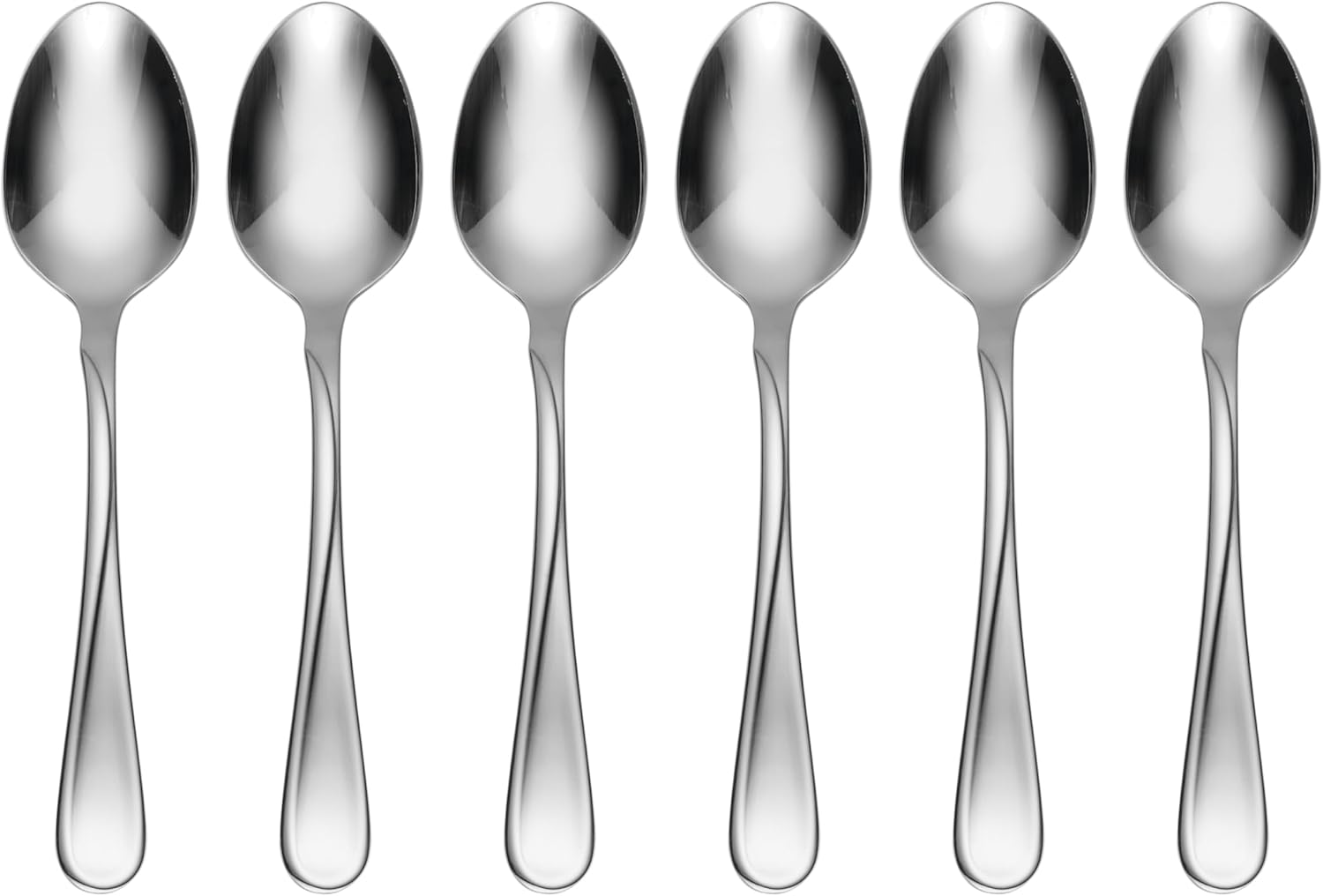 |
Oneida Flight Teaspoons | The steady, easy-to-match choice for everyday tables. | Check on Amazon |
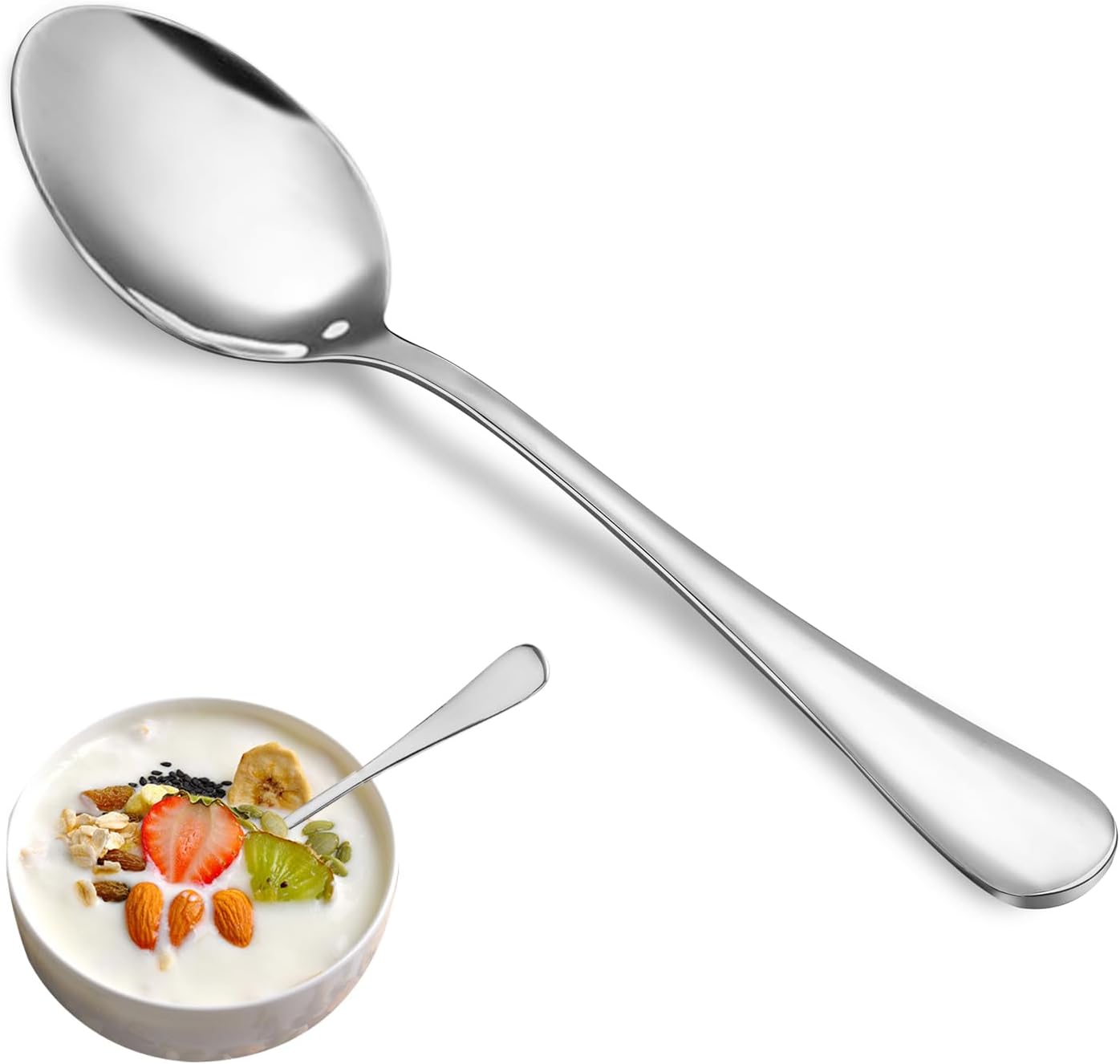 |
The Stainless steel Teaspoon | 18/10 steel, priced and sized for real households. | Check on Amazon |
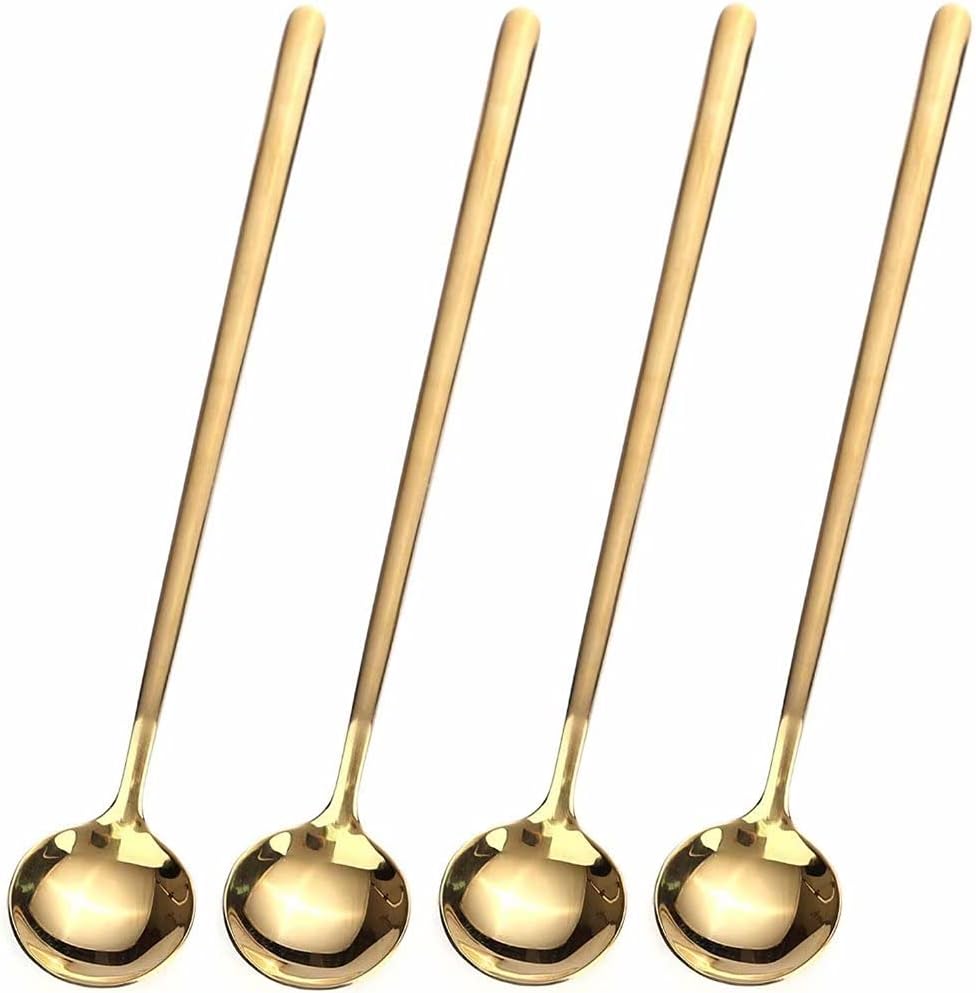 |
Long-Handle Gold Stirring teaspoons | Built for glasses your regular teaspoon can’t reach. | Check on Amazon |
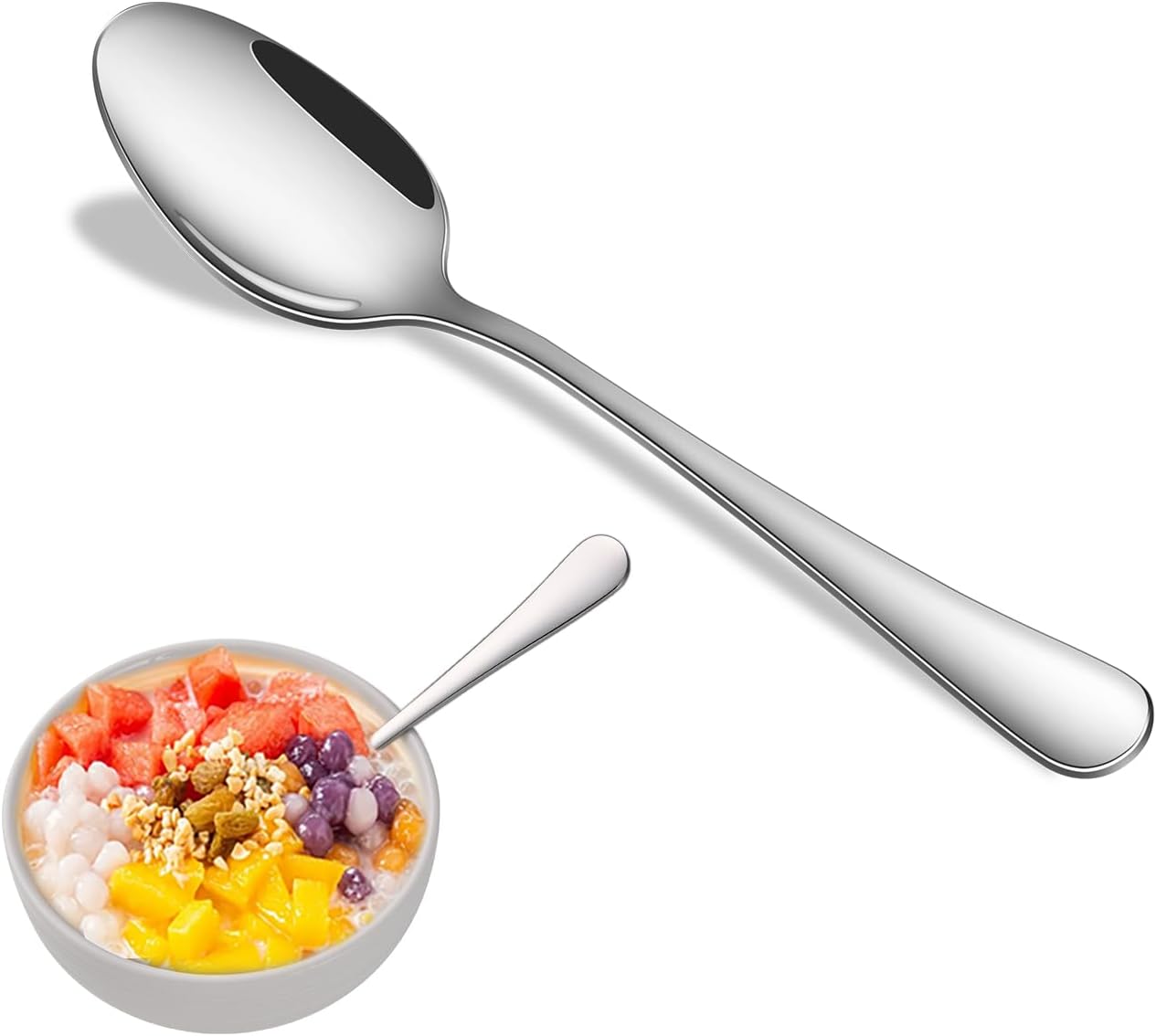 |
Everyday Teaspoon Set | Practical enough for daily use, gentle enough for kids’ hands. | Check on Amazon |
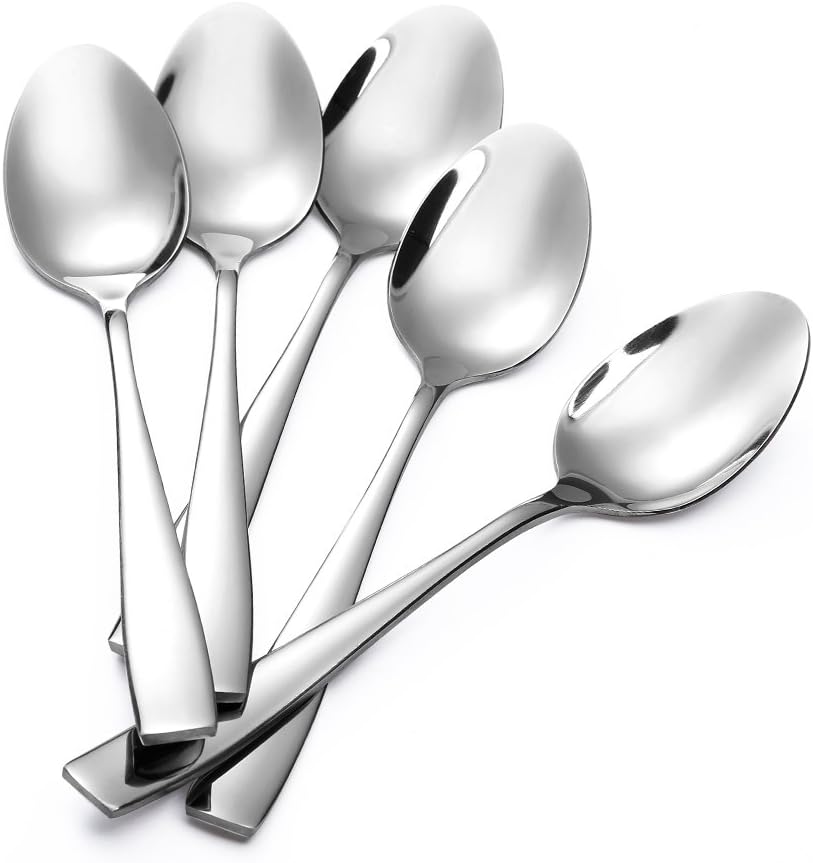 |
Eslite 12-Piece Teaspoons | The lightweight pick for topping up a drawer without the bulk. | Check on Amazon |
How We Tested
Before any of these teaspoons made this list, they earned their spot through actual use in our own kitchen — not a single side-by-side comparison laid out on a countertop for a photo. Each one went through the same routine a teaspoon actually lives: stirring coffee in the morning, sitting in a cereal bowl, going through the dishwasher with everything else, and getting tossed back into a drawer alongside spoons that didn’t make the cut.
That everyday use is what actually surfaces the differences that matter. A spoon that looks fine in a product photo can still feel wrong the moment you rest it on a mug rim and it slides off, or flex slightly the second you press it into a scoop of frozen yogurt. None of that shows up until a teaspoon has spent real time doing what a teaspoon is supposed to do, which is why we didn’t lean on spec sheets or star ratings to make these picks.
How to Choose a Teaspoon
A good teaspoon comes down to five things you can actually check before buying: the steel grade, how it was made, the bowl’s depth, how it balances in your hand, and the finish. None of that shows up in words like “durable” or “premium” — it shows up in the spec sheet, if you know what to look for.
Steel Grade: 18/0 vs. 18/8 vs. 18/10
Those two numbers aren’t marketing code — they’re the actual chromium and nickel percentages in the steel. Chromium, the first number, is what makes stainless steel resist rust in the first place. Nickel, the second number, is what keeps that shine looking new instead of dulling into a cloudy gray after a few months of dishwasher cycles. 18/0 teaspoons have no nickel at all, which keeps the price down but means water spots and dullness show up sooner. 18/8 sits in the middle, and 18/10 holds its polish the longest — the same trade-off we broke down in our slotted spoon buying guide, just scaled down to a smaller utensil.
Gauge: Stamped vs. Forged
This is the difference between a spoon cut flat from a sheet of steel and one shaped from a solid block under heat and pressure. Stamped teaspoons are thinner and lighter, which keeps them cheap, but that same thinness is why they flex — press one into a tub of frozen yogurt or a scoop of hard-packed brown sugar and you’ll feel it give slightly. Forged teaspoons are heavier and hold their shape under that same pressure. Neither is wrong for every kitchen; it depends on whether you’re mostly stirring drinks or scooping firm food daily.
Bowl Depth and Shape
A shallow, narrow bowl moves through a cup of coffee or tea without knocking loudly against the sides, which is exactly what a stirring spoon needs to do. A deeper, wider bowl holds more per scoop, which is what actually matters if you’re eating cereal, yogurt, or pudding rather than just stirring a drink. Buy the wrong shape for the job and it shows immediately — a shallow bowl makes eating dessert feel painfully slow, and a deep one sloshes liquid over the rim the moment you stir with any real speed.
Balance
Balance is about where the weight of the spoon sits, not how much it weighs overall. A bowl-heavy spoon tips forward and slides off the edge of a saucer or a mug rim the moment you set it down. A well-balanced one — where the handle’s weight roughly offsets the bowl’s — rests flat and stays put instead. This matters more than people expect, especially with spoons left resting mid-meal or parked next to a coffee cup on a desk.
Finish: Mirror Polish vs. Satin
Mirror-polished teaspoons reflect light and look formal, which is why they show up in gift sets and “premium” listings — but that same shine makes fingerprints and water spots more visible between washes. Satin or brushed finishes are matte and non-reflective, which hides small scratches and daily wear far better, and it’s why this finish shows up more often on restaurant-style or everyday sets. Neither finish is objectively better; one prioritizes looking good on a table, the other prioritizes looking fine after months of actual use.
Top Picks
1. Oneida Flight 6-Piece Teaspoon Set– Best overall
Every kitchen eventually loses a spoon or two down the disposal, and a six-piece set quietly becomes four. That’s the exact problem Oneida’s Flight line solves — it’s stayed in steady production long enough that reordering a matching piece years later isn’t the gamble it is with most sets. The sculpted mid-century handle also gives it a slightly wider grip than the flat-stamped teaspoons elsewhere on this list, which is the first thing I notice picking one up.
| Spec | Detail |
|---|---|
| Set size | 6 teaspoons |
| Material | 18/0 stainless steel |
| Finish | Mirror polish |
| Handle style | Sculpted “Flight” pattern |
| Dishwasher safe | Yes |
Key features
- Sculpted handle gives a wider, more substantial grip than flat-stamped teaspoons
- 18/0 stainless resists rust without the added cost of a nickel-heavy alloy
- Part of an established pattern line, so matching pieces are easy to find years later
- Mirror finish suited to everyday table use, not just special occasions
Pros
- Widely stocked, so replacing a lost piece down the road is realistic
- Comfortable, slightly weighted grip
- Reasonably priced for a named flatware pattern
Cons
- 18/0 steel won’t hold its shine quite as long as 18/10 under heavy daily dishwasher use
- Only sold in sixes, so larger households will need more than one set
- The sculpted handle reads as traditional rather than minimalist, so it won’t suit an ultra-modern table
Best for
Anyone who wants a teaspoon they can confidently reorder in a few years without hunting down a discontinued pattern.
2. 18/10 Stainless Teaspoon Set — Best Budget & Bulk
Hosting always exposes how few teaspoons a household actually owns — dessert, coffee, and after-dinner tea all draw from the same small drawer, and a six-piece set runs out fast. This 16-piece set solves that math directly, and the surprising part is that it’s built from 18/10 steel rather than the base-grade 18/0 you’d expect at this price. Next to the smaller sets here, this is the one I’d trust not to look thin when the table’s full.
| Spec | Detail |
|---|---|
| Set size | 16 teaspoons |
| Material | 18/10 stainless steel |
| Length | 6.7″ |
| Finish | Mirror polish |
| Dishwasher safe | Yes |
Key features
- 18/10 steel at a per-piece price usually reserved for base-grade 18/0 sets
- Consistent bowl depth and weight across all 16 pieces
- Enough volume to cover hosting, replacements, and daily use without buying twice
Pros
- Genuinely higher steel grade than the price point suggests
- Doesn’t run short with guests or a full table
- Uniform sizing, so nothing in the set feels like a mismatched spare
Cons
- No named pattern or collection, so it reads as functional rather than decorative
- Handle shape is plain — fine daily, less suited to a formal table
- At 16 pieces, it takes up more drawer space than a smaller set
Best for
Hosting regularly, replacing lost pieces in bulk, or any household that burns through teaspoons faster than a six-piece set can keep up.
3. Long-Handle Gold Stirring Spoons (Set of 4) — Best for Coffee, Tea & Iced Drinks
A standard teaspoon simply doesn’t reach the bottom of a cold brew tumbler or a tall iced latte glass — sugar and cream settle below where a 6-inch handle can stir. That’s exactly why I prefer this longer, gold-toned spoon for my coffee station—it stays there, ready to use, so I don’t have to search through the regular utensil drawer every morning. It won’t replace your everyday teaspoons, but for anything served in a tall glass, it’s the one that actually reaches.
| Spec | Detail |
|---|---|
| Set size | 4 spoons |
| Material | Stainless steel, gold-tone finish |
| Length | 6.7″ (longer than a standard 5.5–6″ teaspoon) |
| Bowl style | A narrow bowl that works best for stirring drinks |
| Dishwasher safe | Yes (hand-washing preserves the gold finish longer) |
Key features
- Extended handle reaches the bottom of tall glasses, tumblers, and deep mugs
- Gold tone doubles as a decorative option when guests are over
- Narrow bowl is shaped for stirring, not scooping soft food
Pros
- Solves the reach issue that standard teaspoons can’t
- Distinct enough from everyday flatware that it doesn’t get lost in the regular drawer
- Looks intentional on a table, not just functional
Cons
- Gold plating can dull faster than plain stainless if it goes through the dishwasher daily
- Only 4 in the set, so it’s a supplement to your teaspoons, not a replacement
- The narrow bowl isn’t practical for cereal, yogurt, or dessert
Best for
Iced coffee, cold brew, tall lattes, or anyone who wants a stirring spoon that stays distinct from everyday flatware.
4. Everyday Stainless Teaspoons — Best for Family Use
A busy household puts teaspoons through more daily wear than almost any other utensil — cereal in the morning, coffee at noon, dessert at night, a dishwasher cycle in between. This set is built to the same plain, no-nonsense spec used in cafes and small restaurants, which is exactly why it holds up rather than needing to be babied. It’s the set on this list I’d hand to kids without worrying about it.
| Spec | Detail |
|---|---|
| Set size | 8 teaspoons |
| Material | Food-grade stainless steel |
| Length | 6.7″ |
| Finish | Mirror polish, smooth edges |
| Dishwasher safe | Yes |
Key features
- Built to the same plain, functional spec used in cafes and small restaurants
- Smooth, rounded edges that are comfortable for kids as well as adults
- Balanced weight suited to daily handling rather than occasional use
Pros
- Built to handle regular dishwasher use with minimal maintenance
- Mid-size count fits a small-to-medium household without excess
- Comfortable, unfussy design that works for every family member
Cons
- No distinct pattern, so it won’t add much to a formal table setting
- Larger households hosting bigger groups will likely want a second set
- No drawer organizer or tray included
Best for
For busy households that need teaspoons that can handle everyday use without extra fuss.
5. Eslite 12-Piece Lightweight Teaspoons — Best Lightweight Pick
Teaspoons are the flatware piece that disappears fastest in most households, which is why buying a full matching set just to replace a handful never quite makes sense. This 12-piece set is sold on its own for exactly that reason, and it’s noticeably lighter in hand than the rest of the sets here — light enough that it stacks flat in a drawer without taking up the space heavier flatware does.
| Spec | Detail |
|---|---|
| Set size | 12 teaspoons |
| Material | Stainless steel |
| Length | 6.7″ |
| Finish | Mirror polish |
| Dishwasher safe | Yes |
Key features
- Noticeably lighter gauge than the other sets on this list
- Sold as teaspoons only, so replacing lost pieces doesn’t mean buying a full flatware service
- Stacks flat and compact, taking up less drawer space than heavier sets
Pros
- Light enough that repeated stirring or eating doesn’t feel tiring
- Good value for 12 pieces
- Easy to buy again a few at a time without committing to a matching set
Cons
- The lighter gauge flexes more than a heavier set when pressed into firm foods like frozen yogurt
- Feels less substantial in hand if you’re used to heavier flatware
- Shows water spots a little more readily if air-dried instead of towel-dried
Best for
Replacing lost teaspoons a few at a time, smaller kitchens with limited drawer space, or anyone who doesn’t want to buy an entire matching flatware set just for spoons.
Which Teaspoon Do You Actually Need?
There’s no single “best” teaspoon — the right pick depends on what you’re actually using it for, not which one has the highest rating. A spoon built for stirring iced coffee in a tall glass will feel wrong at a dinner table, and a bulk set that’s perfect for a big family won’t solve a lost-spoon problem the way a small standalone set does. Match your situation to the pick that actually fits it.
| Situation | Fits Best | Choose This If… |
|---|---|---|
| Everyday coffee, tea, cereal | Best Overall pick | you want one dependable teaspoon that handles daily use without a second thought |
| Iced coffee, cold brew, or tall glasses | Long-Handle pick | your current spoon can’t reach the bottom of the glass without your fingers dipping in |
| Hosting or a full table of guests | Budget/Bulk pick | you need enough volume on hand so nobody’s left digging through a half-empty drawer |
| Busy family household with kids | Everyday Family pick | you want something that survives daily dishwasher cycles without needing to be babied |
| Replacing a few lost teaspoons | Lightweight pick | you just need to top off a drawer, not commit to a whole new matching set |
| Espresso or a small demitasse cup | None of the picks above | a true demitasse spoon runs closer to 4.25–4.5 inches, and anything longer looks and feels oversized next to a small cup |
If more than one row applies to you — say, you host occasionally but mostly stir coffee alone every morning — go with whichever situation actually happens more often in your kitchen. The spoon that fits your daily routine matters more than the one that fits an occasional exception.
Teaspoon vs Measuring Spoon: What’s the Real Difference?
A teaspoon is a piece of flatware you eat and stir with, and its size changes from spoon to spoon. A measuring spoon is designed to hold a precise amount, so a standard measuring teaspoon contains exactly 5 milliliters regardless of the brand. Use flatware for eating and stirring. Reach for a measuring spoon anytime a recipe, or a dose, needs to be accurate.
What a Teaspoon Actually Is
The teaspoon sitting in your cutlery drawer is a piece of tableware, not a measuring instrument. It was designed by a flatware manufacturer to look good on a table, feel comfortable in the hand, and hold a reasonable amount of coffee, tea, cereal, or dessert. Nowhere in that design brief is “hold exactly 5 milliliters.”
Because of that, no two teaspoon patterns are identical. A shallow, narrow-bowled teaspoon meant for stirring espresso will hold noticeably less than a rounder, deeper-bowled one meant for eating yogurt. Multiply that by every flatware brand and every design era, and you get a huge amount of variation hiding behind one word.
What a Measuring Spoon Actually Is
A measuring spoon is built backwards from a teaspoon — the volume comes first, and the shape is just whatever container holds that volume accurately. A measuring teaspoon is manufactured, tested, and labeled to hold precisely 5 mL. A measuring tablespoon holds 15 mL. That’s the entire job of the tool: repeatable, identical volume, every time, regardless of brand.
This is also why measuring spoons look the way they do — narrow, deep, often with a flat top edge you can level off with a knife. That shape exists purely to make it easy to fill the spoon to exactly one line and stop, not to make eating comfortable.
Why the Two Aren’t Actually the Same Tool
This is the part most buying guides skip, and it’s worth understanding because it explains everything else in this article.
The “teaspoon” as a unit of measurement wasn’t invented by a kitchenware brand — it was defined by pharmacists. In the early 1900s, American pharmaceutical and medical associations settled on 5 mL as the official “standard teaspoonful,” specifically because they’d noticed that regular kitchen teaspoons were far too inconsistent to trust with a dose of medicine. That standard is still the one measuring spoons follow today.
And the inconsistency they were worried about is bigger than most people assume. Studies that have actually filled household teaspoons with water and measured the result have found capacities ranging anywhere from about 2.5 mL up to 9 mL — more than a threefold difference between the smallest and largest “teaspoon” someone might grab from their own drawer. A tablespoon shows the same spread, sometimes running from under 5 mL to over 15 mL depending on the piece.
Even the measuring spoon isn’t as universal as people assume. In the US, UK, and Canada, a tablespoon is 15 mL — exactly three teaspoons. In Australia, it’s 20 mL — four teaspoons. It’s one of the few places in the English-speaking world where the same word means a genuinely different amount, so if you’re using an Australian recipe with a US measuring spoon set (or the reverse), your tablespoon measurements will be off by 25%.
Does the Difference Actually Matter? It Depends What You’re Doing
Everyday stirring and light seasoning: grabbing a flatware spoon to stir sugar into coffee or scoop out a bit of peanut butter is harmless. Nobody’s meal is ruined by a spoon that’s 20% off.
Baking: this is where it starts to matter. Baking is closer to chemistry than cooking — baking soda, baking powder, salt, and yeast all react in specific ratios with the rest of your ingredients. A “teaspoon” of baking soda that’s actually 7 mL instead of 5 mL is nearly 40% more leavening agent than the recipe intended, which is enough to noticeably change texture, rise, or flavor.
Medicine: this is where it stops being about taste and starts being about safety. Research on liquid medicine dosing has repeatedly found that a large share of parents and caregivers, when handed a bottle with no dosing device, default to a kitchen teaspoon — and because that spoon might hold anywhere from half to nearly double the intended dose, it’s a genuine, well-documented source of under- and over-dosing. If a medication comes with its own dosing syringe or cup, use that. If it doesn’t, use an actual measuring spoon — never flatware.
A 10-Second Way to Check If Your Own Measuring Spoons Are Accurate
Here’s a trick worth knowing, and it’s one most articles on this topic never mention: not every measuring spoon that claims to hold 5 mL actually does. Testing of low-cost measuring spoon sets has found a meaningful share fall outside their labeled volume — sometimes by enough to matter in baking.
You can check your own set in under a minute with a kitchen scale, because water conveniently weighs almost exactly 1 gram per milliliter:
- Place an empty measuring teaspoon on the scale and zero it out (tare).
- Fill it level with water.
- Check the weight. It should read close to 5 grams.
- Do the same with your tablespoon — it should read close to 15 grams (or 20 grams if it’s an Australian-standard spoon).
If your spoon is noticeably off — say, under 4 grams or over 6 — it’s not measuring what it claims to. That’s a fast, genuinely useful sanity check before you blame a recipe for a bake that didn’t turn out right. If you’re shopping for a set that actually holds its stated volume, we’ve tested several in our measuring spoons guide.
Teaspoon vs Measuring Spoon at a Glance
| Flatware Teaspoon | Measuring Teaspoon | |
|---|---|---|
| Purpose | Eating, stirring drinks | Precise recipe or dose measurement |
| Typical capacity | ~2.5–9 mL (varies by design) | Exactly 5 mL |
| Shape | Rounded bowl, comfortable handle | Narrow, deep bowl with a level top edge |
| Consistent across brands? | No — every pattern differs | Yes, when accurately manufactured |
| Safe for medicine dosing? | No | Yes, when no dosing device is provided |
| Best for | Everyday table use | Baking, cooking with sensitive ratios, medicine |
Mistakes to Avoid When Buying Teaspoons
Most teaspoon buying mistakes come down to trusting a label instead of checking what a spoon actually does. A “teaspoon set” doesn’t automatically fit a tall glass, and an “18/10” tag doesn’t automatically mean sturdy. Here’s what actually trips people up.
Assuming Any Teaspoon Reaches a Tall Glass
Most standard sets top out around 6 inches, which is fine for a coffee cup but falls well short of a cold brew tumbler or a tall iced tea glass. Buy a regular set expecting it to double as an iced-drink spoon, and you’ll end up with sugar and cream sitting untouched at the bottom every single time.
Buying a Whole Flatware Set Just for a Few Teaspoons
Losing a handful of teaspoons is common, and the instinct is to replace them by buying a full 20-piece set that also comes with forks, dinner knives, and serving pieces you don’t need. A standalone teaspoon set solves the actual problem for a fraction of the cost, without cluttering the drawer with duplicate pieces.
Trusting the Steel Grade Number Alone
An “18/10” label tells you about the stainless steel’s nickel content, corrosion resistance, and ability to retain its polished appearance, but it doesn’t indicate the spoon’s thickness, weight, or overall sturdiness. A thin, flimsy 18/10 spoon can still flex under pressure, while a well-made 18/0 spoon can hold its shape just fine for years of daily use. The grade and the gauge are two separate specs, and only one of them usually shows up in the listing.
Skipping the Bowl Depth Check
Product photos rarely make bowl depth obvious, especially from the angle most listings use. Someone expecting a shallow stirring spoon can end up with a noticeably deeper dessert-spoon bowl instead, or the reverse — and it’s usually not noticed until the spoon is already in daily use and feels slightly off for the job.
Assuming Gold or Colored Finishes Wash Like Plain Stainless
A gold or colored finish may be labeled dishwasher-safe, but frequent exposure to heat and detergent can cause it to fade or lose its shine faster than standard stainless steel. Treating it exactly like a basic steel spoon, instead of hand-washing it occasionally, is often what shortens how long that finish actually looks new.
Care & Maintenance
A little care extends a teaspoon’s shine far longer than the material alone ever will. The two things that actually shorten a teaspoon’s life are harsh dishwasher detergent and food left sitting on the metal too long — not normal daily use.
High-chloride dishwasher tablets, the kind marketed for extra grease-cutting power, can slowly pit and dull stainless steel with repeated use. A gentler, chloride-free detergent protects the finish far better over time. Egg and dairy residue left on a spoon before washing is another common cause of spotting, since it reacts with the metal the longer it sits — rinsing soon after use prevents most of it.
If you ever need to replace a lost piece, buying an “open stock” spoon from a different batch than your original set can leave you with a subtle mismatch in shine or handle detail, even if the listing says it’s the same pattern. And when it comes to drying, a quick towel dry leaves noticeably fewer water spots than letting a spoon air-dry in the rack.
Faqs
Is a dessert spoon different from a teaspoon?
Yes. They’re often sold under overlapping labels, but a dessert spoon typically has a noticeably deeper, sometimes slightly wider bowl than a true teaspoon. That extra capacity suits foods like pudding, cobbler, or ice cream, while a standard teaspoon’s shallower bowl is sized more for stirring drinks or eating cereal. If a “teaspoon” set feels oversized in a teacup, there’s a good chance it’s actually shaped like a dessert spoon.
What’s the standard capacity of a flatware teaspoon?
A standard flatware teaspoon runs about 5.5 to 6 inches long, but its bowl capacity isn’t standardized the way a measuring teaspoon’s 5-milliliter volume is. Two teaspoons from different brands can hold noticeably different amounts even at the same length, since bowl depth and width vary by manufacturer and pattern.
Can you use a regular teaspoon to measure ingredients?
Not accurately, no. A table teaspoon’s bowl capacity varies by brand and pattern, while a measuring teaspoon is calibrated to a fixed 5-milliliter volume. For recipes where precise amounts matter, especially baking, a dedicated measuring spoon set gives a consistent result a regular flatware teaspoon can’t.
Are gold-accent teaspoons dishwasher safe?
Most are listed as dishwasher safe, but the gold tone tends to dull faster than plain stainless steel under repeated heat and detergent exposure. Hand-washing a gold-accent set, even just occasionally, keeps the finish looking new for noticeably longer than running it through every cycle.
Can I mix teaspoons from different brands with an existing set?
You can, but expect some visible mismatch. Even spoons with the same finish or steel grade often differ slightly in shine, handle shape, or bowl depth between brands. If matching appearance matters, buying “open stock” pieces from the same brand and pattern as your original set gets you closer than mixing brands entirely.
Conclusion
Back to those eleven teaspoons I lined up at the start of this guide — the four that actually stayed in daily rotation didn’t win because of a name brand or a shiny finish. They won because each one solved something specific: the Oneida stuck around because I could always track down a matching replacement, the gold long-handle spoon earned its spot because it’s the only one that actually reaches the bottom of a cold brew glass, and the Eslite set stayed because it folds flat into a drawer that never had room for anything heavier.
That’s really the only rule worth carrying away from this guide: a teaspoon earns its place by fitting how you actually use it, not by winning on paper. Stirring coffee every morning? Grab the overall pick and stop thinking about it. Hosting next weekend and your drawer’s looking thin? The bulk set fixes that by Friday. And if a recipe or a dose ever calls for an exact amount, set the teaspoon down and reach for a measuring spoon instead — that’s the one distinction here worth remembering long after you’ve forgotten which pick you bought.
Affiliate disclosure
Some links on this page are affiliate links. If you buy through one of them, we may earn a small commission at no extra cost to you. This helps support HomePlora and keeps our content free.

Hi, I’m Muhammad Din. I test and compare kitchen tools in my own kitchen before I ever recommend them — if it’s in a guide on HomePlora, I’ve used it or dug deep enough to know exactly where it holds up and where it doesn’t. My goal is simple: help you find tools that actually earn a spot in your kitchen, without wasting money on ones that don’t.