
Introduction
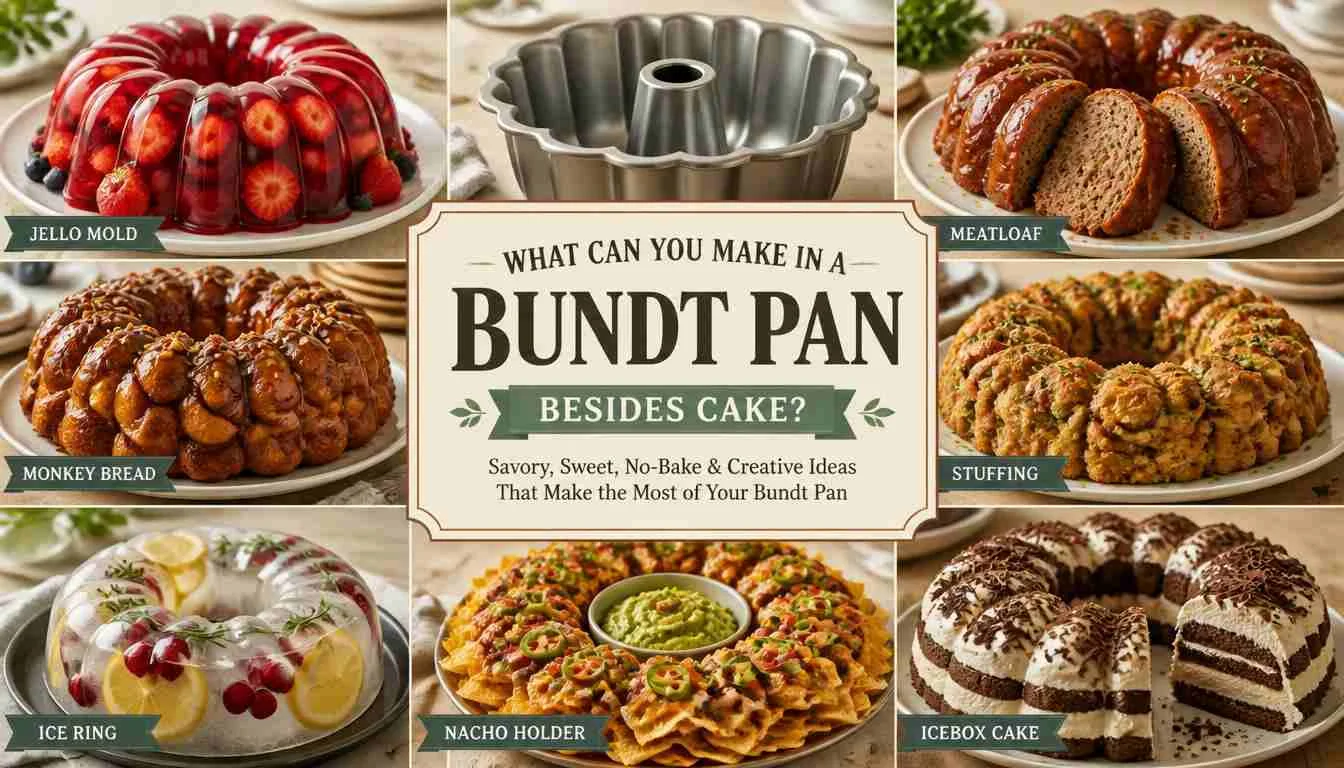
A bundt pan is good for far more than cake: dense savory oven bakes like meatloaf and stuffing, no-bake molds like jello and ice rings, sticky enriched breads like monkey bread, and party-serving pieces like a nacho ring or an ice bucket all work in the same pan already sitting in your cabinet.
Not everything you’ll find is actually worth doing to that pan, though. I’ve tried enough of these myself to know which ones earn a permanent spot in the rotation and which ones just wreck a coating that used to release cake clean.
What Actually Works in a Bundt Pan (And What’s Not Worth It)
Not everything suggested for a bundt pan is actually worth trying. After testing a half-dozen non-cake ideas in mine, here’s the short answer: no-bake molds and serving tricks work beautifully, dense savory bakes work well with a couple of precautions, and delicate layered dishes like lasagna aren’t worth the risk of falling apart on the flip.
| Use Category | Verdict | Why |
|---|---|---|
| No-bake molds (jello, ice rings, icebox cakes) | Excellent | No heat means no coating wear and no sticking risk — the fluted shape is a pure win with nothing working against it. |
| Party and entertaining uses (nacho holder, ice bucket, or s’mores organizer) | Excellent | Nothing is baked directly in the pan, so there’s no food residue to remove or concern about damaging the surface. |
| Dense savory bakes (meatloaf, stuffing, bread rings) | Good, with caveats | The center tube cooks a dense mixture evenly, the same way it does a cake — but acidic sauces sitting on the coating longer than batter does will wear it faster. |
| Sticky enriched breads (monkey bread, coffee cake) | Good, with extra prep | Caramelized sugar bonds to nonstick coating harder than plain batter does, so it needs a heavier grease job than cake gets. |
| Delicate layered bakes (lasagna, spanakopita-style stacks) | Skip it | Noodles and pastry sheets have to bend around the curve, layers compress unevenly near the tube, and the whole thing is far more likely to fall apart on the flip than a solid mass like meatloaf or a set mold. |
The rest of this guide breaks each of these down — starting with where a bundt pan genuinely beats every other dish in your cabinet, and working down to the one I wouldn’t do again.
Savory Bakes That Actually Suit the Shape (Meatloaf, Stuffing, Bread Rings)
A bundt pan’s center tube solves the exact problem that ruins most dense savory bakes: heat reaching the middle. In a solid loaf pan, heat only comes in from the outside, so the center lags behind. In a bundt pan, that open tube lets heat move in from the inside too — the same reason bundt cakes bake so evenly.
Why this actually works, not just “it does”
Any thick, dense mixture — cake batter, meatloaf, stuffing — has the same baking problem: the outside is exposed to oven heat on every side, but the center only gets there by conduction, one slow degree at a time. In a solid pan, that center is often the last part to finish, which means the edges are frequently overcooked by the time it catches up. A bundt pan removes that lag by putting a heat source through the middle of the food, not just around it. It’s not a trick specific to cake — it’s just physics that happens to also apply to meatloaf.
| Dish | Traditional pan | What happens there | In a bundt pan |
|---|---|---|---|
| Meatloaf | Loaf pan | Center can stay pink well after the edges are fully cooked | Center tube brings heat to the middle directly, so the whole loaf reaches temperature closer together |
| Stuffing/dressing | 9×13 casserole | Steam gets trapped under a thick layer, leaving a soggy middle while edges over-brown | Open center vents steam and keeps less bread sitting in a “cold zone” |
| Savory bread ring | Round boule | Dense boules can stay gummy at the core even after the crust browns | No part of the ring sits more than a couple inches from a heat source |
Getting the meatloaf right
Double a standard meatloaf recipe to fill the pan’s volume — a thin layer of meat mixture cooks too fast and dries out before it browns. Press the mixture into the pan in an even layer all the way around the tube; an uneven thickness cancels out the benefit, because the thick side still lags behind. Bake until the mixture hits 160°F at its thickest point, then let it rest for 10 minutes before flipping — resting matters more here than in a loaf pan, since a heavier, wetter mass needs that time to firm up enough to hold its ring shape on the way out.
Stuffing and bread rings
Dense bread-based stuffing behaves the same way — pack it loosely enough that steam can still move through it, since packing it tight defeats the same venting that makes the shape useful in the first place. A savory pull-apart bread ring gets the benefit automatically, since the dough is already portioned into pieces rather than one solid mass.
The trade-off nobody mentions: what sauce does to the coating
Cake batter sits against the coating for maybe 40 to 50 minutes and is close to pH-neutral. A ketchup or BBQ glaze brushed over meatloaf is acidic and sugary, and it sits in direct, concentrated contact with the coating for that same window — and repeated over many bakes, that kind of contact wears a nonstick surface faster than cake ever will. Hold off brushing the glaze on until the last 15 to 20 minutes of baking, or add it after you’ve flipped the loaf out onto a plate. You still get a glazed top either way, but the coating spends far less time under sauce at oven temperature.
No-Bake Molds Where the Fluted Shape Genuinely Wins (Jello, Ice Rings, Icebox Cake)
No-bake molds are the one category where a bundt pan has zero downside. Nothing gets baked, so there’s no oven heat wearing down the nonstick coating and no sauce sitting against it for an hour. Here, the shape’s only job is looking good when it comes out — and it does that job better than almost anything else in your cabinet.
Why nothing here can go wrong
Every caveat in the savory section came down to one thing: heat sitting against the coating for a long stretch, plus fat or acid making that contact harsher. None of that applies to a chilled or frozen mold. There’s no scorching risk, no browning to manage, no glaze wearing down a surface over 40 minutes in a hot oven. The only physics that matters now is release — and cold actually helps here in a way heat doesn’t. Jello, ice, and chilled layers all contract slightly as they set, which pulls them away from the pan wall on their own, before you’ve done anything at all.
Standard vessel vs the bundt pan
| Use | Standard vessel | What you get there | In a bundt pan |
|---|---|---|---|
| Jello mold | Smooth mixing bowl | A plain dome — one curve, no texture, no light play | Flutes catch light and repeat a pattern around the ring, so it reads as made-from-scratch with no extra effort |
| Ice ring for punch | Ice cube trays | Small cubes that melt fast and water down the drink quickly | One larger mass melts slower, and the ridges let fruit or herbs show through several faces instead of one flat side |
| Icebox cake | 9×13 pan | Flat rectangular slices — layers only visible from the cut side | Every wedge shows the layers plus a fluted edge, so each slice looks plated on purpose |
Jello mold
Lightly oil the pan even though nothing sticks the way batter does — a thin coat still makes the release cleaner, especially in the tight corners of the flutes where jello can grip more than it does on a smooth bowl. Chill for a full 4 to 6 hours; pulling it early means the center hasn’t set enough to hold the ring shape once it’s out. To release, dip the outside of the pan in warm water for about 10 seconds, then invert onto a plate — a beat longer than you’d expect, since jello holds its shape better than it looks like it will.
Ice ring for punch
Freeze in layers rather than all at once if you’re adding fruit or herbs — a thin layer of water first, then fruit, then more water, gives you a suspended look instead of everything sinking to the bottom. Use distilled or boiled-and-cooled water for the final layer if you want it clear rather than cloudy. To unmold, run warm water over the outside of the pan for a few seconds; ice is far more forgiving of extra contact time than jello is, so there’s no real risk of melting the detail out of the flutes.
Icebox cake
Line the pan with plastic wrap before layering, since icebox cake layers (cookies, cream, pudding) are softer and less self-supporting than a set jello mold. Chill for at least 6 hours, ideally overnight, so the layers firm up enough to hold together when sliced. Lift it out using the wrap instead of flipping and hoping — the wrap does the work that a confident flip does for a firmer jello mold.
Enriched Breads (Monkey Bread, Coffee Cake, Pull-Apart Loaves)
Sweet enriched bakes need a heavier grease job than cake, and a faster flip once they’re done. The reason is the butter-sugar layer sitting right against the pan — as it bakes, that layer caramelizes into a candy-like coating that grips the pan’s ridges far more aggressively than plain batter ever does, and it only releases cleanly while it’s still warm.
Why sugar grips harder than batter does
Cake batter releases from the pan mostly by way of a baked flour crumb setting against a greased surface — a fairly gentle, even contact. Monkey bread, coffee cake rings, and pull-apart loaves work differently: they all involve melted butter and sugar (often brown sugar) poured directly onto the dough right where it touches the pan. As that mixture bakes, the sugar caramelizes — the same chemistry that makes caramel candy or pralines set hard as they cool. That caramelized layer doesn’t just rest against the coating, it flows into every groove of a fluted pan while liquid, then hardens into something closer to a candy shell once it cools. That’s a mechanical grip, not just a sticking risk, and it’s the reason these bakes need a different release strategy than cake does. (For the base greasing method that applies to any bundt bake.
Cake batter vs a caramelized sugar layer
| Plain cake batter | Butter-sugar layer (monkey bread, coffee cake, pull-apart) | |
|---|---|---|
| Contact with pan | Even, moderate fat content throughout | Concentrated pool of melted butter and sugar right at the surface |
| What forms during baking | A baked flour crumb | A caramelized, candy-like layer |
| Best invert timing | Cooled 10–15 minutes, can wait longer without issue | Warm, usually within 5–10 minutes — waiting too long lets the sugar re-harden in place |
| Risk of delayed release | Minimal | Sugar cools and re-sets, gripping the flutes harder than when it first came out |
Monkey bread
Grease the pan more heavily than you would for cake, working it into every groove of the flutes with a pastry brush rather than a quick spray — the sugar mixture will find any bare spot. Once out of the oven, let it rest just 5 to 10 minutes, not the full cooldown you’d give a cake. Invert onto a plate while the caramel is still soft enough to let go; wait too long and it re-hardens against the coating, and reheating it back to a releasable state isn’t really an option once it’s stuck.
Coffee cake rings with a streusel or glaze layer
If the streusel or sugar topping is baked in direct contact with the pan (rather than added after unmolding), treat it the same way as monkey bread — heavy grease, quick invert. If your recipe adds the glaze after unmolding instead, this isn’t a concern at all, since the batter underneath behaves like a standard cake.
Pull-apart loaves
These usually have less concentrated sugar than monkey bread but still benefit from the same heavier grease approach, since the dough pieces create more seams and edges where a coating-and-sugar mixture can catch. Invert within the same 5-to-10-minute window rather than waiting for a full cooldown
Party & Serving Uses That Don’t Touch the Oven (Nacho Ring, Ice Bucket, S’mores Caddy)
These are the lowest-risk uses in the entire lineup, because nothing here touches heat or needs to release from the pan. A bundt pan is just a container in this tier — no coating wear, no unmolding, no food-safety window to manage. If you want to try something with your pan before committing to a full bake, this is where to start.
Why the shape works here, too
Every other use in this guide depends on what happens to the pan’s coating or how something releases from it. None of that applies when the pan is just holding things at room temperature. What makes it useful here is simpler: the fluted ring creates two distinct zones in one vessel — an outer trough that runs all the way around, and a center well from the tube hole. A flat platter or a basket only gives you one uniform surface. A bundt pan gives you a built-in place for the “main thing” and a separate place for what goes with it, without needing two dishes.
Standard serving item vs the bundt pan
| Use | Standard item | What you get there | In a bundt pan |
|---|---|---|---|
| Chips and dip | Flat platter + separate bowl | Dip bowl slides around, chips spread everywhere, two things to find table space for | Chips fill the trough, dip bowl sits locked in the center well — one vessel, no sliding |
| Chilling drinks | Cooler or drink tub | Bulky, floor- or counter-hogging, no separate space for garnish or a citrus bowl | Low profile fits a table or bar cart, and the center hole holds a garnish bowl right in the middle of the drinks |
| S’mores fixings | Open basket or tote | Marshmallows, chocolate, and graham crackers roll around and mix together | Trough keeps each item in its own arc, and the center hole stands up a stack of skewers or napkins |
Chip-and-dip ring
Arrange chips or vegetables around the trough, then set a small bowl of dip directly into the center hole so it sits flush and stable — no separate dish sliding across the table every time someone reaches in. This works with a pan of any age or condition, scratched nonstick included, since nothing here is cooking against the surface.
Ice bucket for drinks
Fill the trough with crushed or cubed ice and nestle cans or bottles into it standing up. Use the center well for a small bowl of lime wedges or a mini tub of a second drink option, so the whole station serves two purposes from one vessel. Refill the ice directly in the pan; there’s no cleanup consideration beyond a rinse.
S’mores caddy
Load graham crackers, chocolate bars, and marshmallows into the trough in separate sections, and stand a bundle of roasting skewers or a stack of napkins up through the center hole so they don’t get buried. It carries in one trip instead of several, and nothing inside touches heat until it’s over the fire.
What Nobody Tells You Before You Put Meat or Sauce in Your Cake Pan
A single savory bake in a bundt pan won’t hurt anything. What actually costs you is the second, tenth, and fiftieth one: grease packed into the flutes that a sponge can’t reach, a wet food heavy enough to make flipping it risky, and a coating that wears faster under fat and acid than it ever did under cake batter.
Cake use vs. savory use, side by side
| Cake use | Savory use (meatloaf, sauce-heavy bakes) | |
|---|---|---|
| Cleanup | Batter wipes out of the flutes with a soft sponge | Rendered fat and sauce residue set into the grooves and need a brush or a soak to fully clear |
| Weight coming out | Light — inverts easily even if it resists a little | A 2-lb-plus dense mass makes a stuck release far more likely to drop or tear |
| Contact against the coating | Neutral-pH batter, around 45 minutes | Fat, salt, and often acidic sauce, for the same or longer stretch |
| Long-term coating wear | Standard rate | Measurably faster, from repeated fat and acid exposure |
The cleanup difference nobody mentions
In a smooth pan, rendered fat pools in one spot and wipes off in a couple of passes. In a fluted pan, that same fat runs down into every groove and channel on its way out, then sets as it cools — and a sponge simply can’t reach into a tight flute corner the way it can wipe a flat surface. Soak the pan in hot, soapy water for 10 to 15 minutes before you touch it, then work a bottle brush or an old toothbrush into each groove individually. Don’t let the pan sit with grease cooling inside it overnight — once it hardens in place, it grips the coating the same stubborn way caramelized sugar does, and a quick rinse won’t move it.
Flipping something heavy is not like flipping a cake
A cake that resists a little still comes free with a light tap, because there’s not much mass working against you. A 2-pound meatloaf is a different problem entirely: if it’s even partly stuck, you’re now trying to control a heavy, hot, wet mass on the way down instead of a light one, and hot fat can splash the second it lets go. Let it rest a full 10 minutes before you invert — longer than you’d give a cake — and invert onto a rimmed sheet pan or cutting board rather than straight onto a serving plate, so any juice that escapes has somewhere to go besides your counter. Use both hands and oven mitts on the flip itself; a one-handed cake flip isn’t a habit worth carrying over here.
Should you keep a separate pan for savory use?
This comes down to how often you actually do this, not a rule you have to follow. If savory bakes are a once-in-a-while thing, thorough cleaning after each use is genuinely enough — there’s no meaningful risk in switching the same pan back and forth. If you bake cakes often enough to care about a flavor-neutral pan, or you’re using an older nonstick coating that’s more porous than it used to be, a second pan dedicated to savory use removes the question entirely, and a basic one is inexpensive enough that it’s not a big commitment either way.
What repeated savory use actually does to the coating over time
This is the trade-off that adds up rather than shows up in one bake. Fat at oven temperature, combined with acidic sauces, breaks down a nonstick surface faster than neutral cake batter does over the same number of uses — the coating chemistry behind that is the same PTFE/nonstick breakdown we cover in the pan-materials section of our tested bundt pan roundup, so we won’t re-explain it here. What matters practically: watch for the surface starting to look dull or slightly scored rather than smooth and glossy. That’s the visual cue it’s wearing down, and it’s worth knowing what that looks like before you decide whether the pan still belongs in regular rotation — our guide on replacing non-stick cookware covers that call in more depth.
Which of the Pans I Tested Handles This Best
Not every pan in a lineup is right for every use, and this held true across the four bundt pans I tested for this site. The shallow-fluted Wilton handles savory bakes best, the compact Novery is the strongest fit for no-bake molds, the classic Nordic Ware Original suits enriched breads, and the ornate Nordic Ware Anniversary pan is wasted anywhere except a party table.
Matching the pan to the use
| Use Category | Best Tested Pick | Why This One |
|---|---|---|
| Savory bakes (meatloaf, stuffing, bread rings) | Wilton Perfect Results Fluted Tube Pan | Shallower flutes trap less grease at cleanup, and its grip-textured handles matter when you’re flipping something as heavy as a 2-lb meatloaf |
| No-bake molds (jello, ice rings, icebox cake) | Novery 9.5″ Fluted Tube Pan | Already built and marketed for flan and jello, and its shallow 3″ profile chills and sets faster than a deeper pan |
| Enriched breads (monkey bread, coffee cake) | Nordic Ware Original Bundt Pan | Even cast-aluminum heat browns the sugar layer consistently, without the extra grease-and-flour prep the deeper braided pan demands |
| Party & serving uses (nacho ring, ice bucket, s’mores caddy) | Nordic Ware 75th Anniversary Braided | Zero heat or coating risk in this tier, so the most decorative pan gets to just be a centerpiece |
For savory bakes: the Wilton Perfect Results
This is the one pick here that isn’t a guess — our own testing notes on this pan mention it doubling for monkey bread and savory pull-apart bread already, so the fit isn’t a stretch. Two things make it the right call specifically for the meatloaf-and-stuffing category: its fluting is shallower than the cast-aluminum picks, which means less surface area for rendered fat to hide in when you’re cleaning up afterward, and its textured handles were built for maneuvering a hot, full pan one-handed — exactly the concern raised earlier about flipping something as heavy and wet as a dense meatloaf. It’s also the one pan in this lineup rated dishwasher safe, which matters more here than it does for cake, given how much grease a savory bake leaves behind.
For no-bake molds: the Novery 9.5″
No matching required here — the Novery is already positioned in our roundup as the pick for flan, jello, and gelatin work, not just cake. Its shallow 3-inch height, the lowest of the four pans tested, is a genuine advantage for chilled molds specifically: less mass means faster, more even chilling, and a cleaner set all the way through before you invert it. Since nothing here touches oven heat, the thinner carbon-steel build that’s a minor concern for baking isn’t a factor at all in this category.
For enriched breads: the Nordic Ware Original
Monkey bread and coffee cake rings need consistent heat to caramelize that sugar layer evenly without scorching one side before the other catches up — which is exactly what cast aluminum does best. The Original’s classic fluted pattern is well-defined without tipping into the deep, ornate territory of the Anniversary pan, so it still needs the pastry-brush greasing method, but not the full butter-and-flour routine that pan requires. That’s the difference between a normal extra step and a genuinely time-consuming one, and it matters more here since a caramelized sugar layer only gives you a short window to flip before it re-hardens.
For party and serving uses: the Nordic Ware 75th Anniversary Braided
This is the pan that loses the least by never touching an oven again. Its deep braided pattern is the most demanding of the four to grease properly and the slowest to clean — real downsides for baking, but irrelevant the moment nothing’s being cooked in it. Since this use tier carries zero coating or food-safety risk, it’s also a legitimate second act for a bundt pan you’ve already retired from baking duty because the coating’s worn down — it doesn’t need to go in the trash just because it’s done its job in the oven.
Faqs
Can you put a bundt pan in the dishwasher after a savory dish?
Only if that specific pan is labeled dishwasher safe — most bundt pans, especially cast aluminum ones, are hand-wash only no matter what’s baked in them. Even on a pan rated dishwasher safe, hand-washing after a savory bake is worth the extra few minutes: grease sets into the flutes, and a coating already working harder against fat and sauce wears out faster with dishwasher cycles stacked on top of that.
Does a bundt pan work for raw meat?
Yes — a meatloaf mixture bakes more evenly in a bundt pan than in a solid loaf pan, since the center tube brings heat into the middle instead of just the outside. The real consideration is cleanup: washing the pan thoroughly afterward matters more here than it does with cake, since raw meat is a genuine food-safety question, not just a sticking risk.
What’s the easiest non-cake use to try first?
A chip-and-dip ring or an ice bucket for drinks — anything from the serving-uses category that never touches the oven. There’s no coating risk, nothing to unmold, and no learning curve, which makes it the lowest-commitment way to find out what the shape is actually good for before you try something that bakes or chills.
Conclusion
A bundt pan earns its keep well past cake, but not in every direction people claim it does. No-bake molds and serving uses are an easy yes, since nothing about them puts the coating at risk. Dense savory bakes and enriched breads are a real yes too, once you know what’s different about how they release compared to cake. Delicate layered dishes like lasagna are the one category I’d skip — the flip works against you there in a way it doesn’t for a solid mass or a set mold.
If you’re trying one of these for the first time, start in the low-stakes tier and work up from there. You’ll get a feel for how your own pan releases before you trust it with a 2-pound meatloaf. And if you don’t have a bundt pan in your kitchen yet, our tested bundt pan roundup covers which of the four we tried is actually worth buying — including which one already doubles for savory and no-bake use before it ever sees a cake.

Hi, I’m Muhammad Din. I test and compare kitchen tools in my own kitchen before I ever recommend them — if it’s in a guide on HomePlora, I’ve used it or dug deep enough to know exactly where it holds up and where it doesn’t. My goal is simple: help you find tools that actually earn a spot in your kitchen, without wasting money on ones that don’t.