

Introduction
A good wood or bamboo utensil set comes down to one thing before piece count, price, or looks ever enter the picture: whether it’s carved from a single solid block or bonded together from thinner strips, and whether the care routine printed on the box actually matches what the material needs to hold up over time. I’ve gone through both materials in my own kitchen, flipping, stirring, and washing them the same way I would any daily tool, and the sets that survive that routine aren’t always the ones with the nicest description.
What sent me down this path was noticing how similar every listing sounds. “Eco-friendly,” “non-scratch,” “heat-resistant” — the same three phrases, copied across dozens of sets, with almost nothing said about how the tools are actually built. So before recommending anything here, I looked past that language and checked the one detail that predicts durability better than any adjective on the label: solid construction versus glued strips, and whether the finish or care advice on offer is realistic or just marketing.
That’s the standard every pick in this guide is measured against — not just how a set looks in a product photo, but how it holds up once it’s actually in a kitchen being used.
Comparison
| Image | Product | Details | Price |
|---|---|---|---|
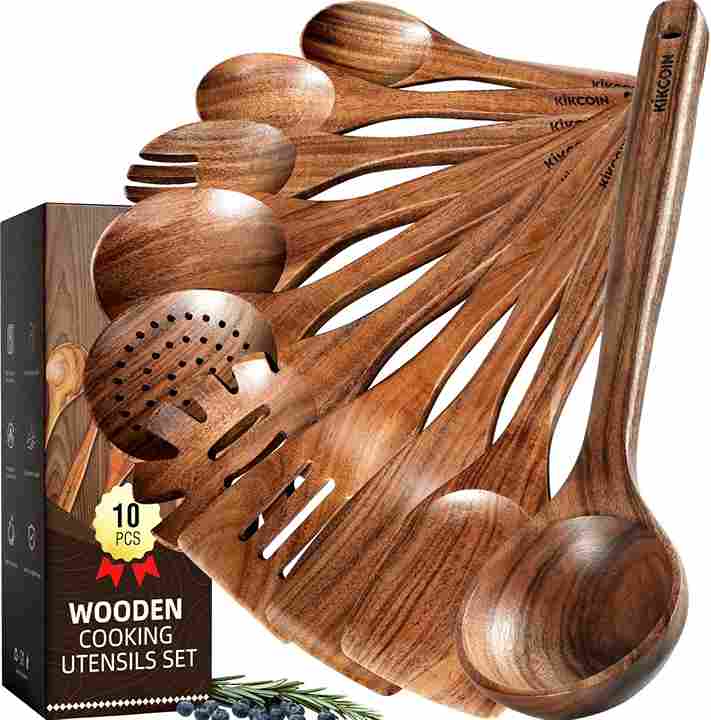 |
Kikcoin’s wooden set | solid, one-piece teak with no lacquer layer to wear off. | Check on Amazon |
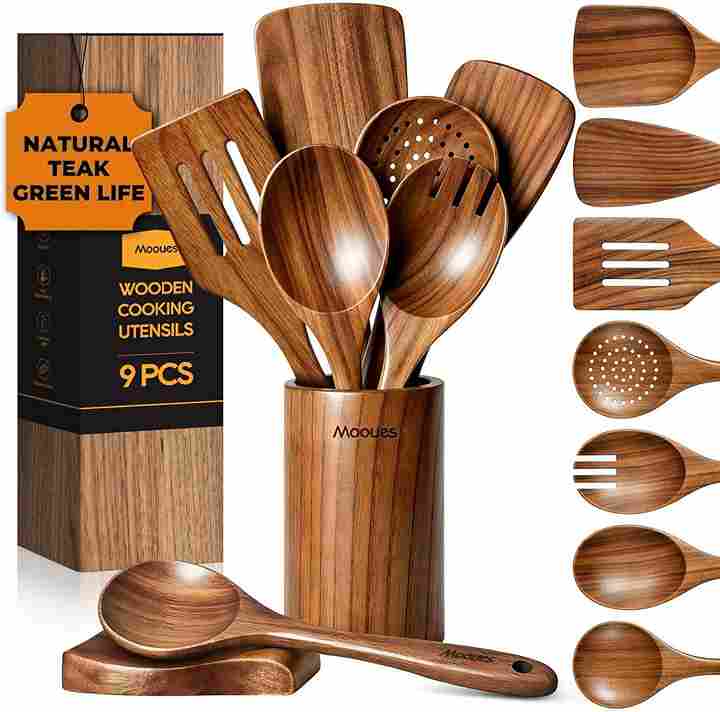 |
Mooues’ set | the polished, display-ready pick with matching storage built in. | Check on Amazon |
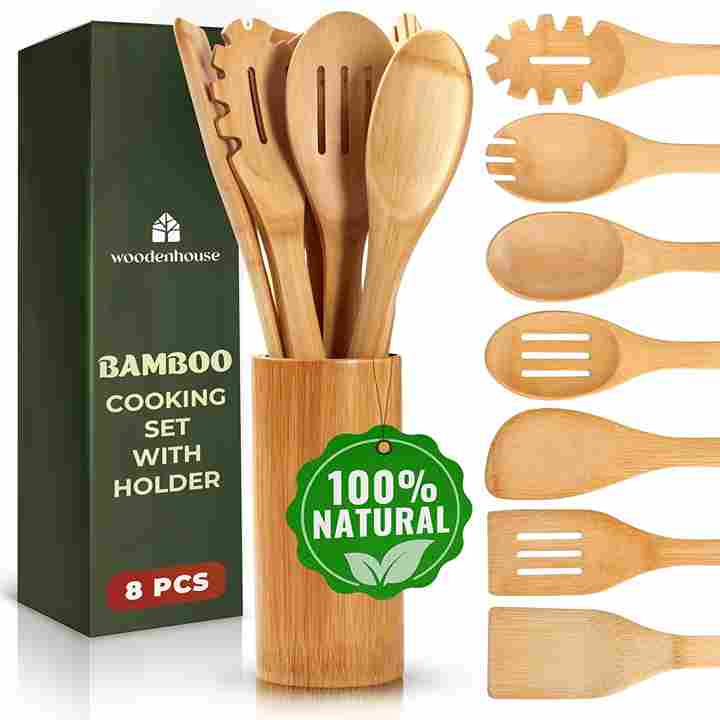 |
WoodenHouse’s set | the more complete bamboo lineup, worth a fast construction check on arrival. | Check on Amazon |
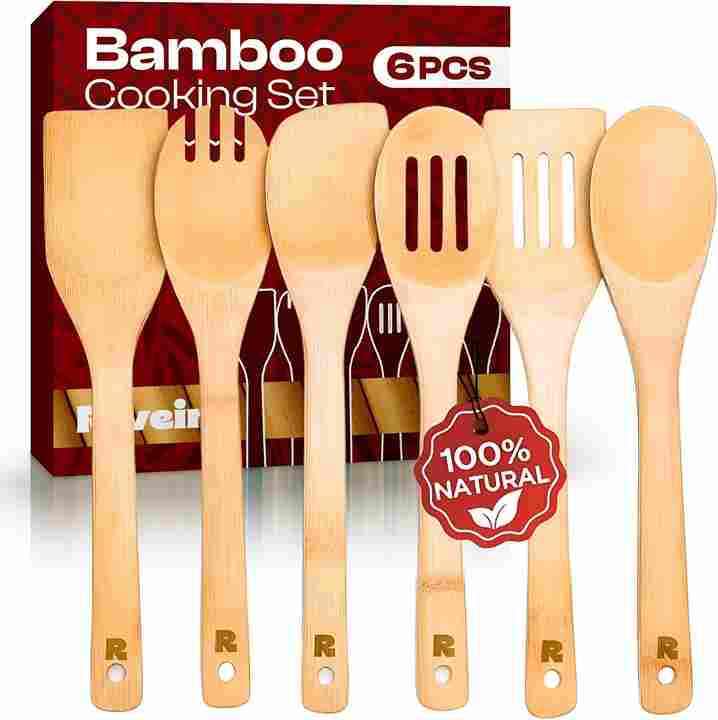 |
Riveira’s set | the space-saving bamboo pick sized for smaller kitchens. | Check on Amazon |
Wood vs bamboo — what actually differs and Which Set You Should Buy
Wood and bamboo utensils look almost identical, but they aren’t the same material. Wood comes from a slow-growing tree with a solid, dense grain, while bamboo is a fast-growing grass with a hollow stem, which changes how each tool is actually built. If you cook often and want the sturdiest option, a solid hardwood set usually lasts longer; if you want something lighter and more affordable for everyday use, a well-built bamboo set is the better fit.
The Difference Nobody Explains: Bamboo Isn’t Wood
Most articles use “wood” and “bamboo” like they’re interchangeable. They’re not. Wood comes from trees like teak, acacia, or olive, which take decades to mature and grow as one solid trunk. Bamboo is technically a grass, and it reaches full height in as little as four years — but it grows as a hollow stem, not a solid trunk.
That single fact explains almost every practical difference between the two materials. A tree trunk gives you enough solid material to carve a spoon or spatula from one continuous block. A bamboo stem doesn’t — it’s thin and hollow, so many bamboo utensils are made by slicing it into strips and bonding them together to build up enough thickness.
How Each One Is Actually Built
This is the part most buying guides skip, and it’s the part that matters most.
- Solid wood utensils are usually carved from one piece of timber. There’s no seam, no glue line, and nothing to come apart with repeated heat and washing.
- Many bamboo utensils are built from several thin strips glued together under pressure. Done well, this is perfectly safe. Done cheaply, it can mean a low-grade adhesive that breaks down faster under heat and moisture — and in some cases, older manufacturing methods used bonding agents that regulators later restricted for hot-food contact.
This doesn’t mean bamboo is unsafe. It means construction quality varies more in bamboo than in solid wood, so it’s worth checking before you buy. Look for listings that clearly state “one-piece” or “solid-cut” construction, or that mention certification such as FSC. If a bamboo set’s listing says nothing about how it’s built, that’s not automatically a red flag, but it is a reason to inspect the tools for visible strip lines the moment they arrive.
Heat, Moisture, and Everyday Toughness
Hardwoods like teak and acacia have a naturally tight, dense grain. That density is why they resist soaking up moisture, odors, and stains better than softer materials — it’s also why a hardwood spoon rarely warps even after years of use.
Bamboo is technically stronger fiber-for-fiber than many woods, but it’s more sensitive to moisture content. Bamboo that’s dried and cured properly stays stable; bamboo that isn’t can crack, swell, or develop mold-friendly damp spots over time.
Both materials handle everyday stovetop heat well and are generally safe up to around 400°F, but neither belongs directly over an open flame or a grill. And despite what “heat-resistant” labels imply, both wood and bamboo benefit from an occasional food-safe oil treatment — skipping it is the single biggest reason either material dries out, dulls, or cracks early.
Sustainability: Where Bamboo Actually Wins
If renewability is your main concern, bamboo has a real advantage. A hardwood tree takes decades to reach a usable size, while bamboo regrows to full height in just a few years. That makes bamboo the more genuinely renewable raw material on paper.
The catch is that this advantage only holds up if the finished product is made responsibly — a fast-growing raw material doesn’t mean much if it’s bonded with a low-quality adhesive. A set made from certified, well-sourced bamboo is a stronger environmental choice than an uncertified one, and it’s worth looking for that detail rather than trusting the word eco-friendly on its own.
Wood vs. Bamboo at a Glance
| Factor | Wood (teak, acacia, etc.) | Bamboo |
|---|---|---|
| Source | Slow-growing tree | Fast-growing grass |
| Typical construction | Carved from one solid piece | Often built from bonded strips |
| Natural moisture/odor resistance | Higher, due to dense grain | Lower unless properly cured |
| Heat tolerance | High, avoid open flame | High, avoid open flame |
| Maintenance | Occasional oiling | Occasional oiling |
| Renewability | Slower to regrow | Regrows in a few years |
| Typical price | Usually higher | Usually lower |
Which One Should You Actually Buy?
Choose a wood set if you cook often, want the fewest maintenance surprises, and prefer knowing exactly how the tool was built — solid, one-piece construction is easy to confirm and rarely fails.
Choose a bamboo set if you want something lighter, more budget-friendly, or more sustainable on paper — just take the extra minute to check for solid or certified construction before you buy, since quality varies more from brand to brand.
Either way, the material matters less than the build quality behind it. A well-made bamboo set will outlast a poorly finished wood one, and vice versa.
Is bamboo better than wood for cooking utensils? Neither is universally better — bamboo is lighter and often cheaper, while solid wood tends to resist moisture and odor slightly better and has more predictable construction.
Do bamboo utensils crack more than wood? They can, if the bamboo wasn’t dried and cured to the right moisture level before manufacturing. Properly made bamboo utensils hold up well; poorly made ones are more prone to cracking than solid wood.
Do wood and bamboo utensils both need oiling? Yes. Both benefit from an occasional food-safe oil treatment to prevent drying and cracking, regardless of what “heat-resistant” or “low-maintenance” marketing suggests.
Is bamboo more eco-friendly than wood? Generally yes, because it regrows much faster than hardwood trees — but only when the finished product uses a responsible, well-certified manufacturing process.
Top Picks
1. Kikcoin Solid Teak Cooking Set (10-Piece)
Metal tools scratching an expensive nonstick pan, or the quiet worry that a “wood” set is actually thin strips glued together, are two problems this set answers at once. Each tool is carved from a single block of dense teak rather than pieced together, so there’s no seam to fail and no clatter against the pan while I’m cooking. It’s the set I’d point a new kitchen toward when durability matters more than polish.
| Spec | Detail |
|---|---|
| Material | Solid teak, one-piece construction |
| Piece count | 10 |
| Includes | Ladle, frying spatula, oil spoon, wok tool, skimmer, slotted turner, pasta server, serving piece, salad server, fork |
| Finish | Unlacquered, hand-polished |
| Care | Hand wash; occasional oiling recommended |
| Storage | Hanging hole on each handle |
Why it stands out
- Each piece is a single carved block, not bonded strips — nothing to delaminate over time
- Noticeably quieter against pans than most metal or thinly-finished tools
- Long handles keep your hand further from heat and splashes
- Ten pieces cover nearly every stovetop task without buying extras
Honest tradeoffs
- The raw finish can dull if it’s never oiled — “heat resistant” doesn’t mean maintenance-free
- Not dishwasher safe, same as any real wood tool
- A couple of the smaller pieces feel light in a larger hand
Best for
cooks who want a wooden utensil set that’s genuinely one-piece rather than glued strips, and who don’t mind a short oiling routine to keep the finish looking its best.
2. Mooues Teak Set with Holder & Rest (9-Piece)
A loose pile of wooden spoons rattling around a drawer is its own kind of clutter, and that’s the gap this set closes. It arrives with a matching holder and rest, so every tool has somewhere to live between meals, and the glossy hand-finished surface looks more like a countertop feature than a utility-drawer item once it’s out on my counter. It’s the one I’d choose when a kitchen gift needs to look as good as it works.
| Spec | Detail |
|---|---|
| Material | Solid teak wood |
| Piece count | 9 (plus holder and rest) |
| Includes | Flat spatula, turner, slotted spatula, strainer piece, salad server, mixing spoon, holder, rest |
| Finish | Hand-sanded, food-safe lacquer coating |
| Care | Hand wash |
| Storage | Holder with drainage + matching rest included |
Why it stands out
- Matching holder and rest mean nothing extra to buy for storage
- Smooth, glossy finish gives it a display-ready look
- Ergonomic, slightly longer handles for a steadier grip
- Genuinely gift-appropriate presentation out of the box
Honest tradeoffs
- The lacquer is a surface coating, not raw oiled wood — heavy daily scraping can wear it thinner over the years, eventually calling for a light resand
- The brand’s claim of outlasting silicone or bamboo is their own marketing line, not an independent test result
- Best suited to moderate, everyday cooking rather than heavy commercial-style use
Best for
kitchens where a wooden utensil set will sit out on the counter and see regular, moderate use rather than daily high-heat, high-volume cooking.
Best Bamboo Utensil Set Picks
3. WoodenHouse Bamboo Set with Holder (7-Piece)
Bamboo sets often arrive as just the tools with nowhere to put them, so having a holder included here solves that from the first use. The lineup covers the core stovetop jobs, and the handle shape stayed comfortable through a full round of stirring and flipping in my kitchen. What the listing doesn’t tell you is exactly how the bamboo is built, and that’s worth checking before it ships to you.
| Spec | Detail |
|---|---|
| Material | Bamboo |
| Piece count | 7 (plus holder) |
| Includes | Slotted round tool, mixing spoon, slotted spatula, turner, pasta server, frying spatula, fork |
| Finish | Hand-crafted, unlacquered |
| Care | Hand wash; mineral oil recommended per the brand’s own instructions |
| Storage | Holder included |
Why it stands out
- Comes with a holder, so there’s less to source separately
- Widest piece range of the bamboo options here
- Handles stayed comfortable through extended stirring in testing
Honest tradeoffs
- The “won’t crack” claim isn’t backed by any detail on whether it’s a single carved piece or bonded strips — worth a quick visual check for seam lines when it arrives
- The brand’s own care guide still calls for regular oiling, which quietly contradicts the low-maintenance framing bamboo often gets
- No stated certification or construction method on the listing itself
Best for
Anyone who wants a fuller bamboo utensil set with storage included and doesn’t mind a quick look-over for build quality once it’s in hand.
4. Riveira Compact Bamboo Set (6-Piece)
Not every kitchen has room for a ten-piece collection, and this is the set I’d hand to someone furnishing their first apartment. A smaller lineup covers the basics without crowding a shallow drawer, and the bamboo stayed light enough that stirring a full pot never tired my wrist. It skips a holder, so plan on a drawer or a cup for storage rather than a counter display.
| Spec | Detail |
|---|---|
| Material | Bamboo |
| Piece count | 6 |
| Includes | Slotted spatula, solid spatula, turner, solid spoon, slotted spoon, fork |
| Finish | Unlacquered |
| Care | Hand wash, warm water |
| Storage | Not included |
Why it stands out
- Small enough to fit neatly in compact drawers and first-time apartment kitchens
- Noticeably light in the hand during extended stirring
- Fewer pieces means less to replace if one wears out first
Honest tradeoffs
- No holder included — budget for your own storage
- Same construction gap as the WoodenHouse set: no disclosure of single-piece vs. bonded-strip build, so the same on-arrival check applies
- Six pieces can run short for anyone cooking multi-step meals regularly
Best for
A first apartment or smaller kitchen that needs a compact bamboo utensil set without extra pieces to store.
1. The Construction Detail: One-Piece vs Laminated
The single biggest quality signal on any wood or bamboo utensil isn’t the finish or the price — it’s whether each tool was carved from one solid piece or built by gluing several thin strips together. One-piece tools have no seam that can loosen, crack, or break down under heat. Laminated tools can be just as safe, but only if the adhesive holding them together is food-grade and properly cured — and most listings never tell you which one you’re getting.
What “One-Piece” Actually Means
A one-piece utensil is shaped from a single, solid block of material, start to finish. There’s no internal seam, no glue line, and nothing holding two halves together. That matters for one practical reason: repeated exposure to heat, water, and detergent is exactly the kind of stress that causes bonded materials to weaken over time. A solid piece simply has nothing to come apart.
This is easier to achieve with hardwood, since a tree trunk provides enough solid material to carve a full-size spoon or spatula from one continuous piece. It’s harder with bamboo, because a bamboo stem is naturally hollow and thin — which is exactly why laminated construction shows up far more often in bamboo tools than in wood ones.
What “Laminated” Actually Means (and Why It Isn’t Automatically Bad)
Laminated construction means several thin strips of material are pressed and bonded together under heat or pressure to build up enough thickness to shape into a tool. This is a completely standard, legitimate manufacturing method — it’s how a lot of bamboo flooring, cutting boards, and furniture are made, and done properly, it can be just as strong as a solid piece.
The catch isn’t the method itself. It’s the adhesive. A high-quality, food-safe bonding resin holds up fine under normal kitchen use. A low-quality one can break down faster than expected once it’s repeatedly exposed to hot oil, steam, and dishwater — and in some cases, it can introduce substances that were never meant to sit against hot food in the first place. Regulators have already taken action against certain bamboo composite products that relied on a bonding resin not approved for that kind of use, which is exactly why this detail is worth checking rather than assuming.
The Second Layer to Watch: Lacquer and Surface Coatings
Construction is only half the picture. Some wood and bamboo utensils also get a glossy lacquer coating on top, mainly for looks. A good coating protects the surface and gives a polished finish. Like any protective finish, it may gradually wear down in areas that repeatedly rub against hot cookware. Once that coating thins, the exposed material underneath requires extra attention.
None of this means a coated tool is a bad choice. It just means “glossy and new” isn’t the same test as “how will this hold up in six months,” and that’s the question worth asking before you buy.
How to Actually Spot the Difference Before You Buy
You don’t need to be a materials expert to check this — you just need to know what to look for:
- Read for the specific phrase. Listings that say “one-piece,” “solid-cut,” or “carved from a single block” are telling you directly. Vague terms like “premium” or “natural” tell you nothing about construction.
- Look at the grain pattern in photos. A solid piece usually shows one continuous, irregular grain. A laminated piece often shows a repeating, uniform stripe pattern where the strips were joined.
- Check for certification. A mention of FSC certification or a similar sourcing standard is a decent proxy for a manufacturer that’s paying attention to quality control overall, including adhesives.
- When in doubt, inspect on arrival. Run a finger along the edges and look closely for a visible seam line before the tool ever touches food.
Is laminated bamboo safe to cook with? Yes, as long as it uses a food-grade adhesive that’s properly cured. The risk isn’t lamination itself — it’s low-quality bonding resin, which is harder to spot from a product listing alone.
How can you tell if a utensil is one-piece or laminated just by looking at it? Check for a continuous, irregular grain pattern, which usually signals solid construction, versus a repeating striped pattern, which usually signals bonded strips.
Does a lacquer coating mean the utensil is lower quality? No. A lacquer coating is mainly cosmetic and can look great new, but it’s a wear layer that can thin out over years of heavy use, at which point the material underneath needs its own care.
2. How to Care for Wood & Bamboo Utensils So They Actually Last
Wood and bamboo utensils fail early for one main reason: they dry out faster than most people realize, and nobody tells them to fix that. Hand wash them, dry them right away, and oil them every few weeks with a food-safe oil, and either material can comfortably last for years. Skip any one of those three steps, and cracking, splintering, or a rough surface usually shows up within months.
Wash by Hand, Never in the Dishwasher
Run these tools through a dishwasher and two things work against them at once: prolonged soaking and blasting heat. Wood and bamboo absorb some of that water even through a sealed finish, and the extended heat cycle pulls moisture back out too fast once the cycle ends. That push and pull is what causes warping and cracking over time.
Wash by hand instead, with warm water and a small amount of mild dish soap. A quick scrub with a soft sponge is enough — there’s no need to let them soak.
Dry Them Immediately, Don’t Let Them Sit Wet
Leaving a wet spoon or spatula in the sink, or standing upright in a cup while still damp, keeps moisture sitting against the surface for far longer than a quick wash does. That prolonged dampness is exactly what encourages warping, and in humid kitchens, it’s also what creates the damp conditions mold needs to take hold.
Towel-dry each piece right after washing, then let it finish air-drying somewhere with good airflow, laid flat rather than standing in a closed cup.
Oil It Every Few Weeks — With the Right Oil
Every time you wash a wood or bamboo tool, you strip away a little of its natural moisture along with the grease and food residue. Do that often enough without replacing what’s lost, and the material dries out from the inside, which is what eventually leads to splintering and cracking.
The fix is a light coat of food-safe mineral oil or a beeswax-based conditioner, rubbed in and left to absorb for a few hours before wiping off any excess. Skip cooking oils like olive or vegetable oil for this — they don’t fully cure the way mineral oil does, and they can turn rancid over time, leaving an off smell behind.
A light coating every two to four weeks, depending on how often you cook, is usually enough to keep either material from drying out.
Keep It Away From Direct, High Heat
Both materials handle normal stovetop heat well, generally up to around 400°F, which covers sautéing, stirring, and frying without issue. What they don’t handle well is direct contact with an open flame or being left resting against the hot side of a pan for an extended stretch — that’s well beyond what either material is built to take, and it’s what causes scorching, charring, and cracked tips.
Keep tools moving during cooking rather than propped against a hot surface, and never set one directly over a flame.
Watch for These Early Warning Signs
Catching a small problem early is the difference between a quick fix and a tool that needs replacing. Check every so often for:
- A rough, splintery patch developing on the handle or head
- Dark, uneven discoloration that wasn’t there when it was new
- A visible seam line starting to separate, which shows up more often on bonded bamboo pieces than solid one-piece tools
Any of these is a sign the piece needs oiling sooner rather than later — or, if the damage has already gone past the surface, a sign it’s time to retire that piece.
How often should you oil wood or bamboo utensils? Roughly every two to four weeks with regular use, using a food-safe mineral oil or beeswax conditioner rather than a cooking oil.
Can you put wood or bamboo utensils in the dishwasher? No. The combination of prolonged soaking and high heat causes warping and cracking far faster than hand washing does.
What oil should you avoid using on wood or bamboo utensils? Avoid cooking oils like olive or vegetable oil — they don’t cure properly and can go rancid, leaving a lingering smell. Use a food-safe mineral oil or beeswax conditioner instead.
Why do wood and bamboo utensils crack even with careful use? Cracking is almost always a moisture problem — either from repeated dishwasher use, prolonged soaking, or going too long between oil treatments.
Conclusion
After going through all four of these in my own kitchen, the thing that stuck with me wasn’t the finish, the piece count, or even the price — it was how differently each one answered the same simple question: is this one solid piece, or several pieces glued together, and does the listing actually tell you which? That question mattered more than anything else here, because it’s the one detail that predicts whether a set is still doing its job in a year or already splintering at a seam.
If you want the simplest, lowest-risk choice and don’t want to think about it twice, go with the one-piece teak set. There’s no seam to fail, no guesswork about construction, and the trade-off is just remembering to oil it occasionally — a small ask for not having to wonder how it was built. If a polished, display-ready set with its own holder matters more to you, the coated teak option earns its place too, as long as you’re fine keeping an eye on the finish over the years.
The bamboo picks aren’t a step down — they’re simply the ones where you, not the listing, have to do the last bit of homework. A quick look at the grain pattern once the box arrives tells you almost everything the product page won’t. Do that, and either bamboo set is a genuinely solid choice for a lighter, more budget-friendly kitchen setup.
Whichever one you land on, the same rule applies: check the build before you check the price. That’s the difference between a set that lasts and one that doesn’t.
Affiliate disclosure
Some of the products featured in this guide include affiliate links. If you purchase through one of these links, HomePlora may earn a small commission at no extra cost to you.

Hi, I’m Muhammad Din. I test and compare kitchen tools in my own kitchen before I ever recommend them — if it’s in a guide on HomePlora, I’ve used it or dug deep enough to know exactly where it holds up and where it doesn’t. My goal is simple: help you find tools that actually earn a spot in your kitchen, without wasting money on ones that don’t.