
Introduction
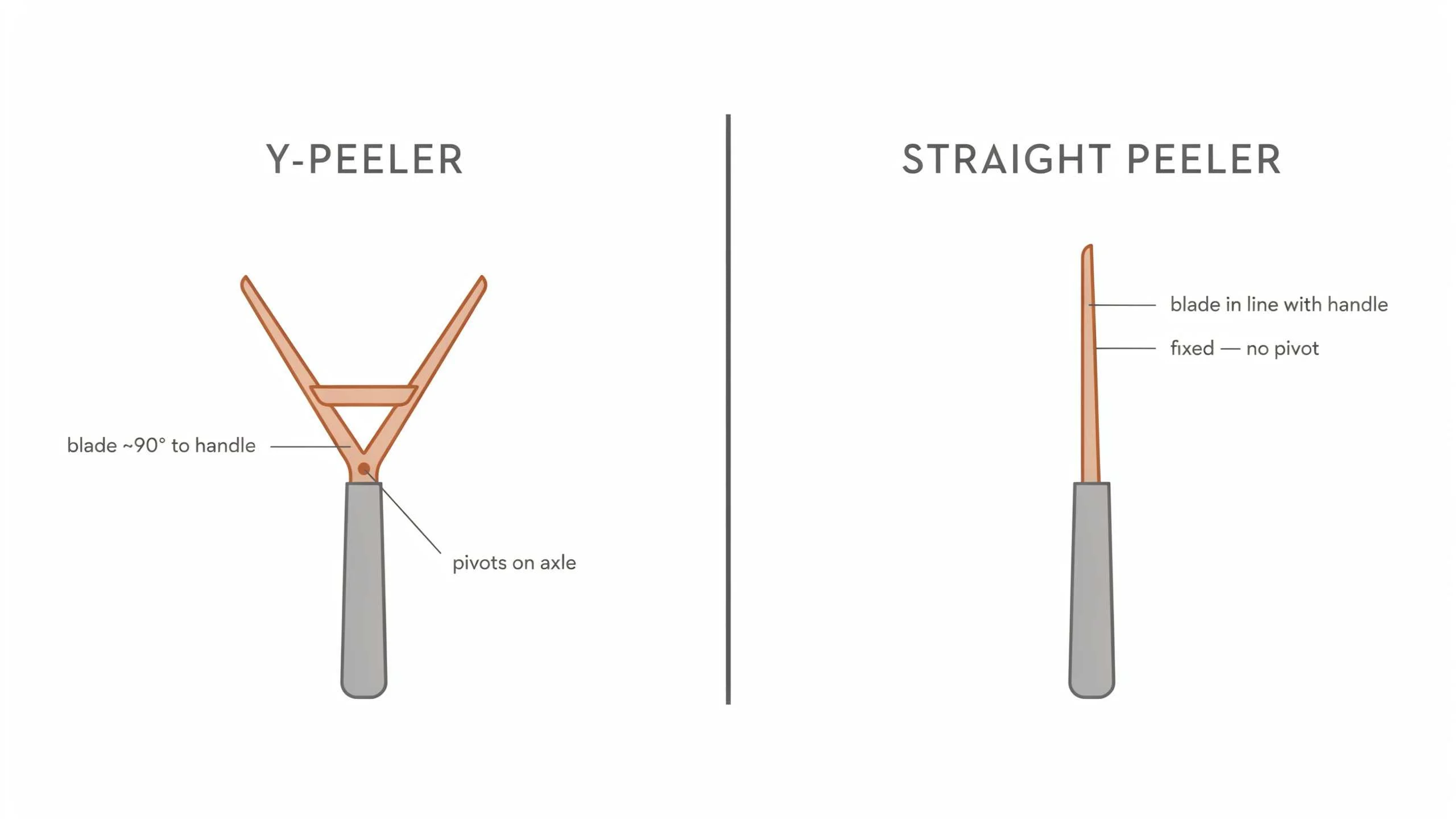
A Y-peeler has a horizontal blade that pivots between two prongs, giving a clear view of the cut and letting the blade follow curves on its own. A straight peeler has a vertical blade fixed in line with the handle, favouring a steady, familiar stroke over automatic curve-following. Y-peelers suit potatoes and squash; straight peelers suit apples and citrus.
Stand in a kitchen aisle long enough and you’ll see the same two shapes on repeat — one that looks like a slim knife with a slot cut across the blade, and one shaped almost like a slingshot with the cutting edge stretched between the fork. The packaging on both calls itself the better pick, and neither one explains why the shape actually changes how it feels in your hand.
I tested both in my own kitchen — same potatoes, same carrots, same tired wrist by the end of it — because that’s the only way to actually answer which shape does what. It’s not that one design beats the other. It’s that a handful of small mechanical differences decide how each one behaves the second it touches skin, and those are exactly the details most people never get told. Here’s where the two actually split apart.
Table of Contents
What Is a Y-Peeler vs a Straight Peeler?
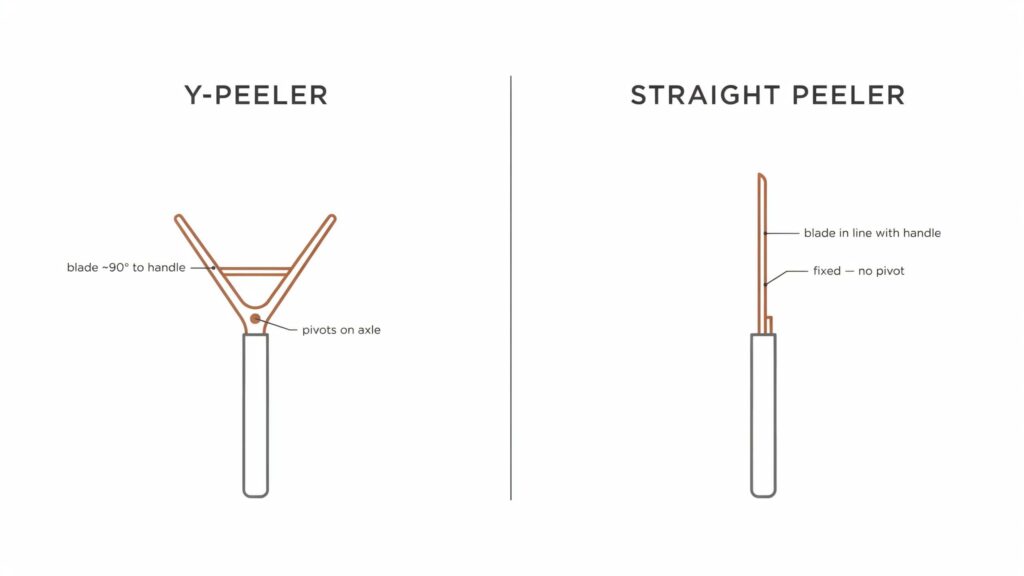
A Y-peeler is a vegetable peeler with a horizontal blade mounted between two prongs, so the whole head sits across the handle like the crossbar of a Y. I’ve run enough of these through testing to notice the same build every time: the blade sits at roughly a 90-degree angle to the handle instead of in line with it, and it pivots on a small axle fixed between the two prongs. That pivot is the whole trick — it lets the blade rock side to side as you move down a potato or a cucumber, so your wrist stays mostly still and the blade does the steering around the curve.
A straight peeler is a vegetable peeler with a blade set in line with the handle, running down its length instead of across it. In this version the blade is fixed — it doesn’t pivot the way a Y-peeler’s does, which is also the detail that separates a straight peeler from a swivel peeler (same in-line blade angle, but a blade that rotates on a pivot point built into the head). Because the blade can’t move independently of the handle, your wrist and forearm are doing the angling here, not the tool.
The Real Difference: Why Blade Direction Changes How You Peel
The difference between these two designs shows up before you even start peeling — it comes down to how much of the blade you can actually see, and which part of your arm ends up doing the steering.
What you actually see while you’re cutting
On a Y-peeler, the blade sits out in front of your knuckles instead of underneath them, so there’s nothing between your eyes and the edge — you can watch the skin lift off in a continuous ribbon the whole time. On a straight peeler, the head is built around the blade to hold it rigid, and on most models that head sits low, right over the cutting edge. The thicker that head is, the more of the blade it hides, and you end up peeling the last few millimeters by feel instead of by sight. That’s the reason a straight peeler that looked fine in the store can feel less predictable once it’s actually running down a curved potato.
Which part of your arm does the work
A Y-peeler is held much like a razor, using short downward strokes powered mainly by your wrist and fingers. A straight peeler gets pushed or pulled along the length of the produce in a longer stroke, which pulls your forearm into the motion instead. Neither one is more tiring by nature — they just tire different muscles. Peel a five-pound bag of potatoes with a Y-peeler and your wrist notices first. Do the same job with a straight peeler and it’s your forearm.
Why the blade angle matters more on curved produce
This is where most people fall short. A Y-peeler’s blade sits on a small pivot between the two prongs, so as it moves over the round shoulder of a potato or an apple, the blade rocks slightly on its own to hold the same cutting depth. A straight, fixed peeler has no pivot — the angle you set with your wrist at the start of the stroke is the angle you’re stuck with until you correct it yourself. On flat or gently curved produce like a carrot or a cucumber, you won’t notice this. On something with more shoulder to it, like a potato or a mango, a fixed blade is more likely to bite too deep in one spot and skate over the skin in the next, unless you actively adjust the angle as you go.
| Attribute | Y-peeler | Straight peeler |
|---|---|---|
| Blade orientation | Horizontal, roughly 90° to the handle, pivots on a center axle | Vertical, in line with the handle, fixed — no pivot |
| Best produce | Potatoes, squash, zucchini, cucumbers — anything with a rounded shoulder | Apples, pears, citrus, radishes — small or delicate produce |
| Learning curve | A few strokes to find the right blade angle | Familiar push-pull motion, no adjustment needed |
| Ambidextrous? | Yes by design — the symmetric blade sits the same in either hand | Usually, but check the handle shape first — some contoured grips are molded for one hand |
| Wrist strain (repetitive use) | Short wrist flick, repeated often; forearm stays mostly still | Longer forearm stroke, sustained load; wrist stays mostly still |
| Typical peel thickness/waste | Stays even on curved produce — the pivot follows the shoulder as you go | Can bite too deep on curves unless you correct the angle mid-stroke; very even on flat produce |
| Ease of cleaning | Rinse the pivot joint — thin peel strips can lodge between the prongs | Wipes clean in one pass, nothing to trap scraps |
| Average price range | $6–$15 for a single blade; $12+ for premium carbon-steel models | $5–$12 for a single blade; multi-blade sets run higher |
Which Is Safer for Arthritic Hands: Y-Peeler or Straight Peeler?
Neither shape wins outright — the handle matters more than the blade. A thin-handled Y-peeler and a thin-handled straight peeler put roughly the same strain on a sore hand; a well-padded version of either one takes that strain away. The blade shape changes how you move your wrist. The handle changes how hard you have to squeeze. For arthritis, the second thing matters more.
Why the handle does more work than the blade
Every peeler asks your hand to do one of two things: pinch it, or wrap around it. A thin metal handle — straight or Y-shaped, doesn’t matter — forces a pinch grip between your thumb and first two fingers to keep it from twisting in your hand. That pinch concentrates force right at the base of your thumb, which happens to be the single most common joint for arthritis in the hand. A thick, cushioned handle lets you close your whole palm around it instead, spreading that same force across four fingers rather than loading it onto one joint.
The design philosophy behind OXO’s Good Grips line goes beyond the common “arthritis peeler” label, making the real story far more interesting than the marketing suggests. Betsey Farber, who lived with arthritis, struggled to use a traditional metal peeler because its narrow handle caused discomfort. To solve the problem, she first molded a more comfortable handle from clay. She and her husband, Sam, later partnered with a design firm to create a peeler featuring a wider, soft rubber-grip handle while retaining the familiar swiveling blade design. The blade didn’t change. The grip did. That’s the whole lesson for shopping: chase handle diameter and cushioning first, blade shape second.
Ambidextrous by default — mostly
A Y-peeler’s blade sits centered between two symmetrical prongs, so it works the same whether the handle is in your left hand or your right — there’s no “correct” side to hold it from. A straight peeler is ambidextrous too, as long as the handle itself is a plain symmetrical shape; some contoured ergonomic grips are molded slightly for one hand, so check that detail before assuming any “ergonomic” straight peeler works both ways. One honest caveat: plenty of left-handed cooks report that a Y-peeler still feels awkward to them regardless of the symmetric design, simply from a lifetime of using tools built right-handed. Symmetrical geometry doesn’t erase decades of habit.
Which motion is easier on a sore wrist
A Y-peeler’s short flicking stroke uses less force per pass but asks your wrist to repeat that flick many times over one potato. A straight peeler’s longer push-pull stroke covers more surface per pass but holds your wrist in one loaded position for longer per stroke. If your pain flares with repetitive small motions, the straight peeler’s longer stroke may bother you less. If sustained pressure through a joint is what flares things up, the Y-peeler’s quick, low-force flick may be the easier one. There’s no universal winner here — it comes down to which motion your hands already tell you to avoid.
The eye-remover scoop nobody checks before buying
Most peelers, of either shape, have a small pointed scoop near the tip for digging out potato eyes and blemishes. Where that scoop points is a real safety detail: a scoop angled up toward your hand can catch skin instead of the potato, and testers at America’s Test Kitchen documented exactly that happening with a poorly designed model. A scoop angled down toward the blade only ever meets the vegetable. It takes five seconds to check before you buy, and it has nothing to do with whether the peeler is a Y or a straight — it’s a separate design detail worth inspecting on either one.
Which Peeler Is Better for Which Produce?
Reach for the Y-peeler
- Potatoes — round shoulders and medium-thick skin are exactly what the pivot is built for; it follows the curve instead of you correcting for it stroke by stroke.
- Carrots — long and tapered, so the Y-peeler’s longer stroke clears more skin per pass than a shorter straight-peeler stroke would.
- Cucumbers and zucchini — thin skins and a mostly straight shape, making speed more important than the swivel feature.
- Butternut and other winter squash — thick, tough skin needs real downward pressure, and gripping the Y-peeler like a knife handle gives you more leverage to push through it than a straight peeler’s in-line blade allows.
- Fresh ginger — the knobby surface changes direction constantly, and the pivot adjusts to each bump without you having to reposition your grip mid-stroke.
- Chocolate curls and parmesan shavings — not produce, but the same mechanism applies: the open blade stays visible the whole time, which makes continuous, even shavings easier to control than a straight peeler’s longer, blinder pull.
If potatoes are the produce that brought you here, our potato masher guide picks up right where the peeling ends.
Reach for the straight peeler
- Apples — smaller and more tightly curved than a potato, with flesh that bruises under too much pressure; the straight peeler’s slower, steadier stroke keeps pressure even instead of catching an edge near the stem.
- Pears — same logic as apples: delicate flesh and a smaller radius reward control over speed.
- Radishes and other small roots — a Y-peeler’s wider prong stance can overshoot something this small; a straight peeler’s narrower profile is easier to keep centered.
- Citrus, for a shallow strip of zest — you want only the colored layer, not the bitter white pith underneath, and a fixed blade holds a consistent shallow depth better than one that’s pivoting under your hand.
Apples are their own rabbit hole once you’re past the peeling — our apple corer guide covers the rest of that job.
Two produce types neither peeler really wins
Tomatoes and very ripe mangoes have skin that’s smooth, thin, and slippery under blade pressure — a Y-peeler and a straight peeler both tend to slide instead of bite, which means you end up pressing harder than the fruit can take. That’s genuinely a job for a serrated peeler, whose small teeth grip the skin instead of gliding across it. If either one shows up in your kitchen more than occasionally, it’s worth keeping a serrated peeler in the drawer alongside whichever of these two you already own — not as a replacement for it.
Common Myths About Y-Peelers and Straight Peelers
A few claims about these tools get repeated so often they start to sound like settled facts. Some of them are true. A few aren’t. Here’s what actually holds up.
Do Y-peelers waste more produce than straight peelers?
No — waste comes down to blade angle control, not blade shape. A fixed straight blade held at even a slightly wrong angle on curved produce either digs too deep, taking flesh with the skin, or skates over the surface and misses spots you then have to re-peel. A Y-peeler’s swivel blade follows the shape of the produce, making it easier to create thin, consistent peels on rounded vegetables like potatoes. The honest exception: on small, delicate fruit like a pear, a straight peeler’s steadier single-angle stroke can waste less in the hands of someone still getting used to how much pressure a Y-peeler needs.
Are Y-peelers only for right-handed cooks?
No — the blade sits centered between two symmetrical prongs, so the tool works identically no matter which hand holds it. There’s no handle contour favoring one side and no blade angled toward a specific grip, which is what makes it ambidextrous by construction rather than by marketing claim. One practical point to keep in mind is that some left-handed cooks may find the peeling motion a bit unusual at first. In most cases, that’s simply because they’ve spent years using kitchen tools built with right-handed users in mind, so it takes a little time to adjust rather than indicating any problem with the peeler itself.
Is a pricier peeler always sharper?
No — the steel and how the edge is ground determine sharpness, and a $6 stainless steel peeler can hold an edge just as well as a $20 one. Most of that price difference is paying for a cushioned handle, an extra blade in the set, or packaging, not a meaningfully sharper cut. Where price actually buys something real is edge retention: carbon steel blades hold their sharpness longer than basic stainless, but they also need to be dried immediately after washing or they’ll rust — a genuine tradeoff, not just an upsell.
Are a straight peeler and a swivel peeler the same tool?
No — a straight peeler’s blade is fixed in place, while a swivel peeler’s blade rotates on a small pivot, even though both sit vertically in line with the handle. A lot of buying guides use these two names interchangeably, which is where the confusion starts. With a straight peeler, your wrist holds the correct angle for the whole stroke; with a swivel peeler, the blade adjusts partway on its own — the same idea as a Y-peeler’s pivot, just turned 90 degrees. If a product photo shows a small rotating collar sitting just behind the blade, that’s the swivel mechanism, and its absence is what makes a peeler genuinely “straight.”
Is a Y-peeler always faster than a straight peeler?
No — which one is faster depends on the produce, not a fixed rule. For long, gently curved vegetables such as carrots and zucchini, a Y-peeler removes more peel with each stroke, making the job quicker. On small, tightly curved produce like radishes or a lemon you’re zesting, a straight peeler’s shorter, more controlled stroke often finishes just as quickly, since there’s less surface to cover and less need to reposition your grip mid-task.
Which One Should You Actually Buy?
How often you’re peeling
If you’re prepping vegetables most days — potatoes for dinner, carrots for lunches, squash on the weekend — a Y-peeler earns its keep through sheer stroke length; it clears more surface per pass, which adds up fast over a big batch. If peeling is closer to an occasional task — one apple, a few carrots, not a daily habit — the extra speed of a Y-peeler barely matters, and a straight peeler’s familiar push-pull motion means no adjustment period at all.
Your grip and hand comfort
If you have a strong, pain-free grip, either blade shape works fine and this factor drops out of the decision entirely. If your hands tire or ache with repetitive motion, go back to what your hands already tell you: a short, repeated wrist flick (Y-peeler) bothers some people less than a longer, sustained push (straight peeler), and for others it’s the reverse. What matters more than either blade is an oversized, cushioned handle — that detail cuts hand strain regardless of which shape you pick, so don’t let blade shape override handle quality when you’re comparing two specific products.
What’s usually on your cutting board
If potatoes, squash, carrots, and cucumbers make up most of your prep, the Y-peeler’s pivot is built for exactly that curved, thicker-skinned produce. If you’re peeling more apples, pears, citrus, or small roots like radishes, a straight peeler’s steadier single-angle stroke keeps you from taking off more flesh than skin on something that small. If your prep is a genuine mix of both, that’s the one case where owning both isn’t overkill — it’s just matching the tool to the produce in front of you.
How much drawer space you have
A Y-peeler’s two prongs give it a wider head than a straight peeler, so it takes up more lateral space in a drawer and can catch on other utensils if it’s tossed in loose. A straight peeler’s slimmer, roughly linear shape lies flatter and stacks more easily in a crowded drawer or a utensil crock. Not a dealbreaker for most kitchens, but worth factoring in if your drawer is already tight.
If the checklist above points you toward a Y-peeler, the Gourmet Easy Stainless Steel Y-Shaped Peeler is the cleanest single-blade pick from our testing. If a straight peeler is the better fit, the OXO Good Grips 2-Piece Peeler Set includes both a durable fixed straight peeler and a julienne peeler, giving you two versatile tools in one package. And if you genuinely can’t call it — your produce mix is split, or you just want to try both before committing to one — the MAD SHARK Ultra Sharp Vegetable Peeler & Y Peeler is worth a specific mention here: it’s sold as a two-piece set with one straight blade and one Y-shaped blade, so it sidesteps the decision entirely rather than asking you to pick.
Do You Need Both?
Honestly, plenty of kitchens end up with one of each — and that’s not indecision, it’s just how the produce mix works out. If you’re peeling potatoes and squash most days and also handle apples or citrus regularly, a Y-peeler for the curved, thicker-skinned stuff and a straight peeler for the smaller, delicate stuff solves two real problems instead of compromising on one tool for both.
That said, if you peel produce only occasionally — a carrot here, an apple there — buying both is just clutter in a drawer that’s probably already tight. One good peeler, matched to whatever you cook most, will cover nearly everything you throw at it. The mismatch only shows up on the produce that’s genuinely outside its comfort zone, and most people can live with that a few times a month.
So the answer isn’t “buy both to be safe.” It’s: buy one that matches your most common prep, and only add the second if you notice yourself fighting the first one on a specific, recurring task.
Conclusion
The difference between a Y-peeler and a straight peeler isn’t which one is better — it’s which motion suits your hands and which produce fills your cutting board most often. A Y-peeler’s pivoting blade earns its keep on curved, thicker-skinned vegetables like potatoes and squash; a straight peeler’s fixed blade holds a steadier line on small, delicate produce like apples and citrus. Match the tool to what you actually cook, and the choice mostly makes itself.
Faqs
Is a Y-peeler or straight peeler better for potatoes?
A Y-peeler is generally the better choice for potatoes. Its blade pivots on a small axle, so it follows the rounded, uneven shoulders of a potato without you having to correct the angle mid-stroke. A straight peeler still works fine on potatoes — it just asks more from your wrist to match that curve on its own.
Which peeler is easier for beginners?
A straight peeler is usually easier for a first-timer, because the stroke mimics a familiar knife-like push or pull with no blade angle to figure out. A Y-peeler works just as well once you’ve found its short flicking motion, but it typically takes a few strokes of practice before that motion feels natural.
Can left-handed people use a Y-peeler?
Yes. A Y-peeler’s blade sits centered between two symmetrical prongs, so it works the same whether you hold it in your left hand or your right — there’s no side built for one hand over the other. Some left-handed cooks still find the motion unfamiliar at first, but that comes from habit, not the tool’s design.
Which peeler wastes less produce?
Neither peeler wastes more produce by design — waste comes down to blade angle control. A Y-peeler’s pivot tends to leave a thinner, more even strip on curved produce like potatoes, while a straight peeler can be just as efficient on small, flat produce where a steady single-angle stroke is easy to hold.
Is a Y-peeler good for arthritis?
A Y-peeler can be a good choice for arthritis, but the handle matters more than the blade shape. A thick, cushioned handle lets you hold it in a relaxed palm grip instead of a tight pinch, which is what actually reduces strain — and that detail matters just as much on a straight peeler.

Hi, I’m Muhammad Din. I test and compare kitchen tools in my own kitchen before I ever recommend them — if it’s in a guide on HomePlora, I’ve used it or dug deep enough to know exactly where it holds up and where it doesn’t. My goal is simple: help you find tools that actually earn a spot in your kitchen, without wasting money on ones that don’t.