

Introduction
The first time I broiled a rack of lamb chops on the flimsy stamped-steel pan that came with my oven, it warped down the middle before the meat was anywhere close to done — and every chop slid downhill into a pool of its own rendered fat. That’s the moment I stopped treating broiler pans as an afterthought that just comes free with the oven, and started actually testing which ones can survive direct, 500°F-plus radiant heat without buckling, flaking, or turning dinner into a smoke-alarm situation.
A broiler pan isn’t a smaller roasting pan — it’s built around a single job: pull fat away from food fast enough that it doesn’t smoke, scorch, or flare under the broiler element. Most of the pans that ship with home ovens are thin, coated in something that was never rated for that kind of heat, and warped or flaking within a year or two of real use. I’ve cooked on enough of them, good and bad, to know which materials actually hold up under a broiler, which sizes fit a standard oven versus a drawer that needs an exact match, and which stock pans are actually worth replacing. Here’s what I’d put under my own broiler.
The best broiler pan for oven use overall is the Nordic Ware Naturals Classic Broiler Pan — uncoated aluminum with nothing to flake or degrade under direct heat, backed by a lifetime warranty. If your factory pan has warped or gone missing, match it to your oven brand instead: the GE Appliances WB48X10056 is the exact-fit pick for GE and Hotpoint ranges, while the Bagean porcelain pan cross-referenced to the Whirlpool 4396923 covers most other brands at a lower price. For thicker cuts that need a pan that won’t warp under sustained heat, the Culinarin Heavy-Duty Porcelain Broiler Pan is rated specifically to 550°F, and if you want one pan that doubles as an indoor grill, the Culinarin Chrome-Plated Broiler & Grill Pan is the one to grab.
Comparison
| Image | Product | Details | Price |
|---|---|---|---|
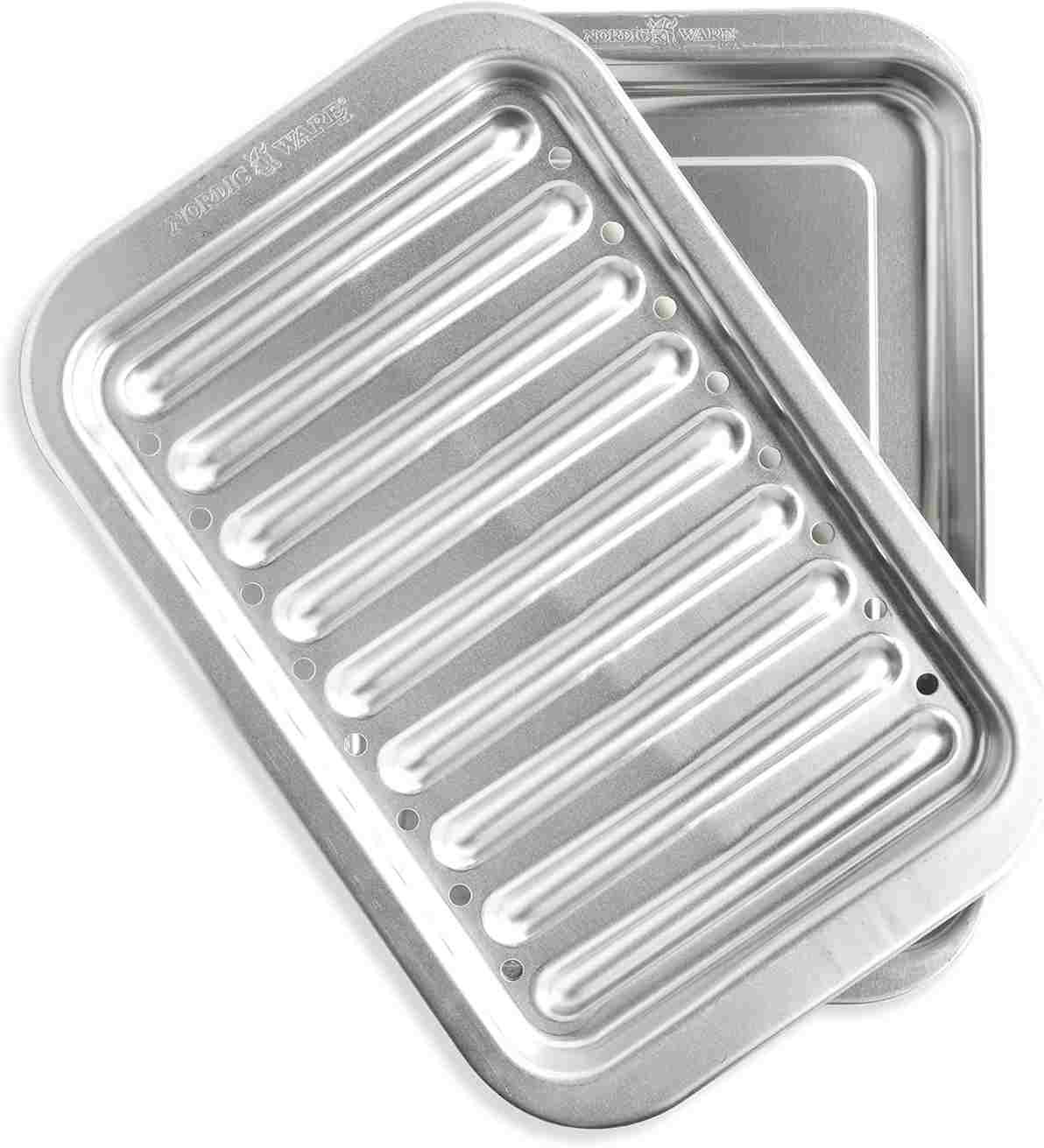 |
Nordic Ware Naturals Classic Broiler Pan | uncoated aluminum built for years of broiler use with nothing to break down. | Check on Amazon |
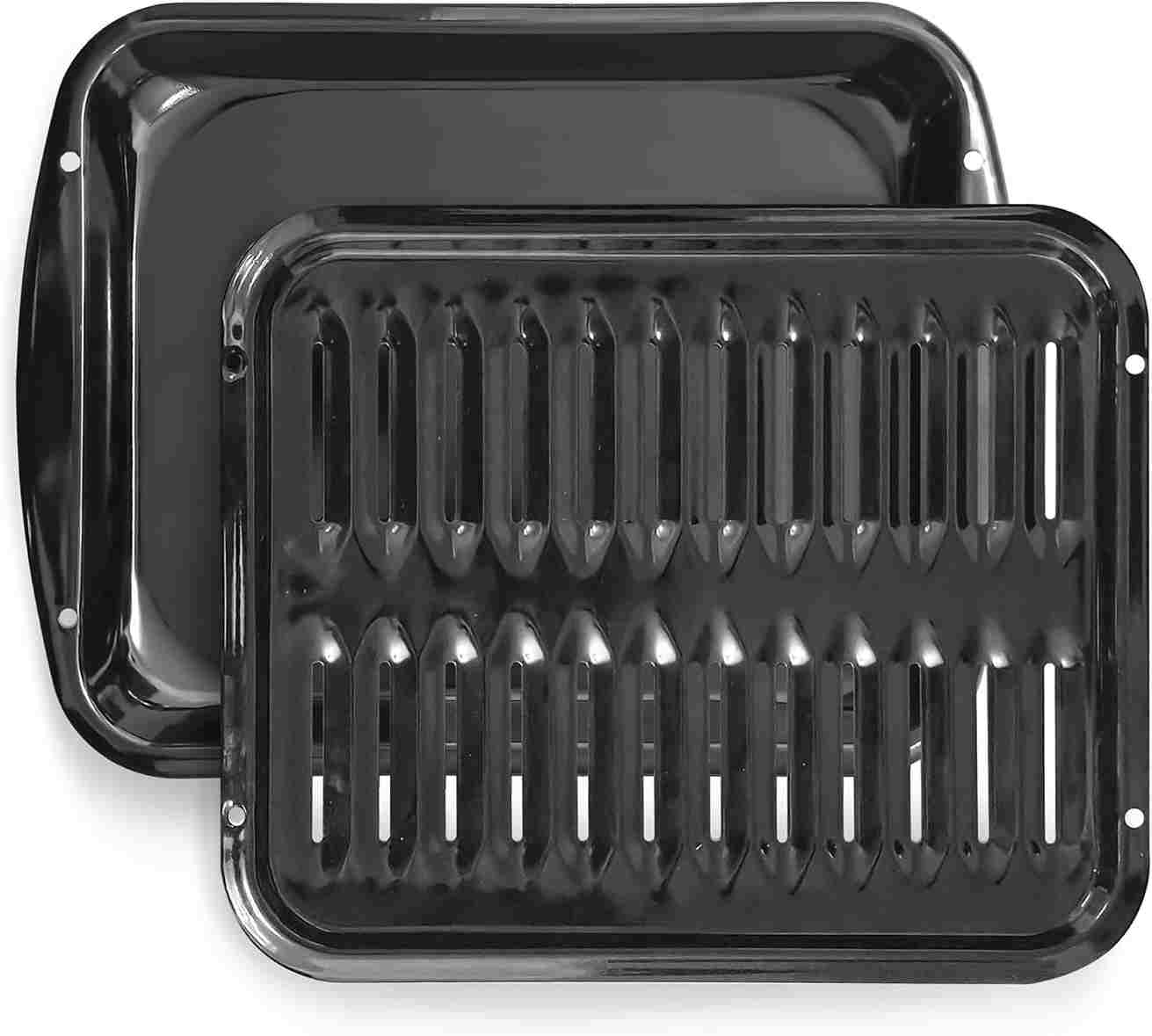 |
Bagean Porcelain Broiler Pan | a heat-rated porcelain replacement built to survive actual broiler temperatures. | Check on Amazon |
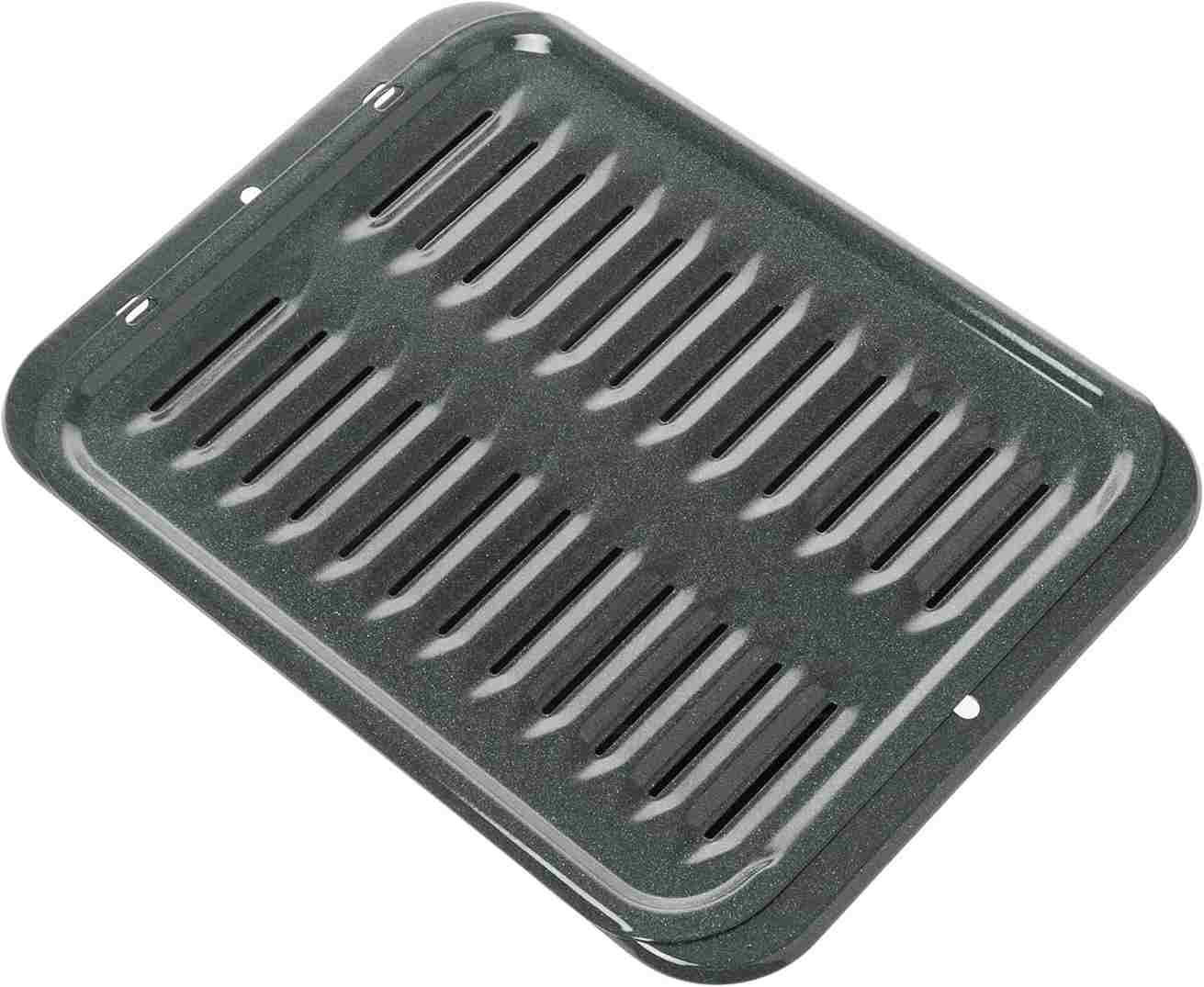 |
GE Appliances WB48X10056 | the genuine factory pan for GE-family ranges, built to the original spec. | Check on Amazon |
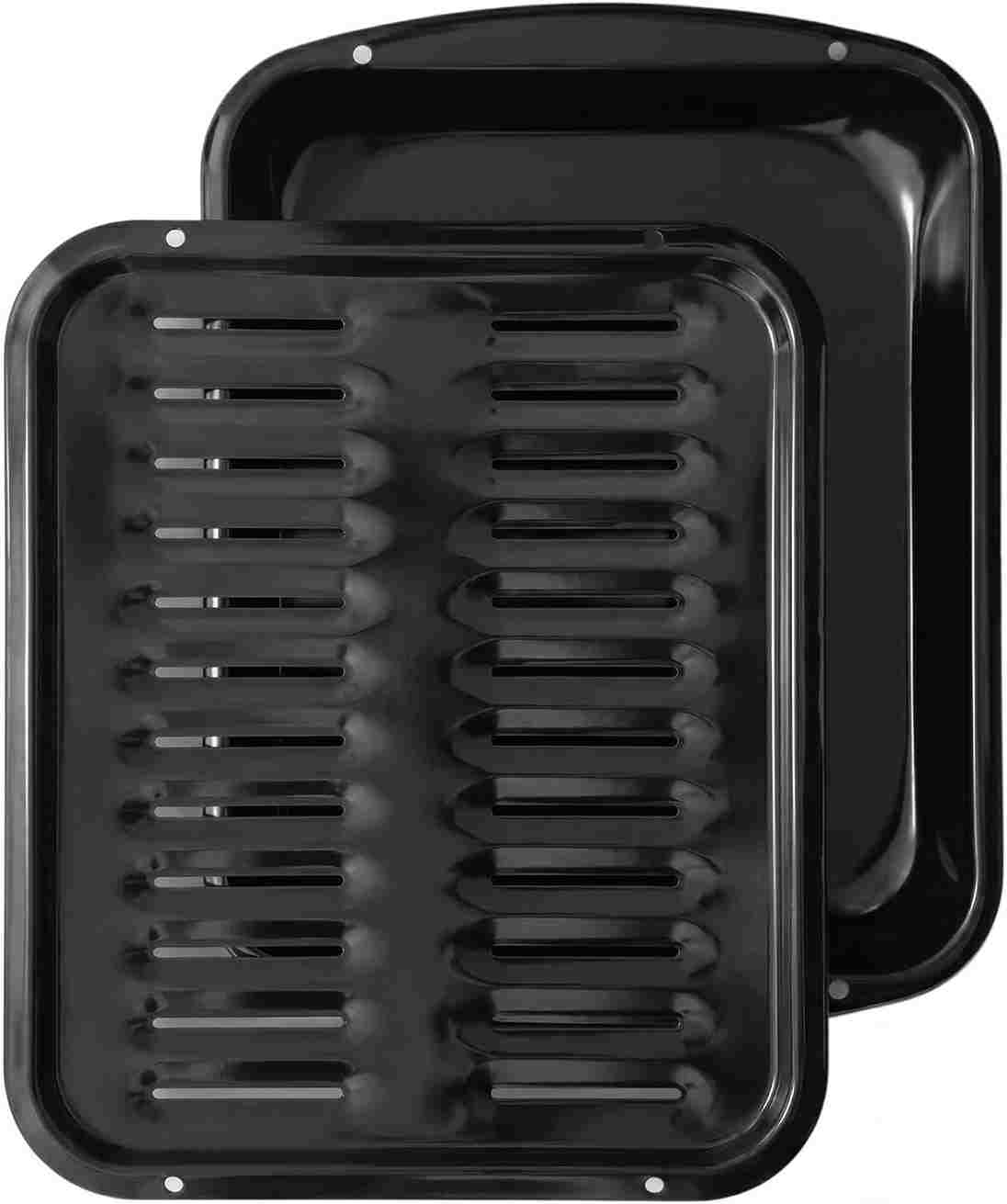 |
Culinarin Heavy-Duty Porcelain Broiler Pan | 550°F-rated and built to stay flat through repeated broiler use. | Check on Amazon |
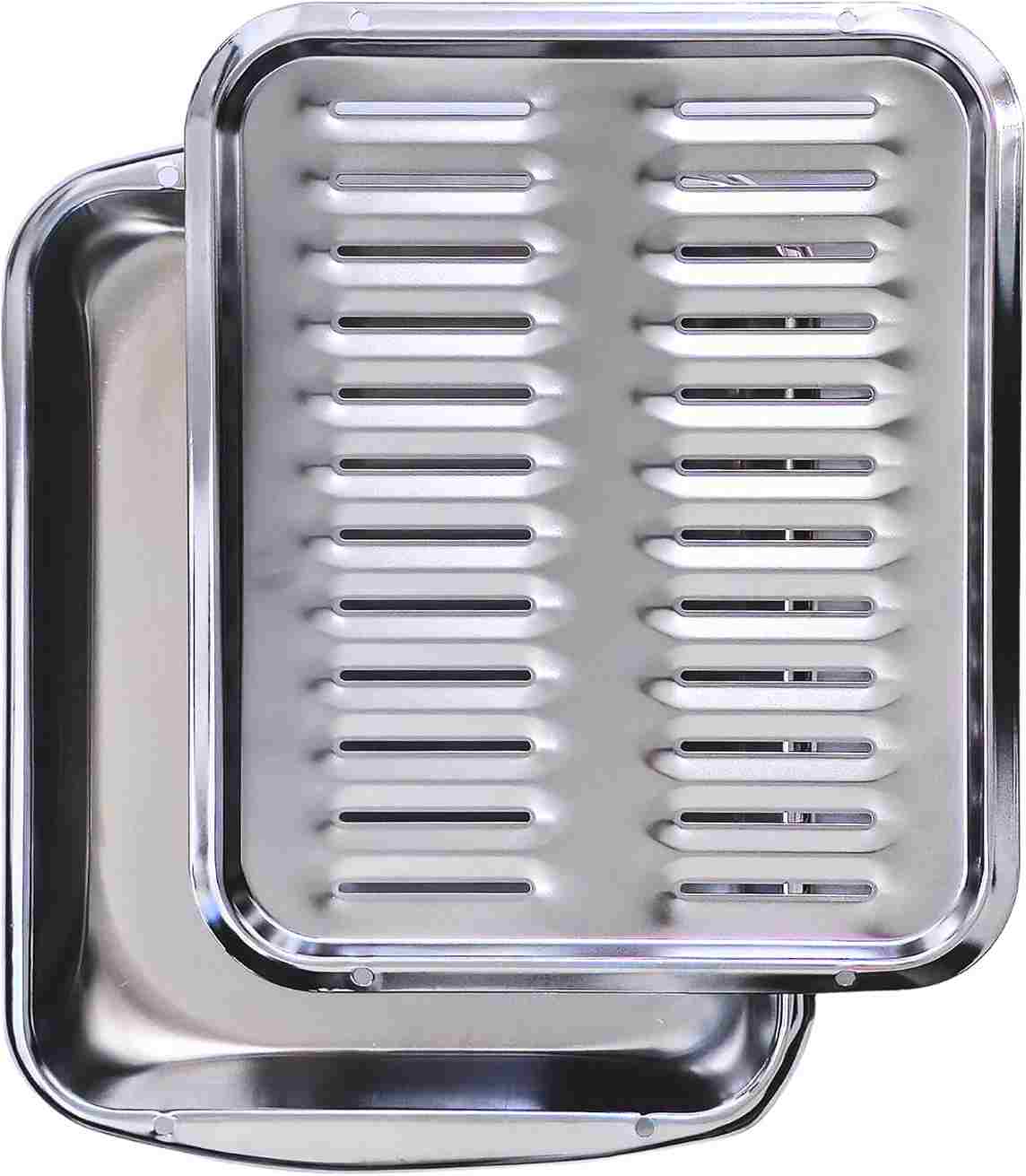 |
Culinarin Chrome-Plated Broiler & Grill Pan | built to double as an indoor grill, not just a drip tray. | Check on Amazon |
What Is a Broiler Pan?
A broiler pan is a two-piece set — a slotted or ribbed rack sitting inside a shallow drip pan — built to sit directly under an oven’s broiler element, where intense heat cooks food from above instead of surrounding it. The rack lifts food out of its own drippings, so fat falls through into the pan below instead of pooling under the food and smoking under that direct heat.
How to Use a Broiler Pan Properly
Broiling isn’t baking with the dial turned up — it’s direct radiant heat with almost no margin for distraction, and most of what goes wrong with a broiler pan comes down to distance, timing, and what’s happening to the pan itself before food ever touches it.
Set the rack distance to match the food, not habit. Broiling cooks by direct radiant heat, so distance is what controls whether the outside chars before the inside catches up. Thin cuts like fish fillets or bacon do best 3 to 4 inches from the element, where the surface browns fast without needing much cook time. Thicker cuts like steaks or bone-in chops need more room — 5 to 6 inches — so the center has time to cook through before the surface goes past done. Get this wrong and you end up with a pan of blackened exteriors sitting on raw middles.
Let food go in before the pan sits empty under heat. An empty porcelain or nonstick-coated pan left under a preheating broiler has nothing absorbing that direct heat, so the surface temperature can spike well past what the coating is rated for. Preheat the broiler itself, then load the pan and slide it in — the food and the light coat of oil underneath it are what should be taking the brunt of that heat, not bare coating.
Oil the rack, not just the food. A dry rack is where sticking actually happens, since the rack — not the bottom pan — is what’s in direct contact with your food. A light wipe of oil on the rack bars before loading keeps fish and chicken from tearing apart when you flip or plate.
Give each piece breathing room. Crowding the rack blocks the airflow that broiling depends on for even browning, and it traps steam between pieces instead of letting it escape — which is how you end up with pale, gray patches instead of an even sear.
Stay at the oven. Broiling can take a piece of food from perfectly done to burnt in under a minute, especially once fat starts rendering and flaring near the element. I keep the oven light on and actually watch rather than setting a timer and walking away — with regular baking that’s fine, with broiling it isn’t.
Tested product picks
1. Nordic Ware Naturals Classic Broiler Pan, 2-Piece
Every steak I’ve ruined under a broiler traced back to the same issue: a pan that couldn’t hold heat evenly before smoke started curling off the rack. The Nordic Ware Naturals Classic Broiler Pan fixes that with uncoated aluminum that heats fast and stays consistent, so meat sears instead of steaming in its own juices. I’ve kept this one in rotation in my kitchen for weeknight salmon and Sunday steaks, and it’s the good broiler pan I reach for when I want a reliable sear.
| Spec | Detail |
|---|---|
| Material | Uncoated natural aluminum (pan + ribbed rack) |
| Dimensions | 15″ x 9.9″ exterior / 12.8″ x 8.4″ cooking surface |
| Oven-safe temp | 500°F |
| Coating | None — naturally nonstick surface |
| Cleaning | Hand wash only |
| Origin | Made in USA |
| Warranty | Lifetime |
Key features
- Ribbed rack lifts food for real grill marks and airflow underneath
- Hardened aluminum alloy resists scratching and warping under direct broiler heat
- No chemical coating to wear off over years of use
- Two-piece nesting design for compact storage
Pros
- Even heat with no hot spots, aluminum’s natural strength
- Nothing to flake or degrade, since there’s no coating at all
- Backed by Nordic Ware’s lifetime warranty
Cons
- Hand wash only — dishwasher detergent discolors the aluminum (cosmetic only, doesn’t affect performance)
- Acidic marinades like vinegar or tomato can pit or darken the pan over time
Best for: cooks who want a coating-free pan built to outlast their oven, not just the return window.
2. Bagean Porcelain Broiler Pan (Whirlpool 4396923 Replacement)
My last broiler pan started shedding its nonstick coating within a year — not surprising, since most Teflon coatings break down around 450°F and broiling runs closer to 525°F. This porcelain-coated pan from Bagean sidesteps that entirely: porcelain holds up at genuine broiler temperatures instead of flaking into your food. I’ve swapped a warped factory pan for one of these before, and the fit was exact. It’s a genuinely capable non stick broiler pan for anyone whose original one gave out.
| Spec | Detail |
|---|---|
| Material | Porcelain-coated steel (2-piece: pan + slotted rack) |
| Dimensions | 16.75″ x 12.75″ |
| Compatibility | Cross-fits Whirlpool 4396923; fits most standard ovens |
| Coating type | Porcelain, not Teflon/PTFE |
| Cleaning | Dishwasher safe |
Key features
- Porcelain coating rated for real broiler heat, not just baking temps
- Slotted top drains fat away from food as it cooks
- Sized as a drop-in replacement for the Whirlpool 4396923 pan
- Dishwasher-safe finish for easier cleanup than bare metal
Pros
- Handles broiler-level heat without the coating breaking down
- Fits ovens beyond Whirlpool despite the cross-reference naming
- Easier cleanup than hand-wash-only aluminum
Cons
- Porcelain-on-steel can chip if dropped or scraped with metal utensils
- Third-party build, so fit tolerances run slightly looser than a genuine OEM part
Best for: replacing a warped or flaking factory broiler pan without paying OEM prices.
3. GE Appliances WB48X10056 Genuine Broiler Pan & Rack
When a stove ships without its broiler pan — or the original one finally rusts through — a look-alike replacement is a gamble on whether it actually seats right in the drawer. The GE Appliances WB48X10056 removes that guesswork: it’s the genuine part GE manufactures for its own ranges, not a third-party approximation. I’ve dropped one into a GE range that was missing its pan entirely, and it slid into place like it came with the oven. As a 2 piece broiler pan, it’s the safest bet when exact fit matters more than price.
| Spec | Detail |
|---|---|
| Material | Black porcelain-coated carbon steel (2-piece: pan + rack) |
| Dimensions | 12-3/4″ x 16-1/2″ |
| Manufacturer | GE Appliances — genuine OEM part |
| Compatible brands | GE, Hotpoint, and related ranges using this part number |
| Cleaning | Dishwasher safe |
Key features
- Manufactured by GE to the exact spec of the original equipment
- Grate elevates food above the drip pan for full air circulation
- Porcelain coating drains fat while resisting stains over repeated use
- Sized specifically for GE-family range broiler drawers
Pros
- Guaranteed fit for GE and Hotpoint ranges using this part number — no measuring required
- Genuine OEM manufacturing, not a generic cross-reference
- Straightforward drawer-slide replacement, no tools needed
Cons
- Priced higher than generic universal alternatives
- GE-family specific, so it’s not the pan to buy for a different oven brand
Best for: GE or Hotpoint owners who want an exact factory replacement, not a universal guess. This is your pick for a genuine pan for broiling with zero fit uncertainty.
4. Culinarin Heavy-Duty Porcelain Broiler Pan
Thin broiler pans warp the first time they meet real heat — I’ve watched a cheap one bow in the middle after just a few uses, which throws off how evenly everything on it cooks. The Culinarin pan is built heavier, with a porcelain coating rated to handle broiler temperatures up to 550°F without breaking down. I’ve broiled thick-cut pork chops on one of these and it came out of the oven exactly as flat as it went in — a porcelain broiler pan built for the heat broiling actually produces, not just baking.
| Spec | Detail |
|---|---|
| Material | Porcelain-coated steel (2-piece: pan + slotted rack) |
| Dimensions | 16.75″ x 13″ |
| Max temp rating | 550°F |
| Color | Black |
| Cleaning | Dishwasher safe |
Key features
- Heavier-gauge steel resists warping under sustained high heat
- Porcelain coating explicitly rated to 550°F broiler temperatures
- Slotted rack separates food from drippings for a drier, crisper sear
- Fits most standard oven broiler drawers
Pros
- Genuinely rated for broiler-level heat, not repurposed bakeware
- Larger cooking surface than most universal replacement pans
- Stays flat under repeated high-heat use
Cons
- Porcelain coating can chip with metal utensils or hard impact
- Black finish shows heat discoloration more visibly than lighter finishes
Best for: broiling thicker cuts where a pan that won’t warp under sustained heat actually matters.
5. Culinarin Chrome-Plated Broiler & Grill Pan
Most broiler pans only do one job, but I like a pan that pulls double duty for indoor grilling when the weather doesn’t cooperate. The Culinarin chrome-plated set is built for exactly that — the same slotted rack that drains fat while broiling steak doubles as a grill-marked surface for vegetables. I’ve used this broiler pan with rack for everything from weeknight salmon to grilled corn in the dead of winter, and the chrome finish has held up to both without flaking.
| Spec | Detail |
|---|---|
| Material | Chrome-plated steel (2-piece: pan + rack) |
| Dimensions | 16″ x 13″ |
| Finish | Polished chrome (silver) |
| Use cases | Broiling, roasting, indoor grilling |
| Cleaning | Soak-and-wash recommended for baked-on residue |
Key features
- Chrome plating adds scratch resistance beyond standard porcelain coatings
- Slotted rack doubles as an indoor grill surface, not just a drip rack
- Even heat circulation across the full cooking surface
- Fits standard broiler drawers without modification
Pros
- More scratch-resistant than porcelain, so metal tongs aren’t a concern
- Genuinely doubles as a grill pan, not just marketing language
- Sleek finish that doesn’t discolor the way black porcelain can
Cons
- Baked-on grease needs an overnight soak rather than a quick wipe-down
- Slightly smaller cooking surface than the heavy-duty porcelain pick above
Best for: one pan that handles both broiling and indoor grilling.
OEM Replacement vs Upgrade Pan — Which You Actually Need
Which one you need comes down to a single question: does your oven have a broiler drawer, or do you broil with the pan sitting on a rack inside the main cavity?
Most broiler pan searches actually split into two different buyer intents that rarely get addressed separately — someone whose factory pan warped, rusted, or went missing and just needs an exact replacement, and someone who wants to cook better food and isn’t tied to any drawer dimensions at all. Buying the wrong type solves the wrong problem.
If your oven has a dedicated broiler drawer — the pull-out compartment beneath the main cavity, common on older gas ranges — fit is non-negotiable. The pan has to seat into the drawer’s internal guides and let the drawer close flush, and that’s a mechanical fit problem no amount of “better” material fixes. This is where a genuine OEM part, or a third-party pan explicitly cross-referenced to your model number (like a “Whirlpool 4396923 replacement”), earns its higher price — it’s built to the drawer’s actual tolerances, not an approximation.
If your oven broils with the pan set on the main oven rack — how most modern electric and gas ranges are designed to work — drawer dimensions are irrelevant, and this is where upgrading actually pays off. A heavier, better-built pan in aluminum or thick porcelain will outperform a stock replacement on searing and durability, since you’re not constrained by a drawer’s exact footprint.
The tell: if your existing pan slides into a drawer that has to close around it, replace it with something built to that drawer’s dimensions. If it just rests on a rack, you’re free to buy for performance instead of fit.
Material & Safety Guide: Steel vs. Porcelain vs. Aluminum vs. Ceramic
The material question isn’t about which coating looks nicest — it’s about which one can survive direct radiant heat without breaking down. That’s a higher bar than “oven-safe,” and it’s where most buying advice gets vague.
Uncoated aluminum has no coating to fail in the first place. It heats fast and browns evenly, and its only real limitation is reactivity — acidic marinades like vinegar or tomato can pit or darken the surface over time, which is cosmetic, not a safety issue.
Bare stainless steel is the most broiler-tolerant material there is, precisely because there’s nothing coating it to degrade. It’s the one material broiler-safe cookware guidance recommends without caveats.
Porcelain (enamel) coating is fused glass baked onto steel during manufacturing, not a sprayed-on polymer — which is why it survives broiler heat that would destroy a plastic-based coating. It’s what most dedicated broiler pans are actually built from.
Ceramic nonstick coatings are where labeling gets genuinely misleading. Despite being marketed as a “natural” Teflon alternative, most ceramic nonstick cookware is only rated to around 500°F, and broiler surface temperatures routinely exceed that — which is why brands like All-Clad and Calphalon explicitly state their ceramic lines aren’t broiler-safe, no matter what the general oven-safe label says. A handful of premium ceramic lines are rated higher and genuinely broiler-safe, but that’s the exception — check the specific rating rather than assuming “ceramic” automatically means safe.
The PFOA-free vs. PTFE/PFAS-free distinction matters more than most buyers realize. PFOA was a manufacturing chemical used to produce Teflon that the US industry phased out around 2013 — “PFOA-free” is a claim about how a coating was made, not what it’s made of. PTFE (Teflon itself) is the actual nonstick polymer, and it’s PTFE, not PFOA, that starts breaking down above roughly 500°F and releasing fumes. A pan can be entirely PFOA-free and still be built with PTFE — meaning it’s still not broiler-safe. If broiler safety is the goal, look for “PTFE-free” or “PFAS-free” specifically; “PFOA-free” alone says nothing about heat performance.
| Material | Broiler-Safe? | Why |
|---|---|---|
| Uncoated aluminum | Yes | No coating to degrade; only reactive to acidic foods |
| Bare stainless steel | Yes | No coating at all — highest heat tolerance |
| Porcelain/enamel | Yes | Fused glass coating, not a polymer |
| Ceramic nonstick | Depends on rating | Most rated to ~500°F only — check the label |
| PTFE (Teflon) nonstick | No | Degrades and releases fumes above ~500°F |
Sizing & Fit Guide: Universal-Fit vs Brand-Specific Dimensions
Broiler pan sizing comes down to a question most buying guides skip: are you fitting a pan into a dedicated broiler drawer, or just setting one on an oven rack? Those are two separate fit issues, and each requires a different level of tolerance.
Standard full-size pans run roughly 16″ to 17″ long by 12.75″ to 13″ wide, sized for the 30-inch ranges in most US kitchens. This is the size behind most name-brand and third-party broiler pans, and it’s the safe default when you’re setting the pan on a rack rather than sliding it into a drawer.
Small/compact pans run closer to 7″ x 11″ or smaller, built for toaster ovens, countertop ovens, and the narrower 24-inch ranges common in apartments. A standard-size pan in one of these doesn’t just look oversized — it often won’t let the oven door close.
Brand-specific OEM dimensions are tighter than they look. A GE WB48X10056 measures 12-3/4″ x 16-1/2″; a Whirlpool 4396923 measures 16.75″ x 12.75″. Those look interchangeable at a glance, but broiler drawers have narrow clearance, and even half an inch of extra width can keep a drawer from sliding shut. GE alone makes this part in three sizes — small, large, and extra-large — under three different part numbers, so matching the brand isn’t enough; the exact model matters too.
A universal fit offers flexibility, but it doesn’t guarantee a perfect fit. Third-party universal pans are sized to split the difference across several major OEM dimensions, which works fine set on an oven rack. It’s a less reliable bet for a broiler drawer specifically, where a snug fit against the drawer’s internal guides is what lets it close flush.
The rule that actually works: if your oven has a broiler drawer beneath the main cavity, measure that drawer’s interior length, width, and depth before buying — don’t just match the oven’s brand. If your oven broils with the pan set on a rack inside the main cavity, which is how most modern ranges work, sizing is far more forgiving and a standard full-size pan fits almost anything.
How to clean a broiler pan
Fat and drippings on a broiler pan sit directly under an active heating element, which essentially carbonizes them onto the surface in real time rather than just browning them the way a baking sheet’s contents do. That’s why a quick wipe-down so rarely works.
Deal with it while it’s still warm, not hot. Soaking the pan in hot, soapy water as soon as it’s cool enough to handle — while you’re eating, not after — keeps drippings from fully hardening. Once baked-on fat cools completely, it bonds to the surface and needs real scrubbing to shift.
Match the method to the material:
- Porcelain/enamel — usually dishwasher-safe; for stubborn spots, a baking soda paste left on 15–20 minutes loosens residue without needing a metal pad that can chip the coating
- Uncoated aluminum — hand wash only, since dishwasher detergent discolors aluminum through oxidation; a nylon scrub pad handles residue without scratching
- Bare stainless steel — the one material where steel wool and an oxalic-acid cleaner (like Bar Keeper’s Friend) are genuinely useful, since there’s no coating to damage
- Chrome-plated — soak rather than scrub, and dry immediately after; prolonged repeated soaking can dull the plating
Foil is prevention, not a cleaning step. Lining the pan before broiling cuts cleanup dramatically, but it doesn’t stop fat from hitting the rack itself — the rack still needs washing every time.
Dry it fully before storing. Leftover moisture on aluminum or bare steel invites oxidation or rust between uses — towel-dry rather than air-drying if you’re putting it away right after washing.
Faq
Is a specific type of pan required for broiling?
Yes. Broiling exposes cookware to intense, direct heat from above that most regular bakeware and nonstick pans aren’t rated for. A dedicated broiler pan’s slotted rack lets fat drain away instantly instead of pooling under the food, which is what prevents smoking, flare-ups, and scorched drippings under that heat.
Can you use a broiler pan in the oven?
Yes — a broiler pan works two ways: set on a rack directly under the broiler element for high, direct heat, or used at standard oven temperatures like any other bakeware. Material matters here: uncoated aluminum, stainless steel, and porcelain handle both uses, while nonstick-coated pans should stay out of broiler mode.
What are the signs that a pan is safe to use under the broiler?
Check the material, not just the label. Uncoated aluminum, stainless steel, cast iron, and porcelain/enamel handle genuine broiler heat since they have no coating to break down. For nonstick pans, look for an explicit “broiler-safe” rating — “oven-safe to 500°F” often refers to baking temperatures, not the more intense direct heat broiling produces.
Can you use a baking pan instead of a broiler pan?
Not safely, no. A baking pan is a single solid vessel with nowhere for rendered fat to go, so under direct broiler heat it pools under the food, smokes, and can flare up. A rimmed baking sheet fitted with a separate wire rack works as a substitute in a pinch, but a real broiler pan is built to drain fat by design.
Conclusion
That warped lamb-chop pan I mentioned earlier didn’t survive another broiler session — it went in the recycling bin the same week, and every pan on this list is one I’d trust to replace it. The differences between them come down to exactly two things: what your oven actually needs from a fit standpoint, and how much heat the material can genuinely take before it starts working against you instead of for you.
If you’re not dealing with a broiler drawer, the Nordic Ware Naturals Classic Broiler Pan is the one I’d buy first — there’s no coating to ever fail, and that’s worth more than a slightly lower price tag over years of use. If your oven does have a drawer, match the pan to your model rather than guessing, since that’s the one variable no amount of material quality can fix.
Whichever one you pick, the material and sizing guides above should tell you everything you need before you check out — broiling shouldn’t come down to trial and error with your smoke detector.
Affiliate disclosure
HomePlora is reader-supported. When you buy through links on this page, we may earn a commission on qualifying purchases at no additional cost to you — the price you pay stays exactly the same whether you use our link or not. This doesn’t influence which products we recommend: every pan in this article was chosen based on its own material, construction,tested in our kitchen and fit for real broiler use, not on which one pays the highest commission.

Hi, I’m Muhammad Din. I test and compare kitchen tools in my own kitchen before I ever recommend them — if it’s in a guide on HomePlora, I’ve used it or dug deep enough to know exactly where it holds up and where it doesn’t. My goal is simple: help you find tools that actually earn a spot in your kitchen, without wasting money on ones that don’t.