

Introduction
The best gravy boat for serving is the one that stays steady when it’s passed hand to hand and still pours cleanly even when it’s half-empty — not necessarily the biggest one or the most expensive one on the shelf. That’s a different question than just “which gravy boat is good,” because serving at a table means handling, tilting, and refilling in front of people, not just holding gravy in a cupboard between holidays. After testing 10 gravy boats over a month — filling, pouring, passing, and cleaning each one the same way — a few designs held up to that kind of real handling better than their spec sheets suggested. Below: the picks that actually performed well at the table, how to size one for your group, and what holds up once it’s being passed around instead of sitting still.
What Actually Makes a Gravy Boat Work
A gravy boat performs well when its spout pours cleanly, its base stays stable on the table, and its capacity suits the number of people you’re serving. Get any of these wrong, and you may end up dealing with messy drips, struggling to handle a full boat, or making repeated trips to the kitchen for refills.
The spout is doing more work than people give it credit for. Gravy clings to a rounded rim because there’s nothing to break the surface tension — that’s why cheap boats dribble down the side no matter how carefully you pour. A well-designed spout has a defined point where the lip cuts off sharply, so the gravy separates cleanly instead of following the curve of the bowl back down.
Stability comes from the base and the handle working together, not either one alone. A footed, wider base resists tipping when you’re leaning across the table to hand it off. A handle set at the right angle keeps the weight centered in your grip, so a full boat doesn’t strain your wrist or tilt on its own as you pour.
Material decides how long the gravy stays hot after it leaves the pan. Thicker ceramic and porcelain hold onto heat from the gravy itself for a while; thin stainless steel loses it fast unless the boat is double-walled or sitting on a heated base. (More on how each material actually performs further down.)
Size only matters relative to your table, not on its own. A bigger boat isn’t automatically the better choice — a smaller one that matches your usual headcount will out-perform an oversized one that’s mostly empty and awkward to pour from. (We’ll get specific on sizing in a bit.)
Get those four right, and everything else — color, shape, whether it comes with a saucer — is just preference.
Quick Comparison:Best Gravy Boats at a Glance
| Image | Product | Details | Price |
|---|---|---|---|
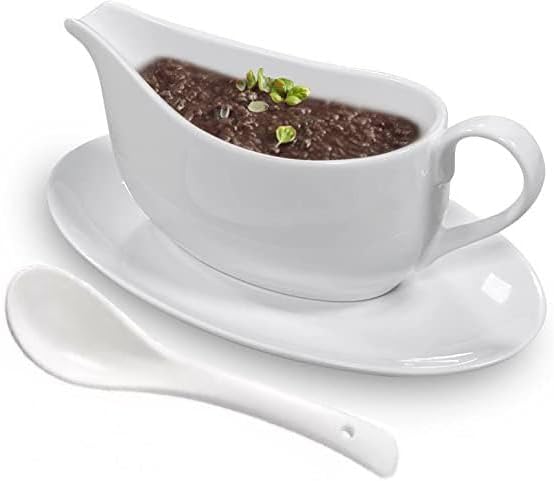 |
Qlans Ceramic Gravy Boat Set | A 3-piece ceramic gravy set with matching ladle and saucer, microwave and dishwasher safe. | Check on Amazon |
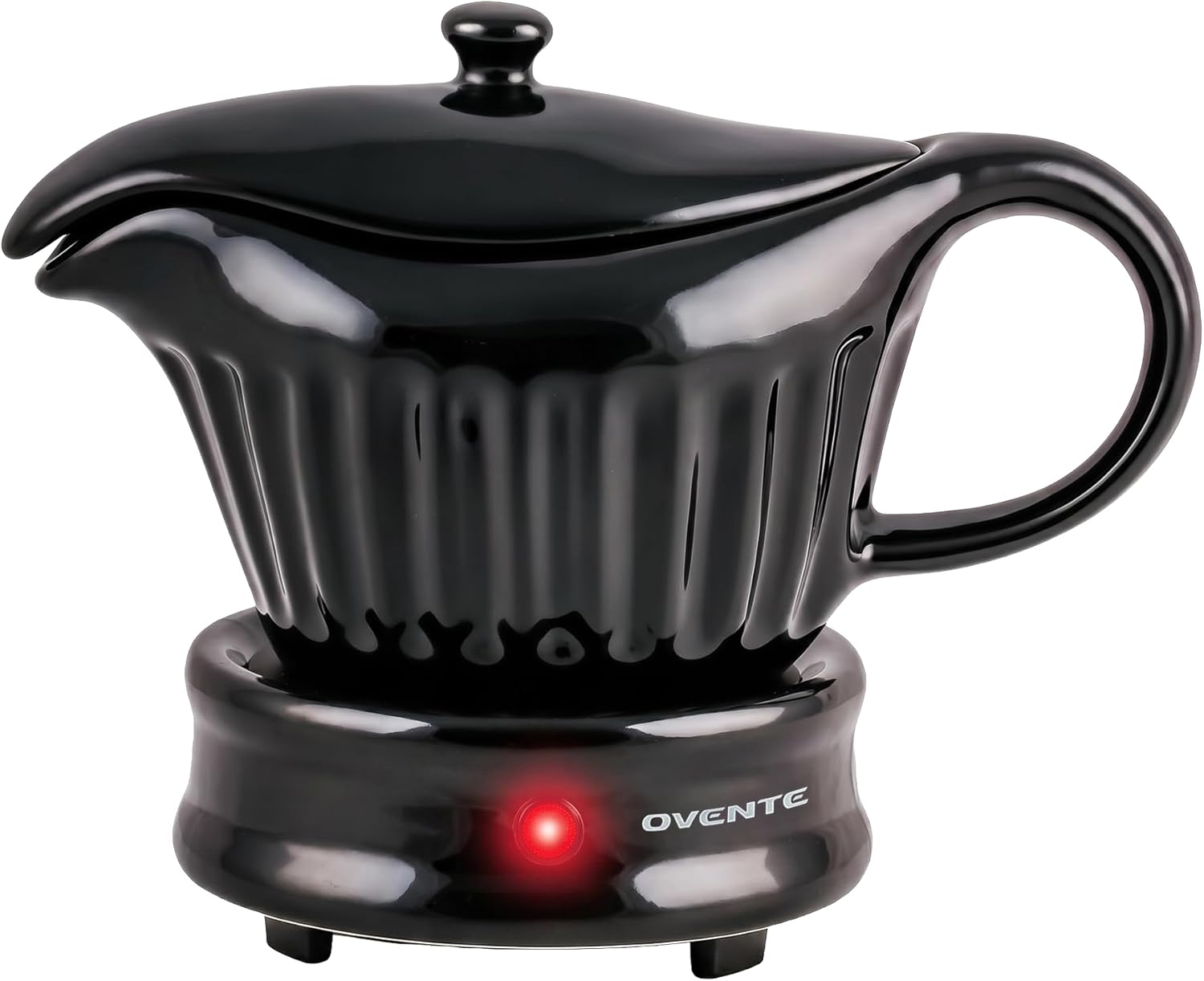 |
OVENTE Electric Gravy Warmer | A 13.5-ounce ceramic gravy boat with an electric warming base, lid, and easy-pour spout for keeping sauces warm during smaller meals and gatherings. | Check on Amazon |
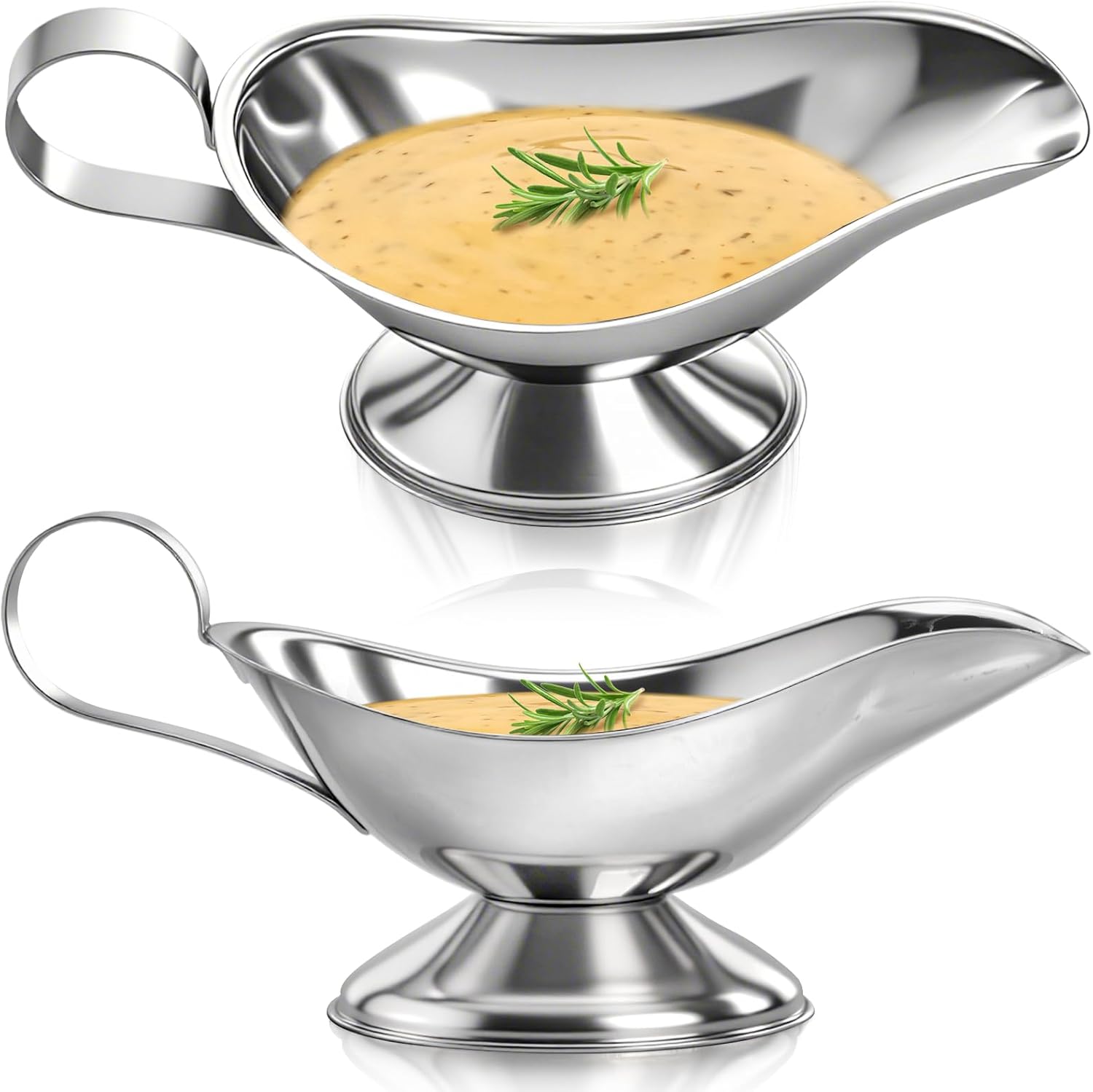 |
ZOOFOX 2-Piece Stainless Steel Gravy Boats | Two durable 8-ounce stainless steel gravy boats with ergonomic handles, stable bases, and easy-pour spouts for cleaner everyday sauce serving. | Check on Amazon |
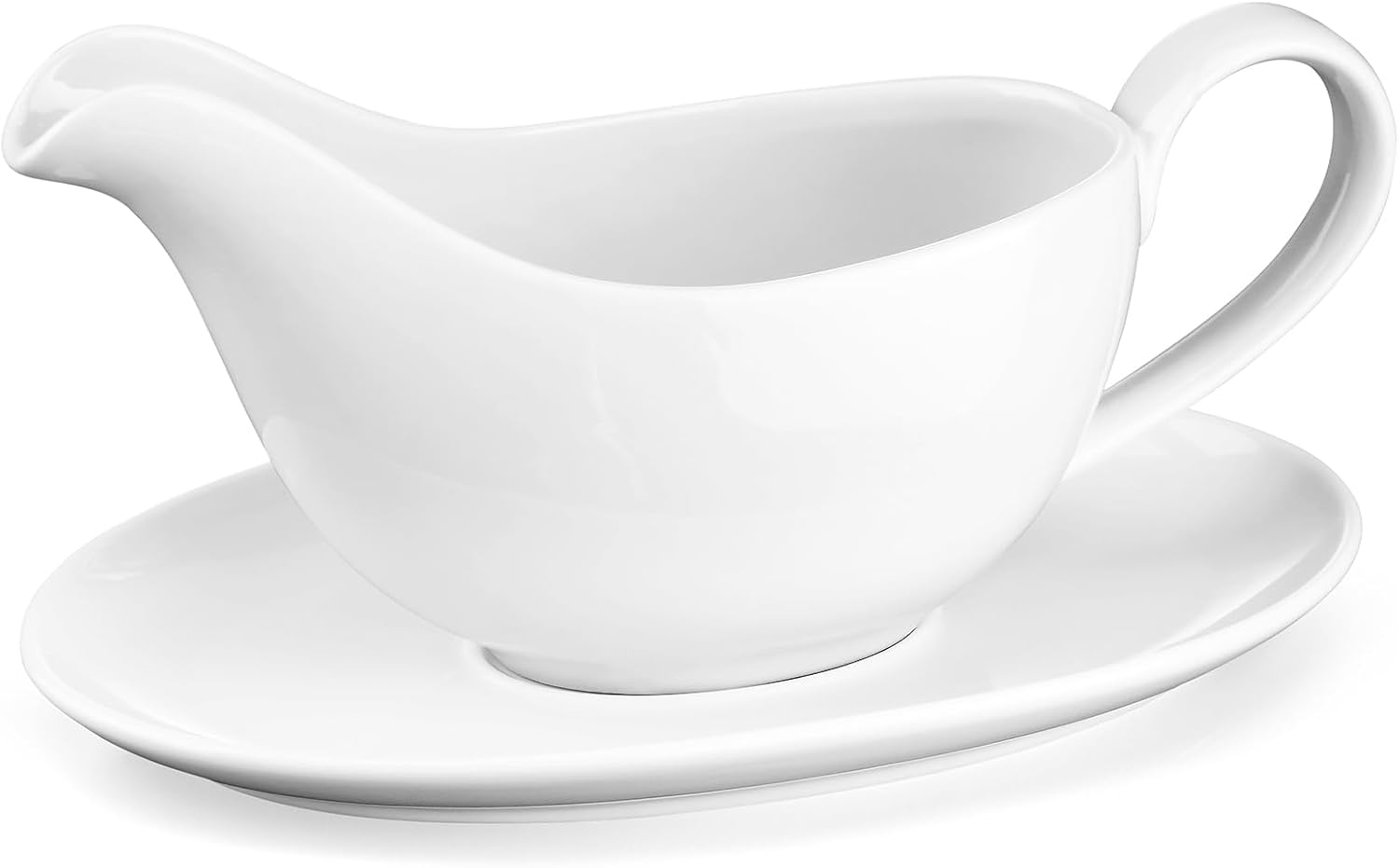 |
Yedio 18-Oz Porcelain Gravy Boat Set | An 18-ounce white porcelain gravy boat with matching saucer, drip-resistant spout, and versatile microwave- and dishwasher-safe design for family meals and entertaining. | Check on Amazon |
How I Tested Gravy Boats in My Kitchen
I tested 10 gravy boats over the course of a month, running each through the same routine rather than judging by the spec sheet alone. Every boat got filled to around 75% capacity with the same batch of gravy and poured over mashed potatoes and turkey to see how the spout handled a full plate, not an empty sink. Each one went through the dishwasher repeatedly to check for staining, scratching, or a dulled glaze, and sat stacked together in a cabinet for stretches at a time to see which held up to normal, everyday storage without chipping. The goal wasn’t naming one universal winner — it was checking which design claims (dripless spout, chip-resistant glaze, keeps gravy hot) actually held up once real gravy, real heat, and normal handling were involved.
Tested Picks
1. Qlans 3-Piece Ceramic Gravy Boat, Ladle & Saucer Set (17 oz)
Nobody wants to be the one refilling a leaking bowl mid-dinner while gravy runs down the side onto the tablecloth. That’s usually because most gravy boats don’t come with a matching ladle or saucer, so you end up improvising with mismatched spoons and a napkin underneath. This ceramic gravy boat with ladle solves that by giving you all three pieces built to fit together, so nothing wobbles or drips when it’s passed around. In my kitchen, the wide mouth loaded straight from the saucepan without splashing, and the saucer caught the stray drops on its own.
| Detail | Info |
|---|---|
| Brand | Qlans |
| Material | Ceramic |
| Capacity | 17 fl oz |
| Set includes | Gravy boat, ladle, saucer |
| Dimensions | 8″W x 3.5″H |
| Weight | 1.2 lbs |
| Shape | Round |
| Color | White |
| Safe for | Microwave, dishwasher, freezer |
Key Features
- Complete 3-piece set — boat, ladle, and saucer made to match, so you’re not hunting for a spare spoon
- 17 oz holds enough for a mid-size family dinner without a mid-meal refill
- Microwave-safe, so leftover gravy reheats right in the same dish
- Freezer-safe for make-ahead gravy the night before
- Doubles as a server for salad dressing, creamer, or broth, not just gravy
- Dishwasher safe — no hand-washing required after a busy dinner
Pros
- Ladle and saucer already match, so you skip buying pieces separately
- Wide opening makes pouring in from a hot pan easy
- Multi-use beyond gravy — dressing, creamer, broth all work fine in it
- Simple white design fits almost any table setting
Cons
- Ceramic is heavier and chips more easily than stainless steel if bumped on a crowded table
- No lid, so gravy cools faster than an insulated gravy boat would
- The saucer catches light drips, not a hard splash if it’s knocked
Best for
Families who want one matching, ready-to-use gravy set for holiday dinners instead of piecing together a bowl, spoon, and tray separately.
2. OVENTE 13.5-Ounce Electric Gravy Warmer with Ceramic Pot
Gravy often loses its appeal when it sits on the table for too long, especially during a relaxed holiday meal where everyone serves themselves at different times. This electric gravy warmer tackles that problem with a heated base that keeps sauces ready to serve instead of relying on a preheated bowl alone. The 13.5-ounce capacity suits smaller dinners and intimate gatherings, while the lid and easy-pour spout add serving convenience. The tradeoff is its 2.6-pound weight and the need to keep the warming base near an outlet.
| Specification | Details |
|---|---|
| Brand | OVENTE |
| Capacity | 13.5 fl oz |
| Material | Ceramic pot |
| Color | Black |
| Power Source | Electric |
| Voltage | 120V |
| Heating Base | Yes |
| Lid | Yes |
| Spout | Easy-pour design |
| Indicator Light | Yes |
| Handle | Cool-touch handle |
| Dimensions | 8.1″D × 6.21″W × 6.14″H |
| Weight | 2.6 lbs |
| Dishwasher Safe | Pot and lid; base should be cleaned separately |
| Best Use | Home meals, small parties, Thanksgiving, and holidays |
Key Features
- Electric warming base: Helps keep gravy and sauces warm while they sit on the dining table.
- 13.5-ounce capacity: Better suited to small gatherings and family meals than large holiday crowds.
- Ceramic serving pot with lid: The covered design helps retain warmth and protects the sauce between servings.
- Easy-pour spout: Designed to make serving gravy and other sauces more controlled.
- Cool-touch handle: Gives you a more comfortable grip while carrying and pouring.
- Indicator light: Provides a quick visual reminder that the warming base is powered on.
- Dishwasher-safe pot and lid: Makes cleanup easier after serving, while the electrical base requires separate care.
Pros
- Keeps gravy warm longer than a standard serving vessel
- Useful for meals where guests serve themselves over time
- Lid helps reduce heat loss and protects the contents
- Easy-pour spout and large handle make table serving more convenient
- Ceramic pot and lid are dishwasher safe
- Suitable for gravy, sauces, butter, and other warm pourable foods
Cons
- 13.5 ounces may be too small for a large Thanksgiving dinner
- Requires access to a power outlet during serving
- 2.6-pound weight makes it less convenient to move around than a simple ceramic gravy boat
- Warming base needs separate cleaning and should not be treated like the dishwasher-safe pot and lid
Best For
Small families, couples, and hosts who want an electric gravy boat warmer to keep sauces warm during longer meals. It’s particularly useful for Thanksgiving or holiday dinners where guests may serve themselves at different times, but the 13.5-ounce capacity makes it less suitable for large gatherings without frequent refilling.
3. ZOOFOX 2-Piece Stainless Steel Gravy Boat Set
When you’re serving gravy or sauce to a table full of guests, a small serving vessel can become frustrating if it tips easily, drips down the side, or leaves you scrambling for a second container. This two-piece set solves that problem by giving you two compact 8-ounce servers with stable bases, comfortable handles, and easy-pour spouts. This gravy boat design is especially practical for everyday meals, although the smaller capacity means larger gatherings may require refilling.
| Specification | Details |
|---|---|
| Brand | ZOOFOX |
| Set Includes | 2 gravy boats |
| Material | Stainless steel |
| Capacity | 8 oz each |
| Color | Silver |
| Shape | Oval |
| Dimensions | 6.5″L × 3.7″W × 3″H each |
| Handle | Ergonomic |
| Base | Non-slip, footed design |
| Spout | Easy-pour, drip-resistant design |
| Care | Dishwasher safe |
| Best Use | Gravy, sauces, dressings, broth, creamers, syrups |
Key Features
- Set of two: Useful when serving two sauces at once or placing gravy servers at opposite ends of a larger table.
- Stainless steel construction: Durable, rust-resistant, and less prone to breaking than ceramic or glass.
- 8-ounce capacity: Compact for everyday meals, smaller gatherings, and serving multiple sauces.
- Easy-pour spout: Helps direct gravy and other pourable foods more neatly onto the plate.
- Ergonomic handle: Provides a comfortable grip when carrying and serving.
- Stable footed base: Helps keep each server steady on the dining table.
- Versatile serving use: Suitable for gravy, salad dressing, broth, creamers, syrups, and other sauces.
- Dishwasher safe: Makes cleanup easier after busy family meals.
Pros
- Comes as a convenient set of two
- Durable stainless steel construction
- Compact size works well for everyday serving
- Stable base helps reduce tipping
- Comfortable handle and controlled pouring design
- Dishwasher safe for easier cleanup
- Can serve both hot and cold sauces
Cons
- 8-ounce capacity may be too small for large holiday gatherings
- Stainless steel doesn’t offer the same traditional appearance as ceramic or porcelain
- Two separate boats take up more table space when both are used
- No included ladle, so you may need a separate serving utensil for thicker gravy
Best For
Families and hosts who want two durable, compact sauce servers for everyday meals, smaller gatherings, or serving different sauces at the same time. This set is particularly useful when practicality and easy cleanup matter more than the formal look of traditional ceramic tableware.
4. Yedio 18-Ounce White Porcelain Gravy Boat with Saucer
When you’re serving turkey or roast beef at a holiday table, a small gravy container can mean constant refilling, while a poor spout can leave drips across the tablecloth. This larger kitchen gravy boat addresses both problems with an 18-ounce porcelain vessel and matching saucer that gives you more serving capacity and a place to catch stray drips. The oval shape suits both casual and formal tables, although the larger design takes up more space than compact gravy servers.
| Specification | Details |
|---|---|
| Brand | Yedio |
| Material | Porcelain |
| Capacity | 18 oz |
| Color | White |
| Shape | Oval |
| Style | Art Deco |
| Dimensions | 5.7″W × 4.5″H |
| Weight | 1.1 lbs |
| Includes | Gravy boat and saucer |
| Spout | Drip-resistant design |
| Microwave Safe | Yes |
| Dishwasher Safe | Yes |
| Oven Safe | Yes |
| Freezer Safe | Yes |
| Best Use | Gravy, sauces, dressings, syrup, milk, and broth |
Key Features
- 18-ounce capacity: Provides more room for gravy at family dinners and holiday meals, reducing the need for frequent refills.
- Matching saucer: Catches stray drips from the spout and helps protect the tablecloth from small spills.
- Porcelain construction: The smooth white finish works well with everyday dinnerware and more formal table settings.
- Designed for controlled pouring: The sleek spout is intended to make serving gravy and sauces cleaner and more precise.
- Microwave and oven safe: Allows the boat to be used for warming and serving, but oven and microwave handling requires care because the porcelain can become hot.
- Dishwasher and freezer safe: Adds convenience for meal preparation, storage, and cleanup.
- Versatile serving vessel: Works for gravy, salad dressing, syrup, broth, milk, and other pourable foods.
Pros
- Larger 18-ounce capacity suits family and holiday meals
- Matching saucer helps contain drips
- White porcelain looks appropriate for casual or formal dining
- Smooth surface is easy to clean
- Suitable for microwave, oven, freezer, and dishwasher use
- Useful for more than traditional gravy
Cons
- Larger size takes up more table space than a compact gravy boat
- Porcelain can still chip or break if dropped or knocked against hard surfaces
- The boat and saucer may become hot after microwave or oven use
- 18 ounces may still require refilling for very large gatherings
Best For
Families and hosts who need a larger serving vessel for turkey gravy, roast beef sauce, or other pourable foods at holiday dinners and family gatherings. The 18-ounce capacity and matching saucer make it a practical choice when you want fewer refills and a cleaner table presentation without sacrificing a traditional white porcelain look.
What Size Gravy Boat Do You Actually Need?
For most households, a 12- to 18-ounce gravy boat is a practical range for family meals. A 6- to 10-ounce gravy boat is generally a good fit for smaller meals or serving an additional sauce, while 18 to 24 ounces or more is better suited to larger gatherings. The right size depends on your guest count, how much gravy people typically use, and how often you want to refill the boat.
| Gravy Boat Capacity | Best For | Typical Use |
|---|---|---|
| 6–10 oz | 1–4 people | Small meals, individual sauces, dressings |
| 10–14 oz | 2–6 people | Everyday family dinners |
| 14–18 oz | 4–8 people | Family meals and smaller gatherings |
| 18–24 oz | 6–10+ people | Holiday dinners and larger tables |
| 24+ oz | Large gatherings | Big meals or frequent gravy service |
These are practical starting points, not strict serving rules. People use gravy differently depending on the meal and personal preference. A table where everyone lightly drizzles gravy will need less capacity than one where guests generously cover mashed potatoes, turkey, or roast beef.
Choose Your Gravy Boat Size Based on Headcount, Not the Occasion
A holiday dinner doesn’t automatically require the largest gravy boat. What matters first is how many people you’re serving.
A Thanksgiving meal for four may need no more gravy capacity than an ordinary Sunday dinner for four. Likewise, a casual family meal for eight can require just as much serving capacity as a larger holiday gathering with the same number of guests.
Think about your normal guest count first, then consider how generously your household serves gravy.
For 1–4 People: 6–10 Ounces
A smaller gravy boat is often enough for a couple or small household. It takes up less space on the table and is generally easier to carry and pass around when filled.
This range can also work well when gravy is served alongside another sauce, dressing, or condiment and you want separate vessels for each.
For 4–8 People: 12–18 Ounces
This is a versatile range for many family kitchens. A medium-sized gravy boat provides useful capacity for a family meal without taking up excessive space on the table.
An 18-ounce gravy boat can be a practical choice for Sunday roasts and smaller Thanksgiving or Christmas meals, particularly when several guests are likely to have second servings.
For 8–10+ People: 18–24 Ounces or More
Larger gatherings can empty a small gravy boat quickly. Moving into the 18- to 24-ounce range can reduce the need for frequent trips back to the kitchen.
However, one oversized boat isn’t always the best solution. For a long table, two medium-sized gravy boats may be easier to pass around and can put gravy within reach of more guests.
Maximum Capacity Isn’t the Same as Comfortable Serving Capacity
The capacity printed on a gravy boat usually describes how much the vessel can hold, but you don’t necessarily want to fill it right to the rim.
Leaving some space at the top makes the boat easier to carry and gives you more room to tilt it when pouring. This is particularly helpful when serving hot gravy around a busy dining table.
If you regularly need almost the entire capacity of your current gravy boat, moving up to the next size may be more practical than filling it to the brim every time.
What If You Serve More Than One Sauce?
The number of sauces on your table can change the size you need.
If gravy is the only pourable sauce, one larger boat may be the simplest option. But if you’re serving gravy alongside another sauce or dressing, two smaller boats can be more useful than one oversized vessel.
For example:
- One 8-ounce boat: Suitable for a smaller serving of one sauce
- Two 8-ounce boats: Useful for serving gravy and a second sauce separately
- One 18-ounce boat: Better when you want one larger serving vessel
- Two medium boats: Helpful for larger tables or different sauce preferences
This approach also means you can keep each sauce separate rather than repeatedly refilling and cleaning one vessel during the meal.
Is a Bigger Gravy Boat Always Better?
No. More capacity is useful only when you actually need it.
A large gravy boat can be heavier when full and may take up more table space than necessary. If you normally serve only a few people, a smaller vessel can be easier to handle and store.
The better rule is simple: pick the smallest gravy boat that comfortably serves your usual meal without needing frequent refills.
When Should You Buy a Larger Gravy Boat?
Consider a larger model if:
- You regularly host large family dinners.
- You serve gravy with roast turkey, beef, or other substantial meals.
- Your guests commonly ask for second servings.
- You want to minimize trips back to the kitchen.
- Your current gravy boat frequently needs refilling during dinner.
If you only host a large gathering occasionally, you don’t necessarily need an extra-large boat. Keeping additional gravy warm in the kitchen and refilling the serving vessel when needed may be more practical.
When Is a Smaller Gravy Boat the Better Choice?
A smaller model may be the better fit when:
- You typically prepare meals for just one to four people.
- Gravy is an optional addition rather than the main part of the meal.
- Your dining table has limited space.
- You regularly serve multiple sauces.
- You prefer a lighter vessel that’s easy to pass around.
For everyday meals, a smaller gravy boat can also be easier to store and clean than a large serving piece.
For most families, a 12- to 18-ounce gravy boat offers a useful balance between capacity and everyday practicality. Choose around 6–10 ounces for smaller meals, consider 18–24 ounces for larger gatherings, and think about using two medium-sized boats when you need to serve different sauces or cover a long table.
The goal isn’t to buy the biggest gravy boat available. Choose a size that gives your guests enough gravy while keeping the vessel comfortable to carry, easy to pass around, and practical for your dining table. Your usual guest count and serving habits matter more than whether the meal is an ordinary Sunday dinner or a major holiday.
How to Use a Gravy Boat Without Making a Mess
Most spills happen from three habits: filling the boat too close to the rim, pouring too fast, and tilting it further than needed once the stream has already started. Pouring slowly, keeping the boat at a gentle angle, and stopping before the final drops run down the spout can help prevent most common serving spills.
Overfilling Is Usually the First Mistake
A gravy boat filled all the way to the rim leaves no room to tilt without gravy reaching the lip immediately. Filling it to roughly 75–80% of stated capacity gives enough headroom that a normal tilt doesn’t send gravy over the edge before you’re ready to pour.
The Pour: Angle, Speed, and the Twist at the End
Tilt the boat slowly, at a shallower angle than feels natural — a steep, fast tilt sends gravy out in a wider stream that’s harder to aim, and that’s what tends to land wide of the plate. A slow, shallow tilt keeps the stream narrow and closer to the spout’s edge, where it’s easier to control.
Hold it close to the plate rather than pouring from a height — the shorter the drop, the less the stream drifts off course before it lands.
When you’re done, twist the boat slightly upward instead of pulling it away in one motion. A quick lift often leaves a trailing drip running down the outside of the spout; a small upward twist tends to cut the stream off at the lip instead.
Thick and Thin Gravy Don’t Pour the Same Way
Thin gravy moves fast and drips easily if the boat is tilted too far, so a smaller, more controlled tilt works better than a big pour. Thick gravy moves slowly and can cling to the spout on its way out — for very thick batches, a spoon or ladle assist is often more reliable than tilting alone, since it doesn’t depend on gravity to keep the flow even.
The Real Risk Point Isn’t the Pour — It’s the Handoff
Many gravy stains occur after pouring, when leftover gravy remains around the spout or collects underneath as the boat is placed down or handed to another person. Setting it down on a saucer or small plate — rather than directly on the tablecloth — catches that residual drip before it reaches the fabric.
A Few Habits That Prevent Most Spills
- Fill to about 75–80% capacity, not the rim
- Pour slowly, at a shallow angle, held close to the plate
- End with a slight upward twist instead of pulling away
- Use a saucer or small plate underneath when the boat isn’t actively being poured
- For thick gravy, use a spoon or ladle instead of relying on tilt alone
None of these guarantee a completely spill-free table — gravy is unpredictable and tablecloths are patient — but together they remove most of the avoidable mess.
How Much Gravy Should You Put in a Gravy Boat?
A common guideline is about 2–4 tablespoons (1–2 fl oz) of gravy per person, with a bit extra made for second helpings. For a table of 6, that works out to roughly 1.5–2 cups total — enough to fill a mid-size gravy boat with some kept in reserve for a refill.
Per-Person Amount, and Why It’s a Range
The 2–4 tablespoon range exists because how much gravy someone wants depends heavily on what’s on their plate. Mashed potatoes and stuffing soak up gravy quickly, so those plates tend to land at the higher end of the range; a plain slice of turkey or a roast usually needs less to feel properly covered.
How Much to Prepare for the Whole Table
| Guests | Per-Person Baseline | Suggested Total to Prepare |
|---|---|---|
| 4 | 2–4 tbsp each | 1–1.5 cups (8–12 oz) |
| 6 | 2–4 tbsp each | 1.5–2.25 cups (12–18 oz) |
| 8 | 2–4 tbsp each | 2–3 cups (16–24 oz) |
| 10–12 | 2–4 tbsp each | 2.5–3.75 cups (20–30 oz) |
These are starting points, not fixed rules — a table of enthusiastic gravy drinkers will go through more than this, and it’s easier to make a little extra than to run out mid-meal.
Don’t Pour the Entire Batch Into the Boat at Once
It’s worth keeping some gravy in reserve rather than transferring the whole batch into the boat in one go. A gravy boat filled to the brim is harder to pour without spilling, and gravy sitting in an open boat for an extended stretch cools faster than gravy kept in a covered pot on low heat. Pouring a partial amount in to start, then topping it off partway through the meal, tends to work better than a single full pour.
Adjusting for How Your Table Actually Eats
If gravy typically runs out before the meal’s over, it’s more useful to increase the per-person estimate for next time than to simply buy a larger boat — a bigger vessel filled with the same amount of gravy doesn’t change how much is actually available to serve.
What to Do With What’s Left Over
Gravy that’s been sitting out at room temperature for more than about two hours is generally best not kept, based on standard food-safety guidance for perishable, dairy- or meat-based dishes. Gravy still in a covered pot on the stove, rather than sitting in an open boat on the table, holds up better if there’s a chance of leftovers being refrigerated and reused.
Gravy Boat vs Sauce Boat: Is There a Real Difference?
No — a gravy boat and a sauce boat are the same shape of serving vessel. The difference is mostly in the name used by the retailer or manufacturer, based on what liquid the product is being marketed for, not a difference in how it’s built.
Same Design, Different Label
Both terms describe a small pouring vessel with a spout, usually with a handle and sometimes a footed base or matching saucer. The spout geometry, handle placement, and capacity considerations that make one work well are identical regardless of which name is printed on the box.
Where the Naming Comes From
“Gravy boat” tends to get used when a product is positioned around roast dinners and holiday meals — turkey, gravy, that kind of context. “Sauce boat” is the broader term, used when a listing wants to cover a wider range of uses: dressings, cream sauces, syrup, hollandaise, or dips. Retailers often use both terms on the same product listing simply to match how different shoppers search, rather than to describe two different items.
The One Place It Sometimes Matters
At the smaller end of the size range — roughly 2–4 oz — “sauce boat” is occasionally used for a small individual dish meant for a single portion of dipping sauce, closer to a mini ramekin with a spout than a shared table server. A “gravy boat” at that size would be unusually small for serving a table. So size is a better signal of intended use than the name alone.
What to Actually Check When You’re Shopping
Since the label isn’t a reliable indicator on its own, it’s more useful to check capacity, material, and included pieces (ladle, saucer) than to filter by whether something is called a “gravy boat” or a “sauce boat” — two products with different names can be functionally identical, and two with the same name can differ quite a bit in size and build.
Ceramic vs. Stainless Steel vs. Glass: Which Material Actually Performs Better
Ceramic holds heat longest but chips or cracks if dropped, stainless steel is the most durable and easiest to handle daily but cools fastest, and glass shows off the gravy’s color but is the most fragile of the three. There’s no single “best” material — the right one depends on whether you’re prioritizing heat retention, everyday durability, or presentation.
| Factor | Ceramic / Porcelain | Stainless Steel | Glass |
|---|---|---|---|
| Heat retention | Best — thicker walls hold heat from the gravy itself for longer | Weakest, unless double-walled or insulated | Weak — thin glass loses heat quickly |
| Weight | Moderate to heavy | Lightest of the three | Light to moderate |
| Break/chip risk | Chips or cracks if dropped on a hard surface | Lowest — dents rather than shatters | Highest — shatters if dropped |
| Microwave safe | Usually yes | No — metal isn’t microwave-safe | Usually yes, though some decorative glass isn’t rated for it |
| Dishwasher safe | Usually yes | Usually yes | Usually yes |
| Everyday durability | Good with careful handling | Best suited to daily, high-traffic use | Needs the most careful handling |
| Table presentation | Classic look, wide range of styles and colors | Modern, minimal look | Shows the gravy’s color and texture through the sides |
Why Ceramic Holds Heat Better
Ceramic and porcelain are thicker and denser than stainless steel or glass, so they absorb some heat from the hot gravy poured into them and release it back slowly. That’s the mechanism behind ceramic staying warmer for longer — it isn’t insulating the gravy so much as acting as a slow-release heat buffer. It’s still an open vessel, though, so it will eventually cool without a lid or heated base.
Why Stainless Steel Cools Faster but Holds Up Longer
Metal conducts heat quickly, which works against it here — heat moves out through the walls of a plain steel gravy boat faster than through ceramic. The tradeoff is durability: steel resists chipping and cracking in a way ceramic and glass can’t, which is why it tends to be the more practical pick for everyday use rather than an occasional holiday piece.
Where Glass Fits
Glass doesn’t hold heat well and carries the highest breakage risk of the three, so it’s a less practical choice if keeping gravy hot matters. Its advantage is purely visual — a clear vessel lets the gravy itself be part of the table presentation, which is why glass gravy boats are more often chosen for how they look than for performance.
A Quick Way to Decide
- Want gravy to stay hot without a heated base or lid? Ceramic or porcelain performs best.
- Hosting often, or want something that survives years of handling? Stainless steel holds up best to daily wear.
- Prioritizing table presentation over heat retention? Glass looks the part, but expect it to cool fastest and requires the most careful handling.
Gravy Boat With Ladle or Without?
A ladle is worth having if more than one person will be serving themselves from the table, since it gives better control over portion size than tilting the boat by hand. If one person is doing all the pouring for a small table, a boat without a ladle is often simpler, with one less piece to wash and store.
What a Ladle Actually Changes
A ladle shifts control of the portion from the pourer’s wrist to a scoop, which matters most when several people are dishing out their own gravy rather than one host serving the whole table. It also reduces how often the boat itself needs to be tilted and passed around, since guests can serve themselves without lifting or angling it.
When a Ladle Genuinely Helps
- Buffet-style or self-serve meals, where the gravy boat sits on the table or counter and multiple people scoop their own portion
- Thick gravy, which can be harder to pour in a controlled stream from a spout and often scoops more evenly than it pours
- Larger gatherings, where the boat is being passed hand to hand rather than staying with one server
When the Spout Alone Is Enough
- Small households, where one person is filling everyone’s plate directly
- Thin gravy, which typically pours cleanly through a well-designed spout without needing a scoop
- Formal, plated service, where gravy is added to each plate individually rather than passed around the table
Matching Sets vs. Buying Separately
A set that includes a ladle built to the same capacity and style as the boat removes the guesswork of finding one that fits — a mismatched ladle from a different set can be too large for the boat’s opening or too small to scoop a full portion efficiently. The tradeoff is that if the ladle is lost or breaks, a matching replacement is harder to source than a generic spoon.
A Quick Way to Decide
| Serving style | Ladle recommended? |
|---|---|
| One host pouring for everyone | Not necessary |
| Guests serving themselves | Yes |
| Thick, heavy gravy | Yes |
| Thin, free-flowing gravy | Not necessary |
| Buffet or potluck setup | Yes |
How to Clean and Store a Gravy Boat Without Ruining the Finish
Most gravy boats are safe to clean in a dishwasher or by hand, depending on the material, but the real risks to the finish come from sudden temperature changes, it usually comes from harsh scrubbing or careless stacking during storage, rather than ordinary washing. Knowing which of those to avoid matters more than the washing method itself.
Cleaning by Material
Ceramic and porcelain generally tolerate dishwasher cycles well, but the glaze can dull over time with repeated exposure to abrasive sponges or harsh scouring powders. A soft sponge and regular dish soap are usually enough for everyday cleanup.
Stainless steel resists staining better than ceramic, but steel wool or abrasive pads can leave fine scratches that dull its shine permanently. A non-abrasive sponge keeps the surface intact.
Glass is generally dishwasher-safe as well, though it’s the most prone to hairline scratches from gritty scouring pads, which can make the surface look cloudy over time even without cracking.
Avoiding Thermal Shock
Thermal shock happens when a vessel experiences a sudden, extreme temperature change — for example, rinsing a boat straight from the dishwasher’s hot cycle under cold tap water, or pouring very hot gravy into a boat that’s been sitting in a cold cabinet. Ceramic and glass are more vulnerable to cracking from this than stainless steel. Letting the boat return closer to room temperature before a big temperature swing in either direction reduces this risk.
Dealing With Stuck-On Gravy and Stains
Dried gravy is easier to remove after a short soak in warm, soapy water than by scrubbing it while dry — dry scrubbing is what tends to push people toward abrasive pads in the first place. For ceramic or porcelain with stubborn discoloration, a baking soda paste applied gently is a commonly recommended approach that avoids the scratching risk of stronger abrasives.
Storing It Without Chipping or Scratching
- Avoid stacking directly on top of other dishes — even light contact between a ceramic rim and another hard surface can chip the glaze over repeated storage cycles.
- A cloth or paper liner between stacked pieces reduces rim-to-rim contact if stacking is unavoidable.
- Store the ladle and saucer with the boat, ideally in a way that keeps them from knocking against each other in a drawer.
- Keep stainless steel away from prolonged contact with silverware or other metal pieces in storage, since scratching between metal surfaces is more likely than most people expect.
Quick Reference
| Material | Safe Cleaning | Main Storage Risk |
|---|---|---|
| Ceramic/porcelain | Dishwasher or soft sponge by hand | Chipping from stacking or impact |
| Stainless steel | Dishwasher or non-abrasive sponge | Fine scratches from other metal contact |
| Glass | Dishwasher or soft sponge | Scratches from abrasive pads, breakage from impact |
Faqs
Can I microwave gravy directly in a gravy boat?
Only if the boat itself is labeled microwave-safe — check the listing rather than assuming ceramic automatically qualifies, since not every glaze is rated for it. Stainless steel gravy boats generally shouldn’t go in the microwave at all, and any metal ladle or trim should be removed first even from a microwave-safe boat.
Is a gravy boat the same as a creamer or milk jug?
They’re similar in shape, but built for different demands. Creamers are usually sized for a cold liquid and don’t need to handle heat the way a gravy boat does, so a gravy boat can often double as a creamer, but a delicate creamer isn’t necessarily designed to hold hot gravy safely.
Should I preheat a gravy boat before pouring in hot gravy?
Warming it briefly with hot water first can reduce the initial heat loss, since a cold ceramic or porcelain vessel otherwise pulls some warmth from the gravy on contact. It’s a reasonable practical step, not a guarantee that the gravy will stay hot for long — it just softens the first temperature drop.
Can a gravy boat go directly on a stovetop or open flame?
No. Gravy boats are built to hold liquid that’s already been heated elsewhere, not to be heated directly on a burner. Oven-safe and microwave-safe are separate ratings from stovetop-safe, and most gravy boats aren’t rated for direct flame at all.
Can a gravy boat be used for sauces besides gravy?
Yes — the same shape works for salad dressing, cream sauces, syrup, and similar pourable liquids, which is why many listings market one product for several uses. The main thing to check is whether the material suits that sauce’s temperature and thickness, not whether it’s technically “for gravy.”
Can a ceramic gravy boat go in the freezer?
Many ceramic and porcelain gravy boats are freezer-safe, based on manufacturer listings, but a sudden jump from freezer-cold to a hot oven or microwave carries a higher risk of cracking. Letting it sit at room temperature briefly before a big temperature swing is the safer approach.
How do I stop a skin from forming on gravy while it sits in the boat?
A thin layer of gravy exposed to air tends to form a skin as it cools, regardless of what the boat is made of. A loose cover or a quick stir just before serving is more practical than trying to prevent it through the vessel itself.
Do I actually need a gravy boat, or will a small pitcher work just as well?
Not strictly — a small pitcher or measuring cup can hold and pour gravy in a pinch. What a gravy boat adds is the detail built specifically for this job: a drip-controlled spout, a handle shaped for a secure one-hand pour, and often a saucer to catch overflow, which a generic pitcher usually doesn’t include.
Conclusion
There’s no single “best” gravy boat — there’s a best gravy boat for your table, your gravy, and how you actually serve it. A spout that cuts the pour off cleanly, a base steady enough for a crowded table, a size matched to your headcount rather than the occasion, and a material suited to how long the gravy needs to stay hot — those four decisions matter more than brand or price.
If you’re serving a small group and pouring it yourself, a straightforward ceramic boat without a ladle is usually all you need. If gravy needs to survive a long holiday table or multiple servers, size up, add a ladle, and weigh whether heat retention (ceramic) or daily durability (stainless steel) matters more for how you’ll actually use it.
The picks covered here — the Qlans ceramic set with a matching ladle and saucer, the OVENTE electric warmer for keeping gravy hot through a longer meal, the ZOOFOX steel duo for serving two sauces at once, and the Yedio porcelain boat for a larger, dressier table — cover different versions of that same decision rather than competing on which is objectively best.
Whichever one fits your table, the details in this guide — fill level, pour angle, cleaning by material — apply regardless of which boat ends up in your cabinet.
Affiliate disclosure
Some recommendations in this guide include affiliate links, which may provide us with a small commission when you buy through them, at no extra cost to you. Our recommendations are based on product features, practical usefulness, and suitability for different kitchen needs. This helps support HomePlora and allows us to continue creating helpful kitchen guides and reviews.

Hi, I’m Muhammad Din. I test and compare kitchen tools in my own kitchen before I ever recommend them — if it’s in a guide on HomePlora, I’ve used it or dug deep enough to know exactly where it holds up and where it doesn’t. My goal is simple: help you find tools that actually earn a spot in your kitchen, without wasting money on ones that don’t.